p.12 抽出テキスト
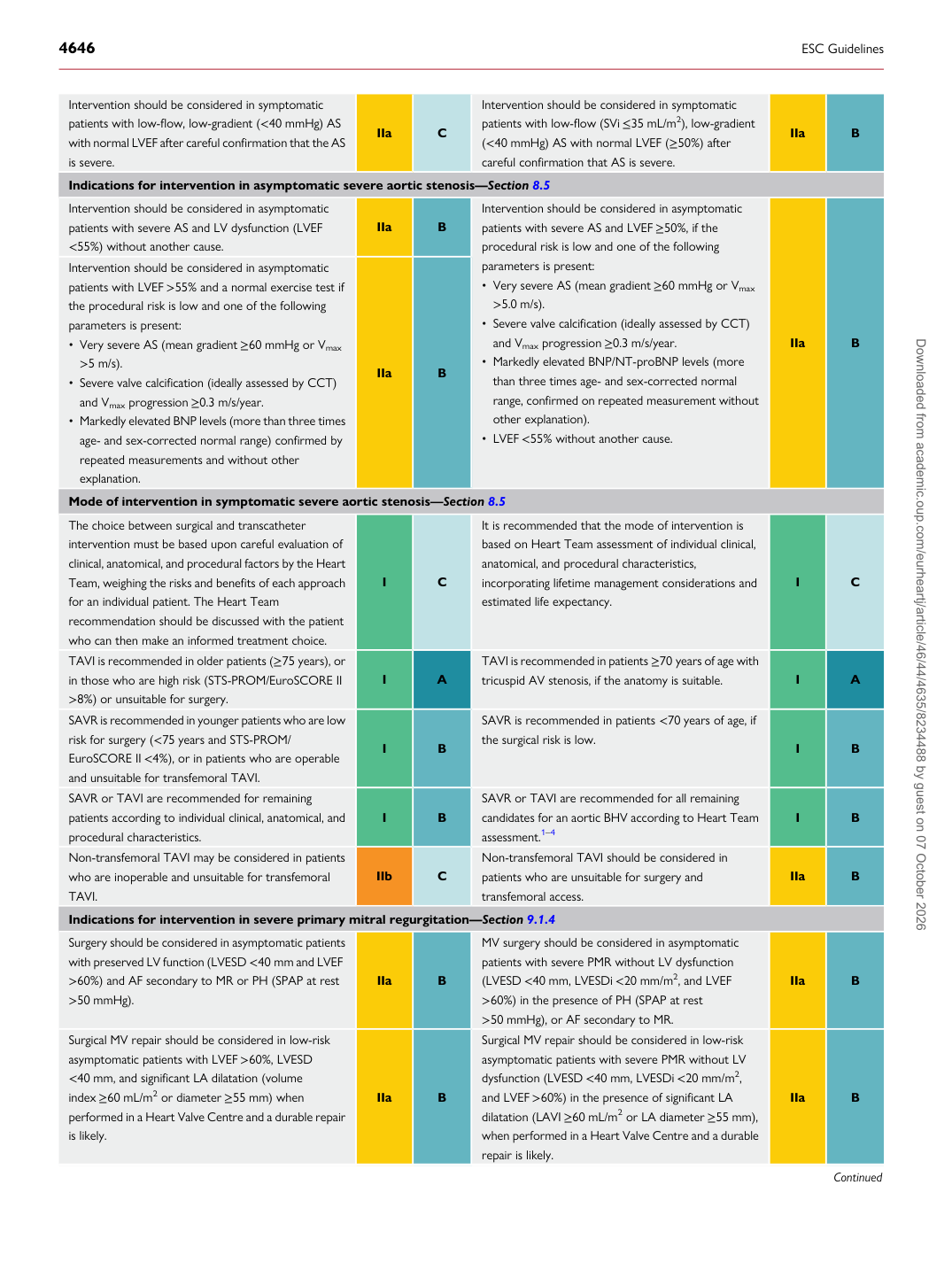
Intervention should be considered in symptomatic patients with low-flow, low-gradient (<40 mmHg) AS with normal LVEF after careful confirmation that the AS is severe. IIa C Intervention should be considered in symptomatic

patients with low-flow (SVi ≤35 mL/m2), low-gradient (<40 mmHg) AS with normal LVEF (≥50%) after careful confirmation that AS is severe. IIa B

Indications for intervention in asymptomatic severe aortic stenosis—Section 8.5 Intervention should be considered in asymptomatic patients with severe AS and LV dysfunction (LVEF <55%) without another cause. IIa B Intervention should be considered in asymptomatic

patients with severe AS and LVEF ≥50%, if the procedural risk is low and one of the following parameters is present: • Very severe AS (mean gradient ≥60 mmHg or Vmax >5.0 m/s). • Severe valve calcification (ideally assessed by CCT) and Vmax progression ≥0.3 m/s/year. • Markedly elevated BNP/NT-proBNP levels (more

than three times age- and sex-corrected normal range, confirmed on repeated measurement without other explanation). • LVEF <55% without another cause. IIa B

Intervention should be considered in asymptomatic patients with LVEF >55% and a normal exercise test if the procedural risk is low and one of the following parameters is present: • Very severe AS (mean gradient ≥60 mmHg or Vmax >5 m/s). • Severe valve calcification (ideally assessed by CCT) and Vmax progression ≥0.3 m/s/year. • Markedly elevated BNP levels (more than three times

age- and sex-corrected normal range) confirmed by repeated measurements and without other explanation. IIa B Mode of intervention in symptomatic severe aortic stenosis—Section 8.5 The choice between surgical and transcatheter intervention must be based upon careful evaluation of clinical, anatomical, and procedural factors by the Heart Team, weighing the risks and benefits of each approach for an individual patient. The Heart Team recommendation should be discussed with the patient who can then make an informed treatment choice. I C It is recommended that the mode of intervention is

based on Heart Team assessment of individual clinical, anatomical, and procedural characteristics, incorporating lifetime management considerations and estimated life expectancy. I C

TAVI is recommended in older patients (≥75 years), or in those who are high risk (STS-PROM/EuroSCORE II >8%) or unsuitable for surgery. I A TAVI is recommended in patients ≥70 years of age with tricuspid AV stenosis, if the anatomy is suitable. I A SAVR is recommended in younger patients who are low risk for surgery (<75 years and STS-PROM/ EuroSCORE II <4%), or in patients who are operable and unsuitable for transfemoral TAVI. I B SAVR is recommended in patients <70 years of age, if

the surgical risk is low. I B

SAVR or TAVI are recommended for remaining patients according to individual clinical, anatomical, and procedural characteristics. I B SAVR or TAVI are recommended for all remaining candidates for an aortic BHV according to Heart Team

assessment.1–4 I B

Non-transfemoral TAVI may be considered in patients who are inoperable and unsuitable for transfemoral TAVI. IIb C Non-transfemoral TAVI should be considered in

patients who are unsuitable for surgery and transfemoral access. IIa B

Indications for intervention in severe primary mitral regurgitation—Section 9.1.4 Surgery should be considered in asymptomatic patients with preserved LV function (LVESD <40 mm and LVEF >60%) and AF secondary to MR or PH (SPAP at rest >50 mmHg). IIa B MV surgery should be considered in asymptomatic

patients with severe PMR without LV dysfunction (LVESD <40 mm, LVESDi <20 mm/m2, and LVEF >60%) in the presence of PH (SPAP at rest >50 mmHg), or AF secondary to MR. IIa B

Surgical MV repair should be considered in low-risk asymptomatic patients with LVEF >60%, LVESD <40 mm, and significant LA dilatation (volume index ≥60 mL/m2 or diameter ≥55 mm) when performed in a Heart Valve Centre and a durable repair is likely. IIa B Surgical MV repair should be considered in low-risk

asymptomatic patients with severe PMR without LV dysfunction (LVESD <40 mm, LVESDi <20 mm/m2, and LVEF >60%) in the presence of significant LA dilatation (LAVI ≥60 mL/m2 or LA diameter ≥55 mm), when performed in a Heart Valve Centre and a durable repair is likely. IIa B

Continued Downloaded from academic.oup.com/eurheartj/article/46/44/4635/8234488 by guest on 07 October 2026