p.11 抽出テキスト
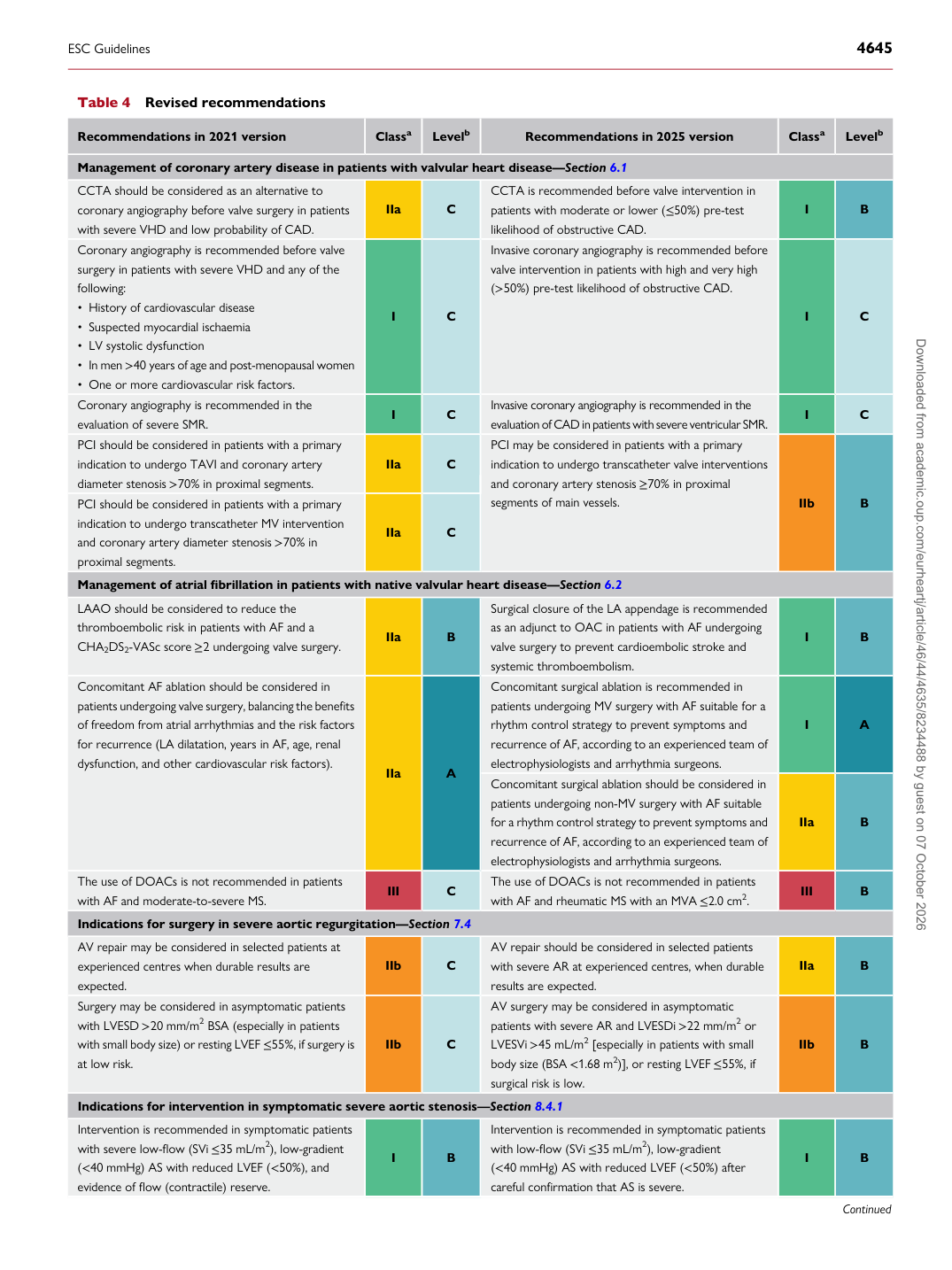
Table 4 Revised recommendations

Recommendations in 2021 version Classa Levelb Recommendations in 2025 version Classa Levelb

Management of coronary artery disease in patients with valvular heart disease—Section 6.1 CCTA should be considered as an alternative to coronary angiography before valve surgery in patients with severe VHD and low probability of CAD. IIa C CCTA is recommended before valve intervention in

patients with moderate or lower (≤50%) pre-test likelihood of obstructive CAD. I B

Coronary angiography is recommended before valve surgery in patients with severe VHD and any of the following: • History of cardiovascular disease • Suspected myocardial ischaemia • LV systolic dysfunction • In men >40 years of age and post-menopausal women • One or more cardiovascular risk factors. I C Invasive coronary angiography is recommended before valve intervention in patients with high and very high

(>50%) pre-test likelihood of obstructive CAD.

I C

Coronary angiography is recommended in the evaluation of severe SMR. I C Invasive coronary angiography is recommended in the evaluation of CAD in patients with severe ventricular SMR. I C PCI should be considered in patients with a primary indication to undergo TAVI and coronary artery diameter stenosis >70% in proximal segments. IIa C PCI may be considered in patients with a primary indication to undergo transcatheter valve interventions

and coronary artery stenosis ≥70% in proximal

segments of main vessels. IIb B PCI should be considered in patients with a primary indication to undergo transcatheter MV intervention and coronary artery diameter stenosis >70% in proximal segments. IIa C Management of atrial fibrillation in patients with native valvular heart disease—Section 6.2 LAAO should be considered to reduce the thromboembolic risk in patients with AF and a CHA2DS2-VASc score ≥2 undergoing valve surgery. IIa B Surgical closure of the LA appendage is recommended as an adjunct to OAC in patients with AF undergoing

valve surgery to prevent cardioembolic stroke and systemic thromboembolism. I B

Concomitant AF ablation should be considered in patients undergoing valve surgery, balancing the benefits of freedom from atrial arrhythmias and the risk factors for recurrence (LA dilatation, years in AF, age, renal dysfunction, and other cardiovascular risk factors). IIa A Concomitant surgical ablation is recommended in

patients undergoing MV surgery with AF suitable for a rhythm control strategy to prevent symptoms and recurrence of AF, according to an experienced team of electrophysiologists and arrhythmia surgeons. I A Concomitant surgical ablation should be considered in patients undergoing non-MV surgery with AF suitable for a rhythm control strategy to prevent symptoms and recurrence of AF, according to an experienced team of electrophysiologists and arrhythmia surgeons. IIa B

The use of DOACs is not recommended in patients with AF and moderate-to-severe MS. III C The use of DOACs is not recommended in patients

with AF and rheumatic MS with an MVA ≤2.0 cm2. III B

Indications for surgery in severe aortic regurgitation—Section 7.4 AV repair may be considered in selected patients at experienced centres when durable results are expected. IIb C AV repair should be considered in selected patients

with severe AR at experienced centres, when durable results are expected. IIa B

Surgery may be considered in asymptomatic patients with LVESD >20 mm/m2 BSA (especially in patients with small body size) or resting LVEF ≤55%, if surgery is at low risk. IIb C AV surgery may be considered in asymptomatic patients with severe AR and LVESDi >22 mm/m2 or

LVESVi >45 mL/m2 [especially in patients with small body size (BSA <1.68 m2)], or resting LVEF ≤55%, if surgical risk is low. IIb B

Indications for intervention in symptomatic severe aortic stenosis—Section 8.4.1 Intervention is recommended in symptomatic patients with severe low-flow (SVi ≤35 mL/m2), low-gradient (<40 mmHg) AS with reduced LVEF (<50%), and evidence of flow (contractile) reserve. I B Intervention is recommended in symptomatic patients

with low-flow (SVi ≤35 mL/m2), low-gradient (<40 mmHg) AS with reduced LVEF (<50%) after careful confirmation that AS is severe. I B

Continued

ESC Guidelines                                                                                                                                                                                          4645

Downloaded from academic.oup.com/eurheartj/article/46/44/4635/8234488 by guest on 07 October 2026