p.10 抽出テキスト
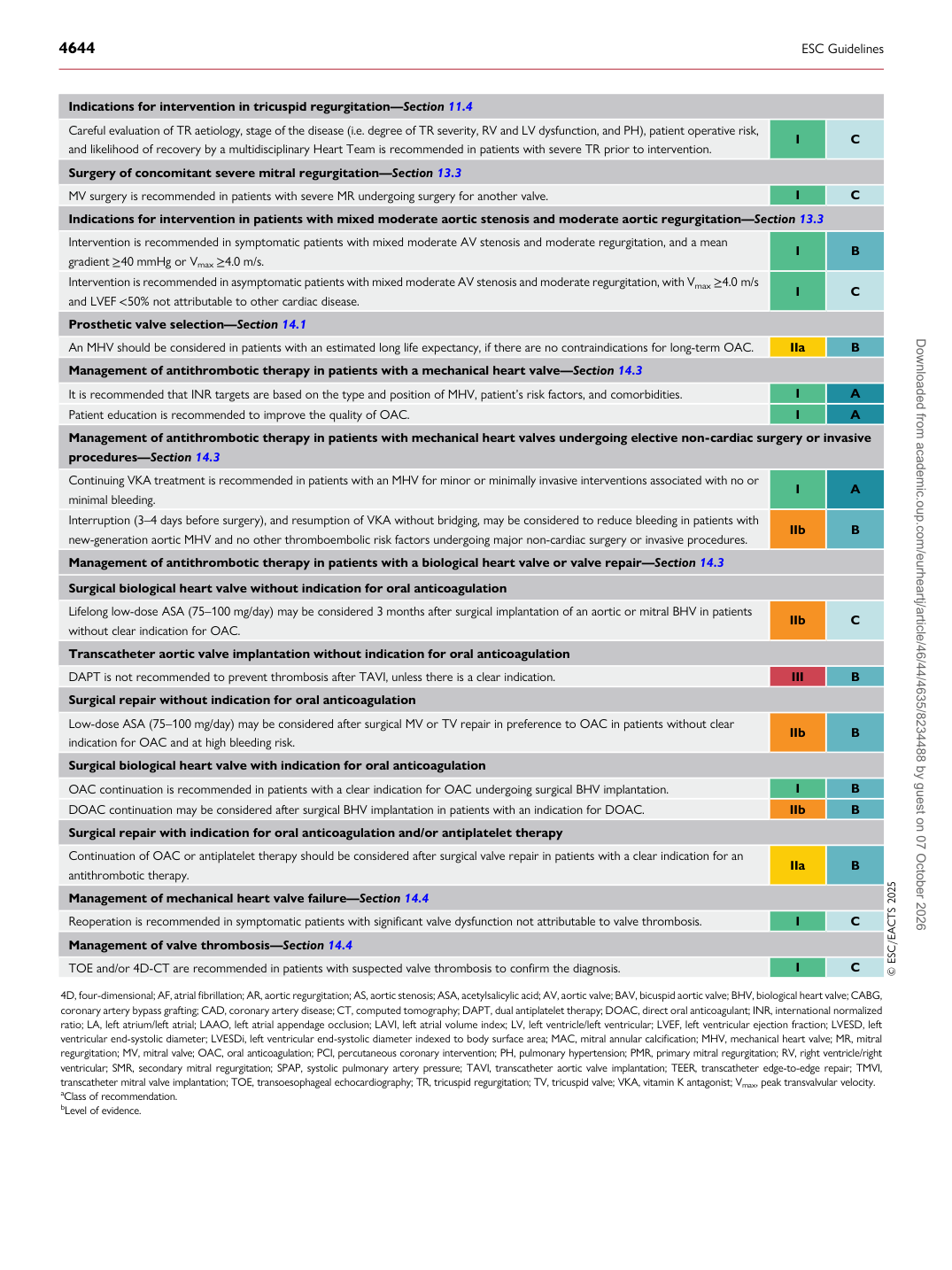
Indications for intervention in tricuspid regurgitation—Section 11.4 Careful evaluation of TR aetiology, stage of the disease (i.e. degree of TR severity, RV and LV dysfunction, and PH), patient operative risk, and likelihood of recovery by a multidisciplinary Heart Team is recommended in patients with severe TR prior to intervention. I C Surgery of concomitant severe mitral regurgitation—Section 13.3 MV surgery is recommended in patients with severe MR undergoing surgery for another valve. I C Indications for intervention in patients with mixed moderate aortic stenosis and moderate aortic regurgitation—Section 13.3 Intervention is recommended in symptomatic patients with mixed moderate AV stenosis and moderate regurgitation, and a mean gradient ≥40 mmHg or Vmax ≥4.0 m/s. I B Intervention is recommended in asymptomatic patients with mixed moderate AV stenosis and moderate regurgitation, with Vmax ≥4.0 m/s and LVEF <50% not attributable to other cardiac disease. I C Prosthetic valve selection—Section 14.1 An MHV should be considered in patients with an estimated long life expectancy, if there are no contraindications for long-term OAC. IIa B Management of antithrombotic therapy in patients with a mechanical heart valve—Section 14.3 It is recommended that INR targets are based on the type and position of MHV, patient’s risk factors, and comorbidities. I A Patient education is recommended to improve the quality of OAC. I A Management of antithrombotic therapy in patients with mechanical heart valves undergoing elective non-cardiac surgery or invasive procedures—Section 14.3 Continuing VKA treatment is recommended in patients with an MHV for minor or minimally invasive interventions associated with no or minimal bleeding. I A Interruption (3–4 days before surgery), and resumption of VKA without bridging, may be considered to reduce bleeding in patients with new-generation aortic MHV and no other thromboembolic risk factors undergoing major non-cardiac surgery or invasive procedures. IIb B Management of antithrombotic therapy in patients with a biological heart valve or valve repair—Section 14.3 Surgical biological heart valve without indication for oral anticoagulation Lifelong low-dose ASA (75–100 mg/day) may be considered 3 months after surgical implantation of an aortic or mitral BHV in patients without clear indication for OAC. IIb C Transcatheter aortic valve implantation without indication for oral anticoagulation DAPT is not recommended to prevent thrombosis after TAVI, unless there is a clear indication. III B Surgical repair without indication for oral anticoagulation Low-dose ASA (75–100 mg/day) may be considered after surgical MV or TV repair in preference to OAC in patients without clear indication for OAC and at high bleeding risk. IIb B Surgical biological heart valve with indication for oral anticoagulation OAC continuation is recommended in patients with a clear indication for OAC undergoing surgical BHV implantation. I B DOAC continuation may be considered after surgical BHV implantation in patients with an indication for DOAC. IIb B Surgical repair with indication for oral anticoagulation and/or antiplatelet therapy Continuation of OAC or antiplatelet therapy should be considered after surgical valve repair in patients with a clear indication for an antithrombotic therapy. IIa B Management of mechanical heart valve failure—Section 14.4 Reoperation is recommended in symptomatic patients with significant valve dysfunction not attributable to valve thrombosis. I C Management of valve thrombosis—Section 14.4 TOE and/or 4D-CT are recommended in patients with suspected valve thrombosis to confirm the diagnosis. I C © ESC/EACTS 2025

4D, four-dimensional; AF, atrial fibrillation; AR, aortic regurgitation; AS, aortic stenosis; ASA, acetylsalicylic acid; AV, aortic valve; BAV, bicuspid aortic valve; BHV, biological heart valve; CABG, coronary artery bypass grafting; CAD, coronary artery disease; CT, computed tomography; DAPT, dual antiplatelet therapy; DOAC, direct oral anticoagulant; INR, international normalized ratio; LA, left atrium/left atrial; LAAO, left atrial appendage occlusion; LAVI, left atrial volume index; LV, left ventricle/left ventricular; LVEF, left ventricular ejection fraction; LVESD, left ventricular end-systolic diameter; LVESDi, left ventricular end-systolic diameter indexed to body surface area; MAC, mitral annular calcification; MHV, mechanical heart valve; MR, mitral regurgitation; MV, mitral valve; OAC, oral anticoagulation; PCI, percutaneous coronary intervention; PH, pulmonary hypertension; PMR, primary mitral regurgitation; RV, right ventricle/right ventricular; SMR, secondary mitral regurgitation; SPAP, systolic pulmonary artery pressure; TAVI, transcatheter aortic valve implantation; TEER, transcatheter edge-to-edge repair; TMVI, transcatheter mitral valve implantation; TOE, transoesophageal echocardiography; TR, tricuspid regurgitation; TV, tricuspid valve; VKA, vitamin K antagonist; Vmax, peak transvalvular velocity. aClass of recommendation. bLevel of evidence. Downloaded from academic.oup.com/eurheartj/article/46/44/4635/8234488 by guest on 07 October 2026