p.71 抽出テキスト
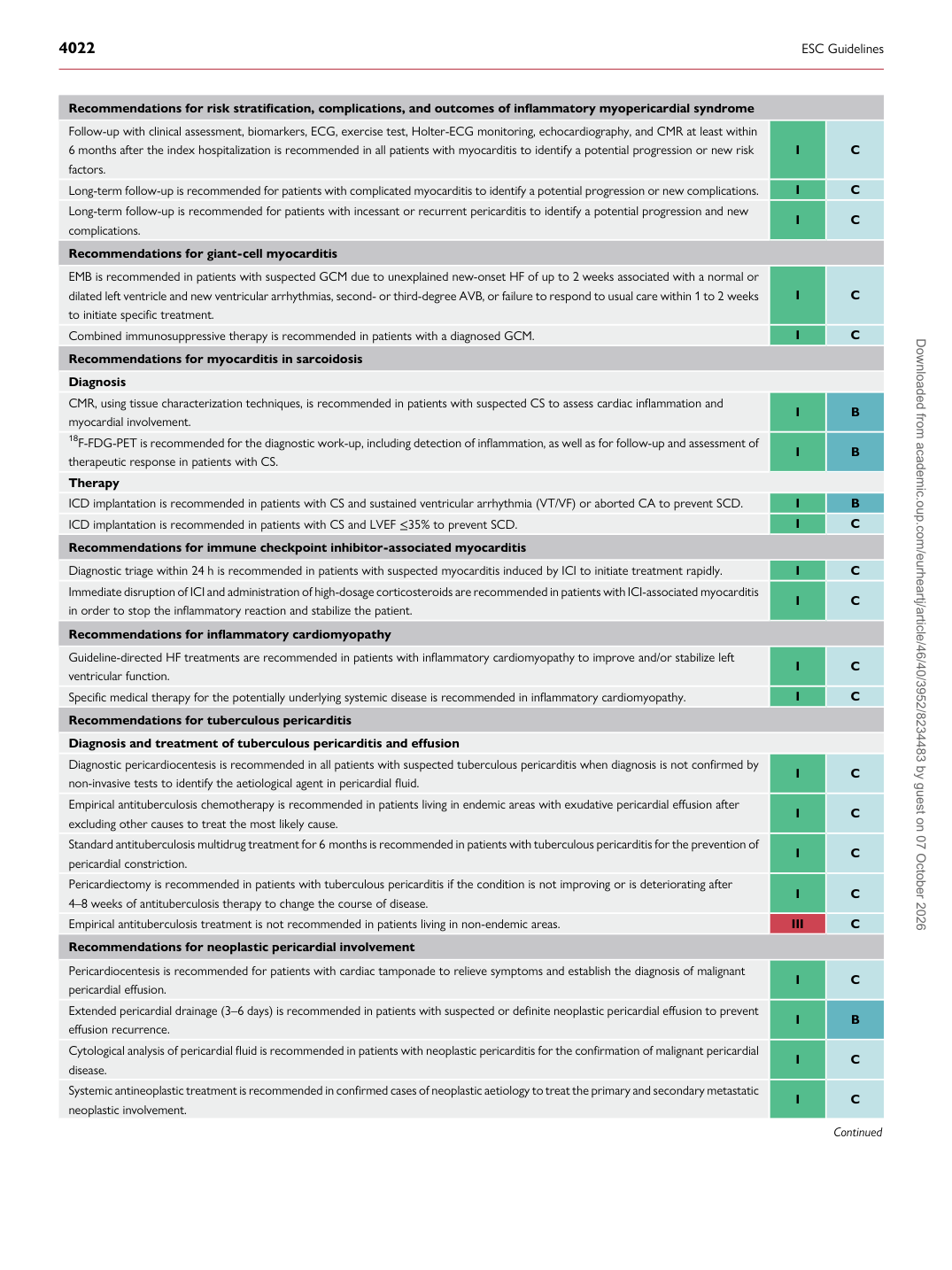
Recommendations for risk stratification, complications, and outcomes of inflammatory myopericardial syndrome Follow-up with clinical assessment, biomarkers, ECG, exercise test, Holter-ECG monitoring, echocardiography, and CMR at least within 6 months after the index hospitalization is recommended in all patients with myocarditis to identify a potential progression or new risk factors. I C Long-term follow-up is recommended for patients with complicated myocarditis to identify a potential progression or new complications. I C Long-term follow-up is recommended for patients with incessant or recurrent pericarditis to identify a potential progression and new complications. I C Recommendations for giant-cell myocarditis EMB is recommended in patients with suspected GCM due to unexplained new-onset HF of up to 2 weeks associated with a normal or dilated left ventricle and new ventricular arrhythmias, second- or third-degree AVB, or failure to respond to usual care within 1 to 2 weeks to initiate specific treatment. I C Combined immunosuppressive therapy is recommended in patients with a diagnosed GCM. I C Recommendations for myocarditis in sarcoidosis Diagnosis CMR, using tissue characterization techniques, is recommended in patients with suspected CS to assess cardiac inflammation and myocardial involvement. I B 18F-FDG-PET is recommended for the diagnostic work-up, including detection of inflammation, as well as for follow-up and assessment of therapeutic response in patients with CS. I B Therapy ICD implantation is recommended in patients with CS and sustained ventricular arrhythmia (VT/VF) or aborted CA to prevent SCD. I B ICD implantation is recommended in patients with CS and LVEF ≤35% to prevent SCD. I C Recommendations for immune checkpoint inhibitor-associated myocarditis Diagnostic triage within 24 h is recommended in patients with suspected myocarditis induced by ICI to initiate treatment rapidly. I C Immediate disruption of ICI and administration of high-dosage corticosteroids are recommended in patients with ICI-associated myocarditis in order to stop the inflammatory reaction and stabilize the patient. I C Recommendations for inflammatory cardiomyopathy Guideline-directed HF treatments are recommended in patients with inflammatory cardiomyopathy to improve and/or stabilize left ventricular function. I C Specific medical therapy for the potentially underlying systemic disease is recommended in inflammatory cardiomyopathy. I C Recommendations for tuberculous pericarditis Diagnosis and treatment of tuberculous pericarditis and effusion Diagnostic pericardiocentesis is recommended in all patients with suspected tuberculous pericarditis when diagnosis is not confirmed by non-invasive tests to identify the aetiological agent in pericardial fluid. I C Empirical antituberculosis chemotherapy is recommended in patients living in endemic areas with exudative pericardial effusion after excluding other causes to treat the most likely cause. I C Standard antituberculosis multidrug treatment for 6 months is recommended in patients with tuberculous pericarditis for the prevention of pericardial constriction. I C Pericardiectomy is recommended in patients with tuberculous pericarditis if the condition is not improving or is deteriorating after 4–8 weeks of antituberculosis therapy to change the course of disease. I C Empirical antituberculosis treatment is not recommended in patients living in non-endemic areas. III C Recommendations for neoplastic pericardial involvement Pericardiocentesis is recommended for patients with cardiac tamponade to relieve symptoms and establish the diagnosis of malignant pericardial effusion. I C Extended pericardial drainage (3–6 days) is recommended in patients with suspected or definite neoplastic pericardial effusion to prevent effusion recurrence. I B Cytological analysis of pericardial fluid is recommended in patients with neoplastic pericarditis for the confirmation of malignant pericardial disease. I C Systemic antineoplastic treatment is recommended in confirmed cases of neoplastic aetiology to treat the primary and secondary metastatic neoplastic involvement. I C

Continued Downloaded from academic.oup.com/eurheartj/article/46/40/3952/8234483 by guest on 07 October 2026