p.66 抽出テキスト
12.4 The elderly

Myocarditis is more prevalent in young people, with a median age between 20 and 40 years.28,55,63,73 In a Swedish study, 64% patients were younger than 50 years of age. In this study, HF/DCM and deaths occurred more commonly in patients aged >50 years.17 Myocarditis is probably more commonly related to drugs in the elderly, e.g. ICIs28,495 and clozapine.508 Age- and sex-based differences have been evaluated in two studies with AP, and one study with RP.45,102,671 In these studies, elderly patients less often had chest pain, fever, ST elevation, and PR depression. They had lower C-reactive protein values but dyspnoea, AF, and PEff were more common. Moreover, they received glucocorticoids more commonly, and had a lower risk of recurrences compared with younger patients. In the elderly, therapy compliance may be problematic, because of cognitive impairment and comorbidities, but the strongest predictor of non-adherence is the number of medications.672 Non-steroidal anti-inflammatory drugs should be used cautiously; dosing should be adapted (e.g. colchicine dose should be halved in some cases), and attention should be paid to evaluate renal impairment and drug interactions.

12.5 Physical activity in inflammatory

myopericardial syndrome Patients with active IMPS are advised to restrict physical activity. It has been proposed that exercise can aggravate myocardial and pericardial inflammation through several mechanisms, including a tachycardiamediated process. The importance of controlling heart rate is confirmed by observational studies, in which the empirical use of β-blockers to control heart rate in patients with pericarditis improved symptom control.274 Previous recommendations have made distinctions between athletes and non-athletes, providing arbitrary times for abstention from 3 to 6 months. This TF recommends an individualized approach, based on remission times. A complete clinical remission should be considered in athletes/non-athletes with normalization of symptoms, biomarkers, and imaging. During the acute stage of myocarditis, patients are advised to rest completely, since exercise has been associated with arrhythmias and SCD. To ensure resolution of the disease, recovery should be monitored, including clinical assessment, rhythm control, laboratory analysis, and multimodality imaging (see Table 15). A personalized prescription of exercise should be performed, based on the patient (athletes, nonathletes), and type of exercise.

12.5.1 Mental health effect of restricting exercise

Exercise restriction can affect patient mental health, especially in children and young adults. It can lead to frustration, sadness, and depression in patients. Freedom to exercise should be approached with shared decision-making, taking into account the risk vs benefit ratio in the single case.

12.6 Multidisciplinary teams for the

management of inflammatory myopericardial syndrome It is recommended to have a multidisciplinary team for high-risk cases with IMPS. The team should be composed of a clinical cardiologist, a CMR imaging specialist with expertise in IMPS, a pathologist with expertise in cardiovascular diseases, and additionally, depending on the case, a rheumatologist (or clinical immunologist), an infectious disease specialist, a geneticist (or a cardiologist with expertise in genetics), interventional cardiologists (including electrophysiologists), and a cardiac intensive care specialist. A cardiac surgeon might be involved subsequently when interventional or surgical decisions are anticipated. More details are given in Figure 20. It is of paramount importance that physicians develop competence and skills in IMPS to allow timely diagnosis and therapy for patients, since mixed forms are common in clinical practice. Patient involvement is important, particularly when the evidence is scarce to foster shared decision-making.375,673,674

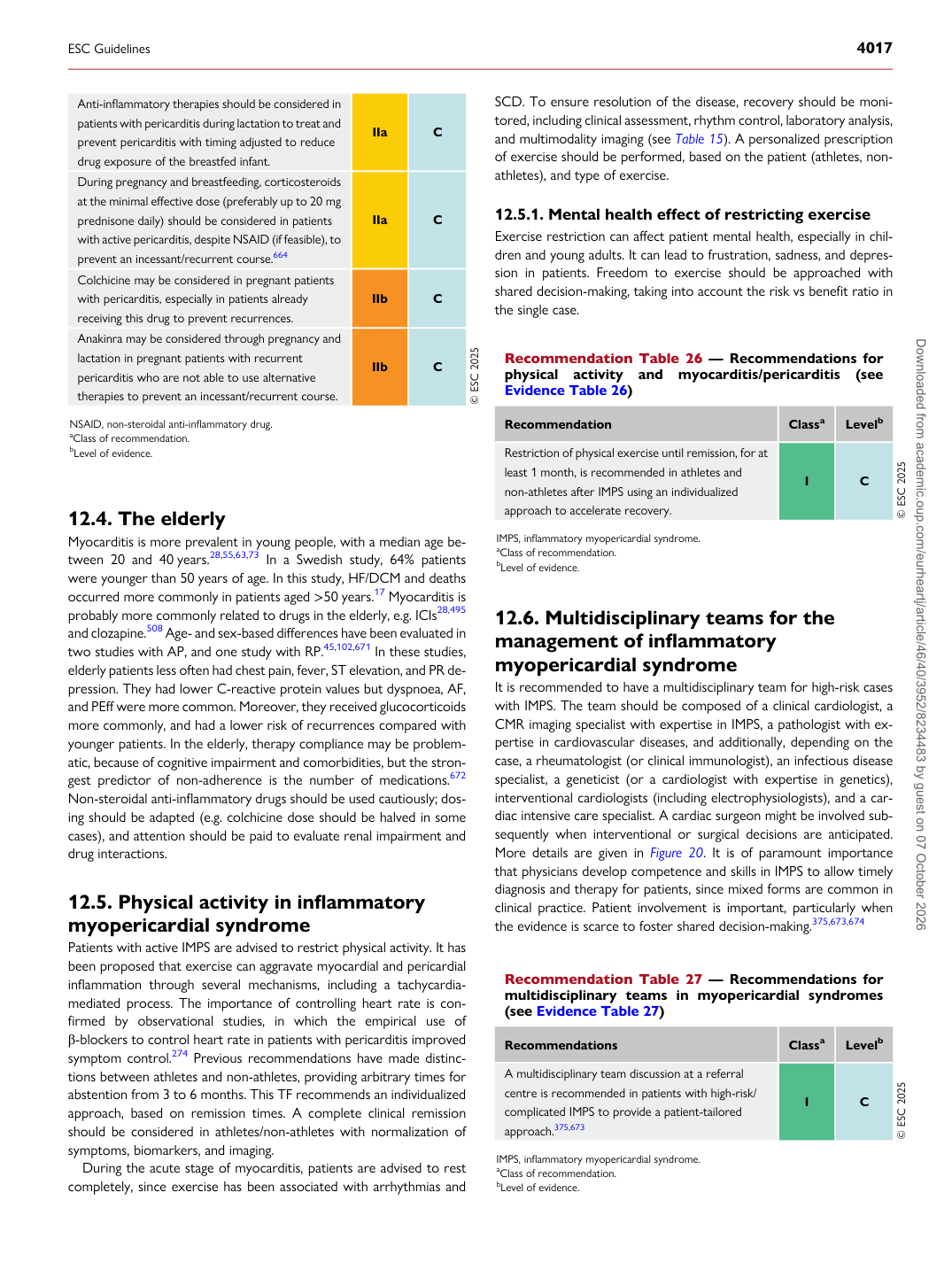
Anti-inflammatory therapies should be considered in patients with pericarditis during lactation to treat and prevent pericarditis with timing adjusted to reduce drug exposure of the breastfed infant. IIa C During pregnancy and breastfeeding, corticosteroids at the minimal effective dose (preferably up to 20 mg prednisone daily) should be considered in patients with active pericarditis, despite NSAID (if feasible), to prevent an incessant/recurrent course.664 IIa C Colchicine may be considered in pregnant patients with pericarditis, especially in patients already receiving this drug to prevent recurrences. IIb C Anakinra may be considered through pregnancy and lactation in pregnant patients with recurrent pericarditis who are not able to use alternative therapies to prevent an incessant/recurrent course. IIb C © ESC 2025

NSAID, non-steroidal anti-inflammatory drug. aClass of recommendation. bLevel of evidence. Recommendation Table 26 — Recommendations for physical activity and myocarditis/pericarditis (see Evidence Table 26)

Recommendation Classa Levelb

Restriction of physical exercise until remission, for at least 1 month, is recommended in athletes and non-athletes after IMPS using an individualized approach to accelerate recovery. I C © ESC 2025

IMPS, inflammatory myopericardial syndrome. aClass of recommendation. bLevel of evidence.

Recommendation Table 27 — Recommendations for multidisciplinary teams in myopericardial syndromes (see Evidence Table 27)

Recommendations Classa Levelb

A multidisciplinary team discussion at a referral centre is recommended in patients with high-risk/ complicated IMPS to provide a patient-tailored approach.375,673 I C © ESC 2025

IMPS, inflammatory myopericardial syndrome. aClass of recommendation. bLevel of evidence.

ESC Guidelines                                                                                                                                                                                          4017

Downloaded from academic.oup.com/eurheartj/article/46/40/3952/8234483 by guest on 07 October 2026