p.65 抽出テキスト
with some studies showing a mild prevalence in males of 59% in AP.37 Males aged 16–65 years are at higher risk of pericarditis (relative risk 2.02) than females. On the other hand, the probability of pericarditis recurrence is higher in females (HR 1.67), probably due to the higher frequency of specific causes (e.g. autoimmune diseases).105

12.2 Paediatric patients

12.2.1. Myocarditis The annual incidence of myocarditis during childhood is between 1 and 2 cases per 100 000 children.21,644,645 In children <6 years of age, the sex distribution was balanced, 50% each,20 but boys had a significantly higher incidence at ages 6 to 15 years.21 The proposed diagnostic approach in adults applies also for children, including CMR (e.g. in the MYKKE registry).646 There are conflicting data regarding the complication rates of EMB in children, with some studies reporting similar incidence of complications as in adults, both around 5%, mainly from RV sampling.40,63 Particular care should be taken in children aged <1 year and in the case of LV biopsies with reported complication rates up to 30%.213 In particular, very young children are predisposed to severe myocarditis. Critically ill children admitted to the intensive care unit (ICU) mostly survived, if receiving high-resource therapies, including MCS.647 In a prospective multicentre registry it was shown that in acute HF and FM, MCS including VAD improved survival.648 Similar results have also been reported from Japan.649 In infants, enteroviruses, such as Coxsackievirus, were found more commonly than in adults.649 A presumed viral aetiology was identified in 11%–50%,40,63 with a death or HT rate of 2%, similar to adults.21 In biopsy-proven myocarditis, the HT rate rises to 7%, and the mortality rate increases to 4%–6%.40 Therapy for myocarditis in children is not well defined. In a meta-analysis evaluating corticosteroids, no mortality reduction was observed, but a significant improvement in LVEF was reached with the use of steroids in other studies.650–652 In a meta-analysis evaluating IVIG,628 treatment was not associated with better survival. This was also supported by a prospective trial653 and a multicentre cohort study.654 On the contrary, another meta-analysis655 in FM concluded that IVIG therapy (usually 1–2 g/kg over 24–48 h) significantly reduced in-hospital mortality and improved LVEF. Genetic evaluation might help in the future in differentiating subsets of children and tailoring therapies.93

12.2.2 Pericarditis

In children aged 12 years or less, the incidence of AP was 2.8/100 000 in a population study from 2009 to 2021.644 The diagnostic criteria (see Table 4), aetiologies, and risk of recurrences (see Tables S2 and S3) are similar to those reported in adults (see Supplementary data online, Table S1). Most paediatric cases of pericarditis are related to PPS, particularly after atrial septal defect closure. Compared with adults, children more commonly have an inflammatory phenotype.656 Non-steroidal antiinflammatory drugs remain the mainstay of therapy at high dosages (see Supplementary data online, Table S15). Most paediatricians avoid aspirin. Colchicine halved recurrences in children, similarly as for adults.656,657 The use of corticosteroids should be restricted even more than in adults, given that their side effects (including striae rubrae and growth impairment) are particularly deleterious in growing children. Anti-interleukin-1 agents have been used for the first time in children with autoinflammatory diseases and then adopted for RP in them, representing a new therapeutic option, especially if they are corticosteroid-dependent. However, it is often difficult to withdraw these drugs when clinical remission is achieved; for instance, in one study only 15% of children were able to stop anti-IL-1 agents after a mean follow-up of 2.6 years.658 Few paediatric patients were enrolled in RCTs testing anakinra and rilonacept.283,284

12.3 Pregnancy, lactation, and

reproductive issues There is very limited published evidence on this topic. There are only case reports for myocarditis,659–663 and one case series describing pregnant women with RP.664 Pregnancy-associated myocarditis is described in Section 9.7. Pericardial effusion is the most common manifestation of pericardial diseases during pregnancy. Effusions during pregnancy are typically benign, mild or moderate, and well tolerated, with spontaneous resolution after delivery, and no specific treatment is required in such cases. However, PEff may be associated with preeclampsia.665 Acute pericarditis is the second most common condition. Pre-conception counselling is essential in women of childbearing age with RP or previous myocarditis. In such cases, pregnancy should be planned in a phase of disease remission, and therapy should be reviewed. Pre-conception assessment should include multidisciplinary evaluation. Echocardiography is the preferred imaging method, while X-ray, CT scan, and CMR can be used in selected cases.666 In patients with IMPS, vaginal delivery is not excluded in uncomplicated cases, while Caesarean section may be required in the presence of haemodynamic instability.666 Appropriate follow-up with a multidisciplinary team with experience in the field is recommended throughout pregnancy to ensure good maternal and foetal outcomes. High-dose aspirin or NSAIDs, such as ibuprofen and indomethacin, can be used up to the 20th week of gestation. Corticosteroids at the minimal effective dose can be given in patients with active pericarditis throughout pregnancy along with NSAIDs and in selected cases colchicine. Azathioprine and IVIG are compatible with pregnancy and breastfeeding. All these medications, apart from high-dose aspirin, may be used during lactation. Colchicine is compatible with pregnancy and breastfeeding, and it can be continued throughout pregnancy to prevent recurrences.664,667–669 The use of IL-1 blockers during pregnancy is controversial. Available literature data seem encouraging; however, the relevant studies are scant and retrospective. Despite the limited evidence, anakinra may be continued through conception, pregnancy, and lactation in women with rheumatic and musculoskeletal diseases who are not able to use alternative therapies.668–670 More details regarding drug dosages can be found in Supplementary data online, Table S16. There are no specific limitations for men with pericarditis who are planning to have children because they can safely continue therapy.667,668

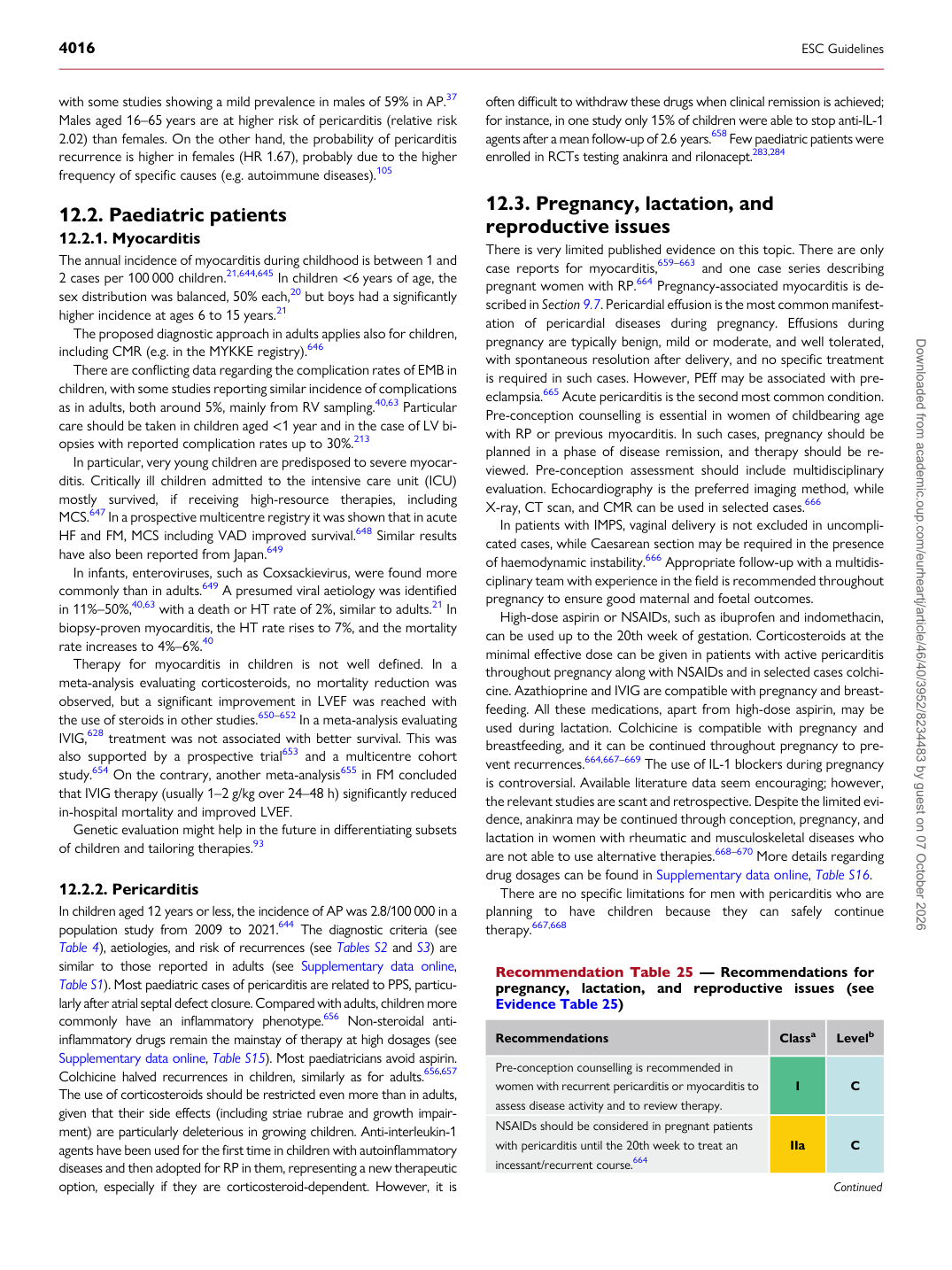
Recommendation Table 25 — Recommendations for pregnancy, lactation, and reproductive issues (see Evidence Table 25)

Recommendations Classa Levelb

Pre-conception counselling is recommended in women with recurrent pericarditis or myocarditis to assess disease activity and to review therapy. I C NSAIDs should be considered in pregnant patients with pericarditis until the 20th week to treat an incessant/recurrent course.664 IIa C

Continued Downloaded from academic.oup.com/eurheartj/article/46/40/3952/8234483 by guest on 07 October 2026