p.59 抽出テキスト
generally a few weeks, until the appearance of the first manifestations, the positive response to anti-inflammatory drugs, and the possibility of recurrences.

11.3.1 Diagnosis

According to proposed diagnostic criteria, the diagnosis of PCIS may be reached in the presence of at least two of the following five criteria: (i) fever without alternative causes; (ii) pericardial or pleuritic chest pain; (iii) pericardial or pleural rubs; (iv) evidence of PEff; and/or (v) pleural effusion with elevated C-reactive protein.593–595 The rationale for proposing specific criteria is that these syndromes may have concomitant pleuro-pericardial involvement and possible pulmonary infiltrates, and are not simply pericarditis.595 Moreover, it is sometimes difficult to differentiate PCIS from the simple mechanical consequences of surgery (such as early pericardial or pleural effusion). The demonstration of inflammatory activity (e.g. C-reactive protein elevation) is essential to establish the diagnosis. Multimodality imaging can be helpful for the diagnosis of complicated cases (e.g. loculated effusions, evidence of inflammation).

11.3.2 Therapy

The same therapeutic scheme adopted for AP, essentially based on empirical anti-inflammatory therapy, is effective for all forms of PCIS, and may improve remission rates and reduce the risk of recurrences. In early post-AMI pericarditis, a 5–7-day course of aspirin seems the most reasonable option, in association with colchicine.587 Different treatment strategies (namely aspirin, methylprednisolone, dexamethasone, and colchicine) have been adopted for the primary prevention of PPS, and the effects of such treatments have been addressed in a meta-analysis that showed that only colchicine was associated with a decreased risk of PPS (OR 0.38), sometimes, however, with an increased risk of gastrointestinal side effects.593,594,596–600 Preventive administration of colchicine can be given after cardiac surgery using weight-adjusted doses (i.e. 0.5 mg once for patients ≤70 kg and 0.5 mg twice daily for patients >70 kg) and without a loading dose for the prevention of PPS and continued for 1 month.596 In this guideline document, the LOE for colchicine recommendation for the prevention of PPS is based on analysis of the available evidence from more than one RCT, systematic reviews and the consensus opinion of the TF members. Neither NSAIDs nor colchicine have to be administered for postoperative effusions in the absence of systemic inflammation.601,602 Early post-operative PEffs are relatively common after cardiac surgery, and usually disappear spontaneously in 7–10 days.1 Asymptomatic small PEffs do not require treatment; however, moderate to large effusions (observed in one-third of cases) can progress to CTP at a rate of 10% within 1 month after surgery and need pericardial decompression.603 Treatment of these asymptomatic effusions by NSAIDs has been shown to be ineffective [e.g. diclofenac in the Post-Operative Pericardial Effusion (POPE) trial], and may be associated with an increased risk of side effects.601 The prognosis of PPS is generally good.600 In the largest published series on PPS patients after cardiac surgery, complication rates were low: <4% for recurrences; <2% for CTP; and no cases of constriction, although hospital stay may be prolonged in these patients.592 Moreover, the development of CP has been reported in ∼3% of cases.347 Both early post-AMI pericarditis and Dressler syndrome are markers of larger infarct size, but without independent prognostic significance.587 11.4 Pericarditis and autoinflammatory

diseases Compared with the previous guidelines, it has become evident that some inflammatory forms of RP share similarities with genetic autoinflammatory diseases characterized by periodic fevers, e.g. FMF and TRAPS.50,51 These are genetic disorders characterized by mutations of genes involved in the regulation of the inflammatory response, without involvement of specific T cells or autoantibodies.605 These disorders are usually detected in the paediatric population, although some patients experience disease onset during adulthood. The most common monogenic autoinflammatory syndromes include FMF, in which serositis episodes last only 1–3 days, and TRAPS, in which fever and symptoms last for weeks.605 Mutations associated with these disorders have been reported in up to 10% of patients with multiple recurrences, especially with a positive family history, and a poor response to colchicine.152 Recently, rare deleterious MEFV variants were observed more frequently in idiopathic RP than in ancestry-matched controls (allele frequency 9/200 vs 2932/129 200, P = 0.040).50 These conditions are characterized by the exaggerated production of IL-1 by the inflammasome. Familial occurrence of pericarditis has been reported among the relatives of idiopathic RP patients, ranging from 4%50 to 10%.113 These data suggest a genetic predisposition in at least a subset of patients; counselling may be warranted in these cases.

11.5 Purulent pericarditis

Purulent pericarditis, namely the most serious manifestation of bacterial pericarditis, is characterized by the macro- or microscopic presence of purulent PEff. It is an exceedingly rare form of pericarditis in the Western world, accounting for <1% of AP cases.606 It has a high mortality in untreated cases while, in optimally treated patients, the reported survival rate is approximately 15%–40%.606 In developed countries, the most common organisms isolated in purulent pericarditis include staphylococci and streptococci, while

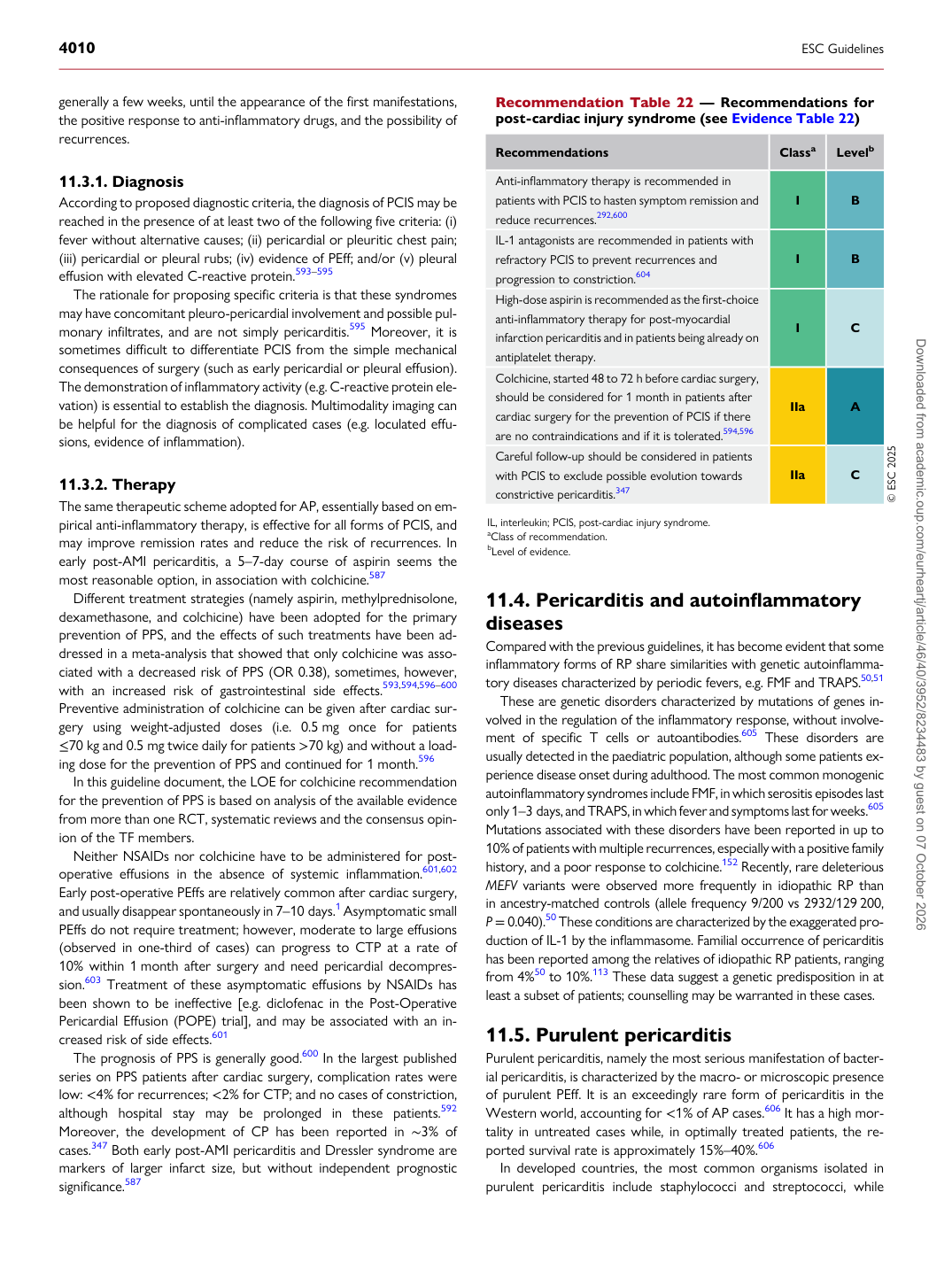
Recommendation Table 22 — Recommendations for post-cardiac injury syndrome (see Evidence Table 22)

Recommendations Classa Levelb

Anti-inflammatory therapy is recommended in patients with PCIS to hasten symptom remission and reduce recurrences.292,600 I B IL-1 antagonists are recommended in patients with refractory PCIS to prevent recurrences and progression to constriction.604 I B High-dose aspirin is recommended as the first-choice anti-inflammatory therapy for post-myocardial infarction pericarditis and in patients being already on antiplatelet therapy. I C Colchicine, started 48 to 72 h before cardiac surgery, should be considered for 1 month in patients after cardiac surgery for the prevention of PCIS if there are no contraindications and if it is tolerated.594,596 IIa A Careful follow-up should be considered in patients with PCIS to exclude possible evolution towards constrictive pericarditis.347 IIa C © ESC 2025

IL, interleukin; PCIS, post-cardiac injury syndrome. aClass of recommendation. bLevel of evidence. Downloaded from academic.oup.com/eurheartj/article/46/40/3952/8234483 by guest on 07 October 2026