p.58 抽出テキスト
11.2 Pericardial involvement in neoplastic

disease 11.2.1. Presentation Neoplastic pericardial involvement is occasionally manifested by pericarditis or, more commonly, an isolated PEff (usually moderate to large, or CTP) with or without evident masses on imaging. It is usually related to metastatic lymphatic involvement (especially for lung cancer) or haematogenous spread (especially for breast cancer). In addition, lymphomas, leukaemias, and melanoma may affect the pericardium, as may cancer of contiguous organs (e.g. oesophageal cancer).574,575 Primary neoplastic disease of the pericardium is rare. Pericardial mesothelioma is the most common form, and it may present as ECP or CP in advanced cases. On this basis, the term ‘neoplastic pericarditis’ is often used incorrectly instead of ‘neoplastic pericardial effusion’.

11.2.2 Diagnosis

The definitive diagnosis is based on the confirmation of malignant infiltration within the pericardial fluid by cytology (pericardiocentesis) or pericardial biopsy. A probable diagnosis may be achieved by the detection of tumour markers in the pericardial fluid (e.g. CEA, CYFRA 21-1, NSE, CA-19-9, CA-72-4, SCC, GATA3, and VEGF), although none of these tumour markers has been proven to be accurate enough for distinguishing malignant from benign effusions.576,577 Evidence of malignant disease elsewhere and concomitant pericarditis or PEff is also suggestive, although in almost two-thirds of patients with documented malignancy, pericardial involvement is caused by non-malignant diseases,15 e.g. radiation,578,579 chemotherapy,580 or infections. Cytological analyses of pericardial fluid are mandatory for the confirmation of malignant pericardial disease.581 Analyses of pericardial fluid and less commonly pericardial or epicardial biopsies are essential for the confirmation of malignant pericardial disease.

11.2.3 Therapy

The management of these patients requires a multidisciplinary approach involving oncologists, cardiologists, and radiotherapists, as well as other specific subspecialty experts according to the type of cancer. General principles of treatment include systemic antineoplastic treatment as baseline therapy. Local antineoplastic treatment is based on tailored intrapericardial therapy according to the type of tumour (e.g. cisplatin is efficacious in lung cancer, thiotepa in breast cancer),582 and intrapericardial instillation of cytostatic/sclerosing agents to prevent recurrences. Malignant PEffs show a high recurrence rate (>50%). Extended pericardial drainage can be necessary in patients with suspected or definite neoplastic PEff to prevent effusion recurrence and provide a route for intrapericardial therapy. Additional interventions for recurrent effusions may include pericardiotomy, pericardial window, and percutaneous balloon pericardiotomy. All techniques are palliative and aimed at improving the quality of life of patients with a poor short-term outcome. Radiation therapy is very effective in controlling malignant PEff in patients with radiosensitive tumours, such as lymphomas and leukaemias. In clinical practice, management is often palliative at late stages with advanced disease, and it is aimed only at the relief of symptoms rather than treatment of the underlying disease, considering the prognosis, and the overall quality of life of the patient. 11.3 Post-cardiac injury syndrome

The term PCIS is an umbrella term indicating a group of inflammatory pericardial syndromes, including late post-acute myocardial infarction (post-AMI) pericarditis (or Dressler syndrome), postpericardiotomy syndrome (PPS), and post-traumatic pericarditis with or without bleeding. Currently several post-traumatic cases are iatrogenic and related to cardiovascular interventions.585,586 Nowadays, Dressler syndrome appears in <1% of cases, mainly in larger infarctions and/or late reperfusion, typically 1–2 weeks after AMI.587 Notably, patients with a post-AMI PEff of >10 mm at enddiastole should be investigated for a possible subacute heart rupture.588,589 In contrast, cases developing after cardiac device implantation or arrhythmia ablation (e.g. pericarditis appears in ∼10% of cases after AF ablation) are becoming increasingly common due to the growing number of invasive procedures.586,587,590,591 Such syndromes are presumed to have an autoimmune pathogenesis triggered by pericardial bleeding and/or pleura incision.47,592 An immune-mediated pathogenesis is supported by a latent period,

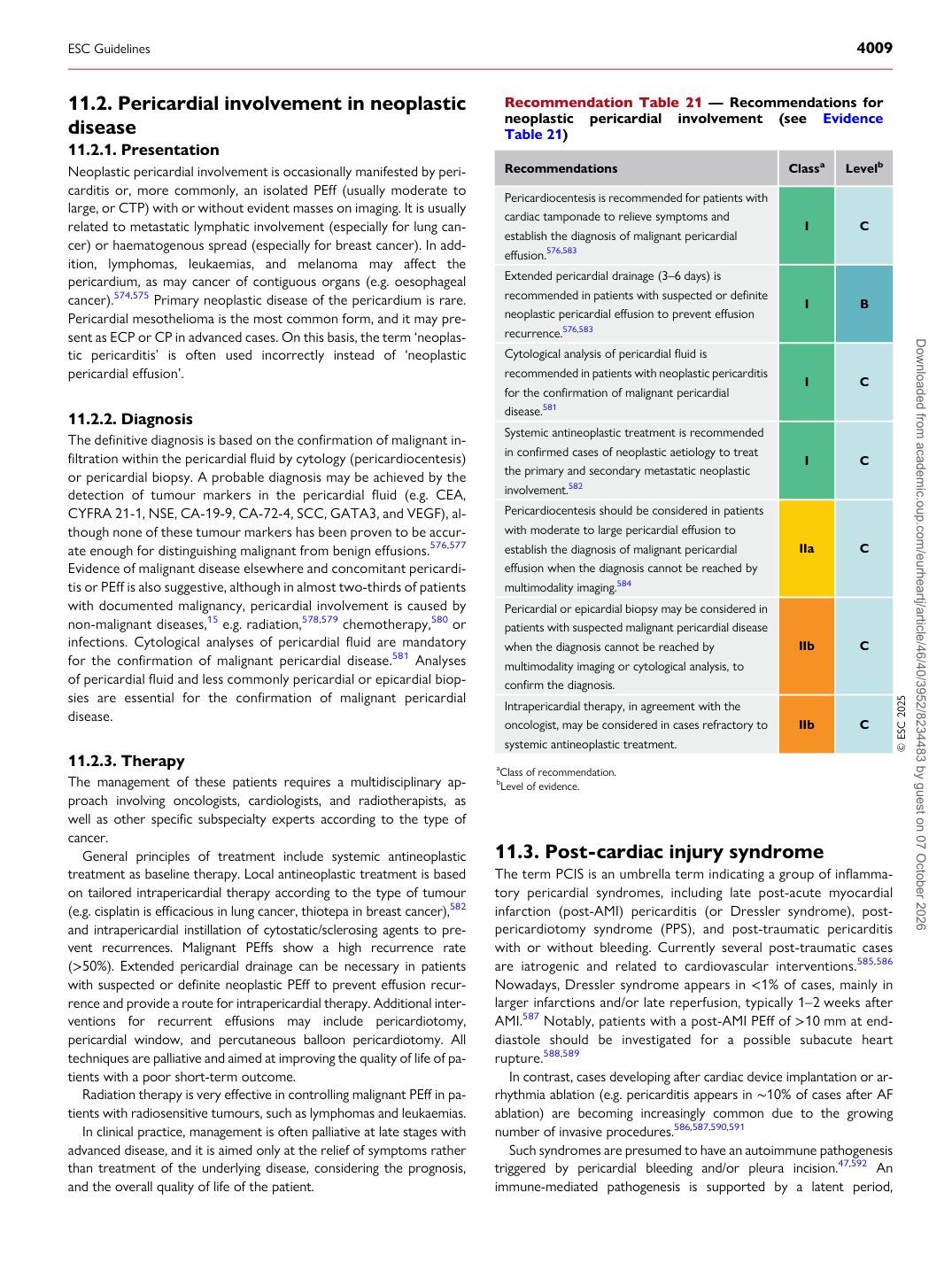
Recommendation Table 21 — Recommendations for neoplastic pericardial involvement (see Evidence Table 21)

Recommendations Classa Levelb

Pericardiocentesis is recommended for patients with cardiac tamponade to relieve symptoms and establish the diagnosis of malignant pericardial effusion.576,583 I C Extended pericardial drainage (3–6 days) is recommended in patients with suspected or definite neoplastic pericardial effusion to prevent effusion recurrence.576,583 I B Cytological analysis of pericardial fluid is recommended in patients with neoplastic pericarditis for the confirmation of malignant pericardial disease.581 I C Systemic antineoplastic treatment is recommended in confirmed cases of neoplastic aetiology to treat the primary and secondary metastatic neoplastic involvement.582 I C Pericardiocentesis should be considered in patients with moderate to large pericardial effusion to establish the diagnosis of malignant pericardial effusion when the diagnosis cannot be reached by multimodality imaging.584 IIa C Pericardial or epicardial biopsy may be considered in patients with suspected malignant pericardial disease when the diagnosis cannot be reached by multimodality imaging or cytological analysis, to confirm the diagnosis. IIb C Intrapericardial therapy, in agreement with the oncologist, may be considered in cases refractory to systemic antineoplastic treatment. IIb C © ESC 2025 aClass of recommendation. bLevel of evidence.

ESC Guidelines                                                                                                                                                                                          4009

Downloaded from academic.oup.com/eurheartj/article/46/40/3952/8234483 by guest on 07 October 2026