p.55 抽出テキスト
9.6.1.2 Other drugs associated with myocarditis

Many drugs have been associated with myocarditis (see Supplementary data online, Table S10), especially clozapine.506 The reported incidence of clozapine-associated myocarditis ranges from 0.1% to 5%.507,508 Drug-induced myocarditis may be associated with drug reaction with eosinophilia and systemic symptoms (DRESS) syndrome.509 Treatment is based on discontinuation of the drug and use of corticosteroids.

9.6.2 Vaccine-induced myocarditis

In 2002 the ‘Brighton collaboration’ was established with the aim to provide standards for the definition of adverse events after vaccination.510 In a clinical context, different vaccines, apart from the SARS-CoV-2 vaccine, have been associated with myocarditis. The main association is with smallpox vaccine,511 with data deriving mainly from the US military population. A systematic review reported cardiac events including IMPS after influenza vaccination, pneumococcal vaccine, and tetanus toxoid.512 Few data reported myocarditis after receiving different vaccines (e.g. meningococcus, hepatitis A and B, diphtheria, poliovirus) (see Supplementary data online, Table S11).513–518 A recent multicentre study reported good mid-term outcomes after COVID-19 vaccine-associated myocarditis without death or need for HT.519 More detailed information can be found in Supplementary data online, Section 5.1.2.

9.7 Pregnancy-associated myocarditis

Peripartum CMP (PPCM) is sometimes associated with myocardial inflammation, more common particularly in patients presenting with arrhythmias.520 Pregnancy-associated myocarditis (PaM) is a rare condition, and its incidence and prognosis varies regionally.521–523 Nutritional deficiencies, viral myocarditis, and autoimmune processes have been postulated as triggers. Recent data support the role of neurohormonal changes of late pregnancy and delivery, as well as the role of genetic predisposition.524

9.7.1 Presentation

There is no clear distinction between the phenotype of PaM and PPCM. Women develop symptoms of HF during late pregnancy or after delivery, with the majority being diagnosed after delivery, typically in the first month post-partum. A minority of patients may present with pulmonary oedema, cardiogenic shock, severe arrhythmias,525 cardiopulmonary arrest, thromboembolic complications, and brain injury.

9.7.2 Diagnosis

There are no specific studies for PaM, therefore the guidance for PPCM should be followed. Transthoracic echocardiography should be performed in any suspected case. In PPCM, LVEF is typically <45%.526 Careful examination should be undertaken to clearly view the LV apex to detect intracardiac thrombi. Brain natriuretic peptide/ N-terminal prohormone of brain natriuretic peptide are usually markedly elevated.527–529 Cardiovascular magnetic resonance imaging is an advanced imaging modality if echocardiogram is inadequate, but gadolinium-based contrast agents should be avoided during pregnancy.530–532 Cardiovascular magnetic resonance is crucial to differentiate underlying causes.533 The detection of active inflammation can be performed without application of contrast media in CMR (Figure 4). Peripartum CMP has been associated with a higher rate of recovery than other forms of HF with reduced EF,534 and remission frequently occurs within the first 3 to 6 months.535 Delayed recovery can also occur after 2 years.536,537

9.7.3 Therapy

There are no dedicated studies for PaM, so advice is based on published literature for PPCM. Treatment of HF is essential, with modifications to ensure foetal safety during pregnancy.521,538–540 Low-molecular-weight heparins do not cross the placenta, and are preferred during pregnancy if the thromboembolic risk is high.541 Direct oral anticoagulants are less well studied in pregnancy, and should be avoided. Anticoagulation should be continued until recovery of LV function. Bromocriptine has been shown to improve LVEF at 6 months, but the results are contradictory.521,542–545 Following delivery, most HF medications are compatible with breastfeeding. Many patients may also relapse. Treatment withdrawal and incomplete recovery of LV function are risk factors for recurrences.546,547 Lifelong treatment has not been proven to be necessary. Pre-conception counselling should include discussion of the potential risks of recurrent myocardial dysfunction, even after recovery.547

Multidisciplinary teams are warranted for patient management.548,549

10 Inflammatory cardiomyopathy

Inflammatory CMP is defined by chronic myocarditis in association with cardiac dysfunction and ventricular remodelling, with a clinical hypokinetic phenotype, either dilated or non-dilated, with or without arrhythmogenic substrate. It can also manifest as the evolution of a prior myocarditis, whether treated or untreated. Inflammatory CMP is involved in the pathogenesis of DCM. It includes immune-mediated/autoimmune forms and infectious subtypes.12,550 A genetic predisposition is

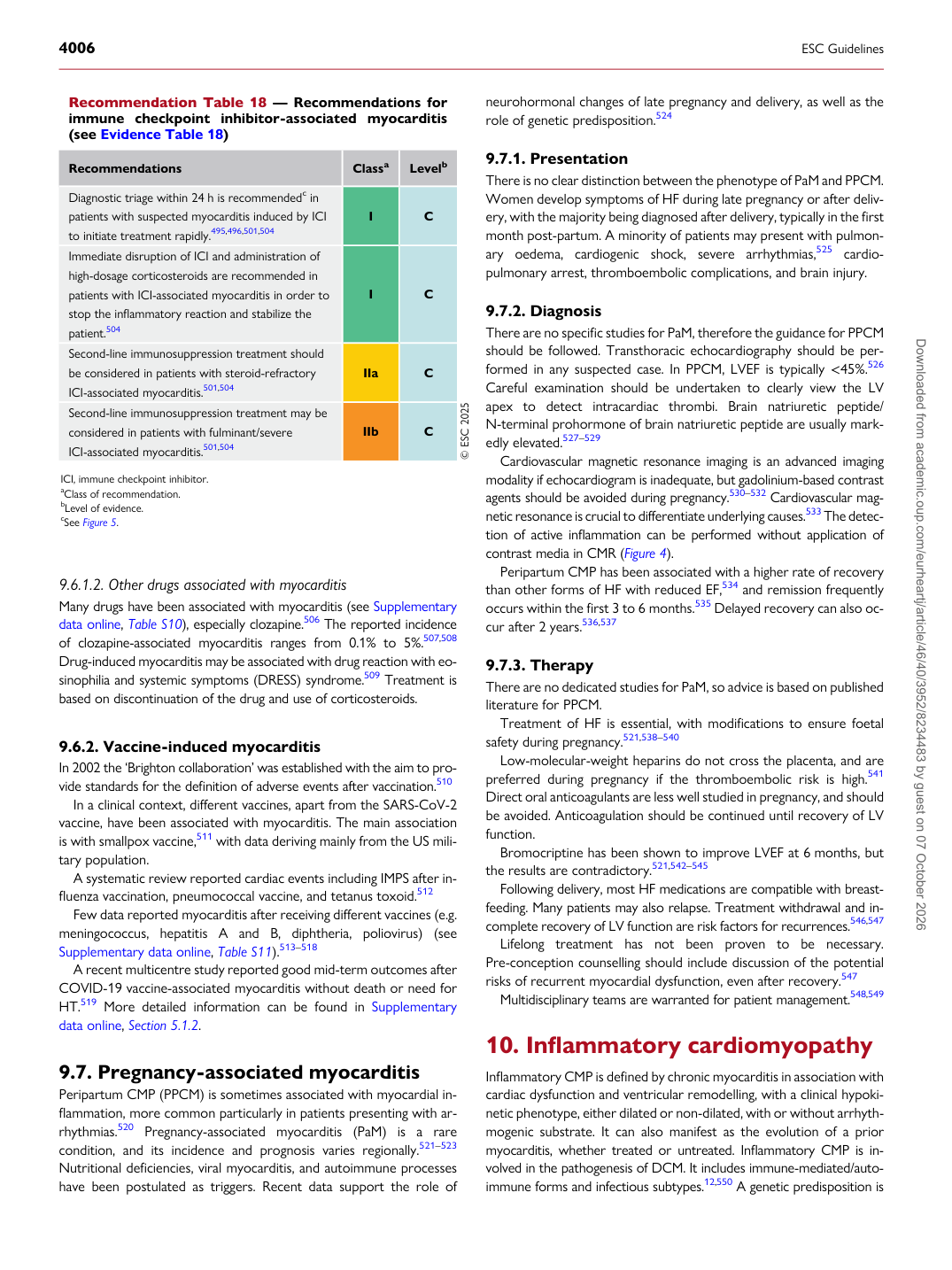
Recommendation Table 18 — Recommendations for immune checkpoint inhibitor-associated myocarditis (see Evidence Table 18)

Recommendations Classa Levelb Diagnostic triage within 24 h is recommendedc in patients with suspected myocarditis induced by ICI to initiate treatment rapidly.495,496,501,504 I C Immediate disruption of ICI and administration of high-dosage corticosteroids are recommended in patients with ICI-associated myocarditis in order to stop the inflammatory reaction and stabilize the patient.504 I C Second-line immunosuppression treatment should be considered in patients with steroid-refractory ICI-associated myocarditis.501,504 IIa C Second-line immunosuppression treatment may be considered in patients with fulminant/severe ICI-associated myocarditis.501,504 IIb C © ESC 2025

ICI, immune checkpoint inhibitor. aClass of recommendation. bLevel of evidence. cSee Figure 5. Downloaded from academic.oup.com/eurheartj/article/46/40/3952/8234483 by guest on 07 October 2026