p.51 抽出テキスト
underestimate the true disease burden.393,394 Giant-cell myocarditis generally affects young and middle-aged adults without a sex predominance. In a large multicentre registry of GCM cases, patients were aged from 16 to 69 years at the time of diagnosis.82 Giant-cell myocarditis is recognized as a non-infectious myosin-induced autoimmune form, as experimental models suggest,395 and an association with autoimmune disorders has been reported in ∼20% of cases.82

9.3.1 Presentation

Early symptoms of GCM might not differ from other types of myocarditis and vary widely at the time of presentation. In an international registry of 63 GCM patients, HF was the presenting symptom in 75% of cases.82 The initial manifestations might be progressive haemodynamic deterioration or cardiogenic shock, intractable arrhythmias, and SCD. The condition often progresses rapidly to death, often within days to months. A systematic analysis including 51 patients with GCM showed that the cumulative incidence of SCD (fatal or aborted) was 22% at 1 year and 26% at 5 years after presentation, and the composite incidence of SCD or VT was 41% at 1 year and 55% at 5 years.326 Other early GCM manifestations include bradyarrhythmias and cardiac conduction abnormalities, including complete AVB. In a study from Finland, 25% of individuals <55 years of age with clinically idiopathic heart block had GCM or CS on heart biopsy.396 The presence of AM complicated by treatment-resistant HF or cardiogenic shock, VA, and AVB should increase the clinical suspicion of GCM.

9.3.2 Diagnosis

Endomyocardial biopsy remains the gold-standard diagnostic modality for GCM and can identify these patients at an early stage.397,398 Patients diagnosed with GCM through EMB had a shorter symptom-onset-todiagnosis time and milder heart damage than those diagnosed during HT.398 The presence of multinucleated giant cells in the absence of wellorganized granulomatous lesions in the myocardial biopsy specimen is the hallmark of GCM. The giant cells are typically located in the interstitium or around blood vessels and are characterized by their large size, multinucleation, and cytoplasmic granules. Giant-cell myocarditis is characterized by myocardial destruction mediated by a large number of T cells, macrophages, multinucleated giant cells, and eosinophils in EMB.39 Generally, the histological diagnosis of GCM is guided by myocyte necrosis, diffuse infiltration of inflammatory cells, and interstitial fibrosis.399,400 The severity of necrosis and fibrosis in EMB predicts the outcome.401 It is important to understand that one set of non-diagnostic EMB samples does not exclude GCM. The sensitivity of the first biopsy is 68% and increases to 93% when the biopsy is performed up to three times. Thus, repeated EMB should be considered when there is a high clinical suspicion of GCM.217 In a single-centre case series of GCM, LGE on CMR was present in 96% of cases, and its distribution correlated with the histology.401 Prompt EMB in the setting of suspected GCM can affect the choice of MCS, leading to an early listing for HT and consideration of cyclosporinebased immunosuppression.402 Administration of i.v. steroids prior to EMB may reduce the diagnostic yield of EMB. There should be an agreement in specialized centres to prioritize the evaluation of EMB, and to provide the results at least within 3 days, optimally within 8 h.

9.3.3 Therapy

As soon as GCM is suspected, immunosuppressive therapy should be initiated promptly to avoid disease progression and delay HT. It is crucial that the therapy should be initiated based on a strong clinical suspicion. Historically, the survival of patients with GCM without immunosuppression was about 3 months from symptom onset to death or HT. Many studies have shown that immunosuppression is useful for the treatment of GCM. Immunosuppressive therapy typically involves two or three drugs, including corticosteroids, and at least one, and usually two additional immunosuppressive agents (see Table 12). In GCM patients, immunosuppression with corticosteroid monotherapy is not associated with a prolongation of transplant-free survival.82

Patients with GCM should receive the same guideline-based treatment for HF and arrhythmias as patients with heart disease from other causes.12,58 Cyclosporine is the most commonly used immunosuppressant. In multiple retrospective and prospective studies, concomitant use of cyclosporine was associated with improved prognosis. Combining immunosuppressive therapy with corticosteroids and cyclosporine, azathioprine, or both improved transplant-free survival on average to 12 months, while patients treated with corticosteroids alone survived on average 4 months.82 A cases series of GCM reported that 1-year transplant-free survival was 73% in patients who received corticosteroids and cyclosporine with or without muromonab-CD3, with a reported decrease of the degree of necrosis, cellular inflammation, and giant cells after 4 weeks of treatment.403 A systematic review of 27 studies with 43 biopsy-proven GCM cases requiring MCS showed that the administration of immunosuppressive therapy prior to MCS implantation was associated with significantly better survival than treatment with MCS alone. Immunosuppression may reduce the severity of HF in these patients by preventing further autoimmune destruction of the myocardium.404 Cessation or reduction of immunosuppression is associated with GCM recurrence as long as 8 years after diagnosis.344,403 In a single-centre study, the risk of life-threatening VA in GCM patients exceeded 50% at 5 years after admission. Permanent ICD effectively terminated life-threatening ventricular tachyarrhythmias, and no GCM patient with the device suffered from a SCD.326 Transplantation could be considered for GCM patients who fail to respond to GDMT and immunosuppression. A recent systematic review and meta-analysis of 499 patients with CS and 69 with GCM who underwent HT found that 1- and 5-year survival rates in GCM patients were similar to those in transplant recipients with other HF aetiologies.405

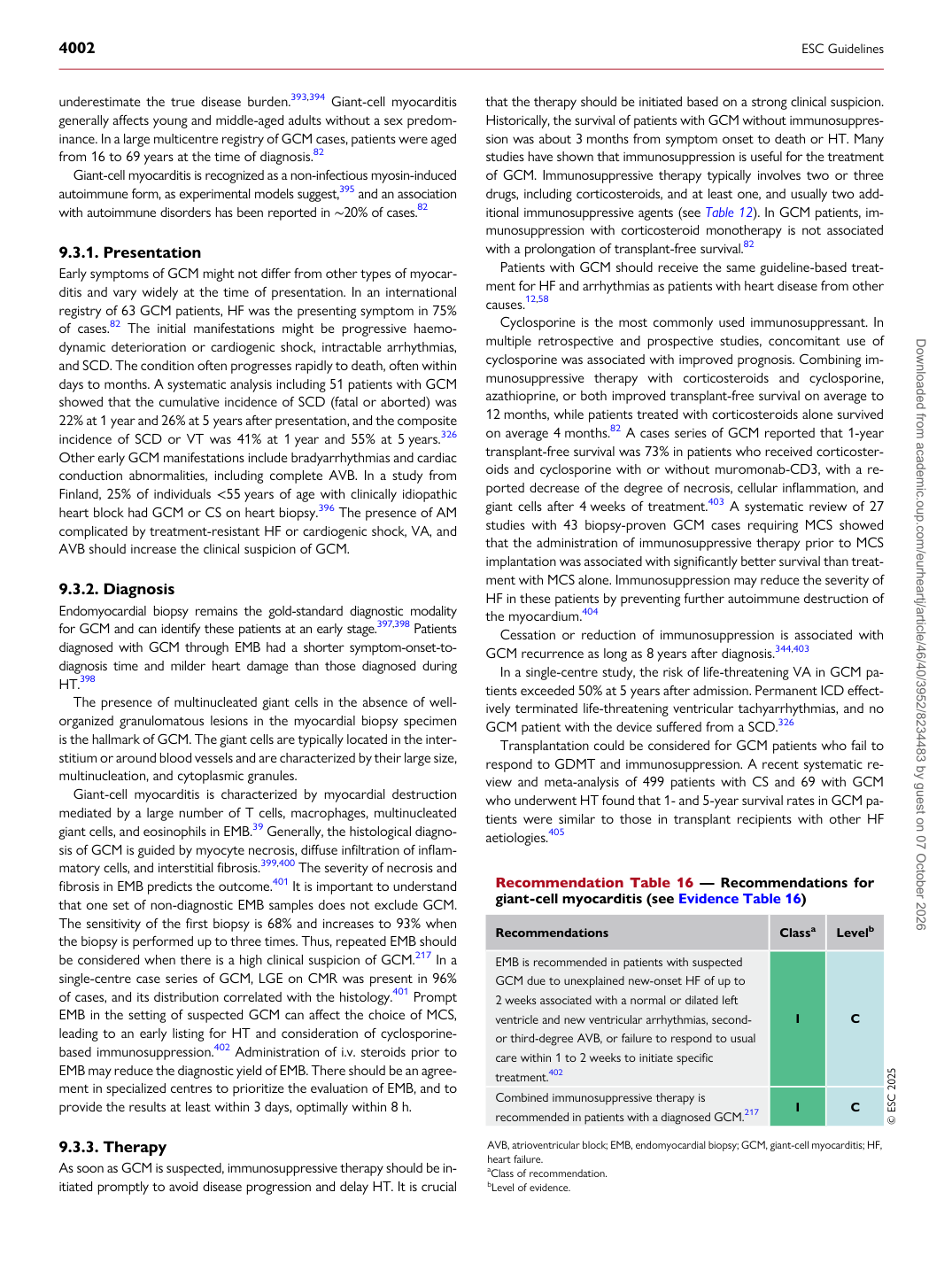
Recommendation Table 16 — Recommendations for giant-cell myocarditis (see Evidence Table 16)

Recommendations Classa Levelb

EMB is recommended in patients with suspected GCM due to unexplained new-onset HF of up to 2 weeks associated with a normal or dilated left ventricle and new ventricular arrhythmias, secondor third-degree AVB, or failure to respond to usual care within 1 to 2 weeks to initiate specific treatment.402 I C Combined immunosuppressive therapy is recommended in patients with a diagnosed GCM.217 I C © ESC 2025

AVB, atrioventricular block; EMB, endomyocardial biopsy; GCM, giant-cell myocarditis; HF, heart failure. aClass of recommendation. bLevel of evidence. Downloaded from academic.oup.com/eurheartj/article/46/40/3952/8234483 by guest on 07 October 2026