p.45 抽出テキスト
and chronic myocarditis.58 In addition to these guidelines, our aim is to provide a special focus on several selected scenarios.

6.5.1 Role of active devices (wearable and implanted

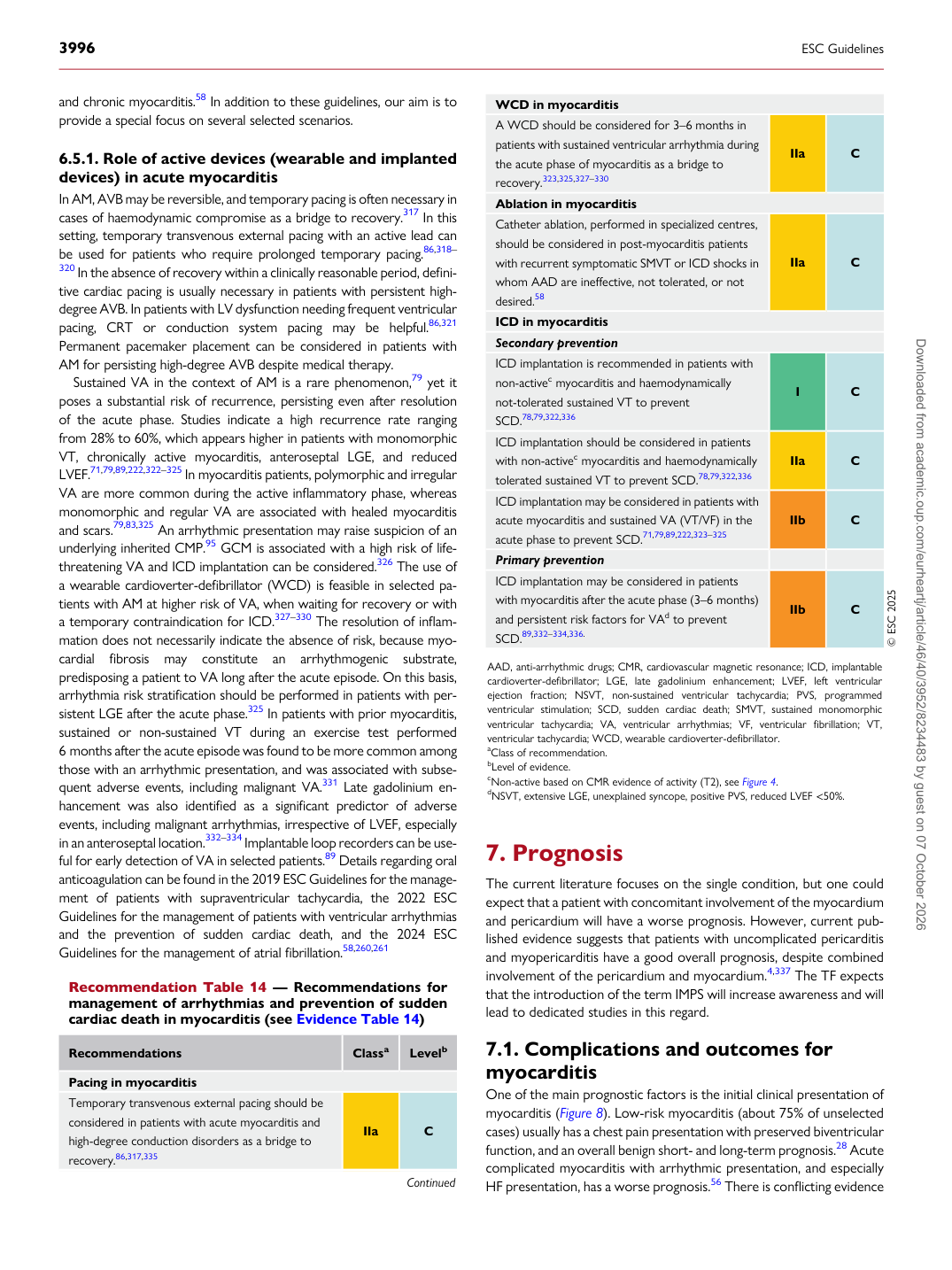
devices) in acute myocarditis In AM, AVB may be reversible, and temporary pacing is often necessary in cases of haemodynamic compromise as a bridge to recovery.317 In this setting, temporary transvenous external pacing with an active lead can be used for patients who require prolonged temporary pacing.86,318– 320 In the absence of recovery within a clinically reasonable period, definitive cardiac pacing is usually necessary in patients with persistent highdegree AVB. In patients with LV dysfunction needing frequent ventricular pacing, CRT or conduction system pacing may be helpful.86,321 Permanent pacemaker placement can be considered in patients with AM for persisting high-degree AVB despite medical therapy. Sustained VA in the context of AM is a rare phenomenon,79 yet it poses a substantial risk of recurrence, persisting even after resolution of the acute phase. Studies indicate a high recurrence rate ranging from 28% to 60%, which appears higher in patients with monomorphic VT, chronically active myocarditis, anteroseptal LGE, and reduced LVEF.71,79,89,222,322–325 In myocarditis patients, polymorphic and irregular VA are more common during the active inflammatory phase, whereas monomorphic and regular VA are associated with healed myocarditis and scars.79,83,325 An arrhythmic presentation may raise suspicion of an underlying inherited CMP.95 GCM is associated with a high risk of lifethreatening VA and ICD implantation can be considered.326 The use of a wearable cardioverter-defibrillator (WCD) is feasible in selected patients with AM at higher risk of VA, when waiting for recovery or with a temporary contraindication for ICD.327–330 The resolution of inflammation does not necessarily indicate the absence of risk, because myocardial fibrosis may constitute an arrhythmogenic substrate, predisposing a patient to VA long after the acute episode. On this basis, arrhythmia risk stratification should be performed in patients with persistent LGE after the acute phase.325 In patients with prior myocarditis, sustained or non-sustained VT during an exercise test performed 6 months after the acute episode was found to be more common among those with an arrhythmic presentation, and was associated with subsequent adverse events, including malignant VA.331 Late gadolinium enhancement was also identified as a significant predictor of adverse events, including malignant arrhythmias, irrespective of LVEF, especially in an anteroseptal location.332–334 Implantable loop recorders can be useful for early detection of VA in selected patients.89 Details regarding oral anticoagulation can be found in the 2019 ESC Guidelines for the management of patients with supraventricular tachycardia, the 2022 ESC Guidelines for the management of patients with ventricular arrhythmias and the prevention of sudden cardiac death, and the 2024 ESC Guidelines for the management of atrial fibrillation.58,260,261 7 Prognosis

The current literature focuses on the single condition, but one could expect that a patient with concomitant involvement of the myocardium and pericardium will have a worse prognosis. However, current published evidence suggests that patients with uncomplicated pericarditis and myopericarditis have a good overall prognosis, despite combined involvement of the pericardium and myocardium.4,337 The TF expects that the introduction of the term IMPS will increase awareness and will lead to dedicated studies in this regard.

7.1 Complications and outcomes for

myocarditis One of the main prognostic factors is the initial clinical presentation of myocarditis (Figure 8). Low-risk myocarditis (about 75% of unselected cases) usually has a chest pain presentation with preserved biventricular function, and an overall benign short- and long-term prognosis.28 Acute complicated myocarditis with arrhythmic presentation, and especially HF presentation, has a worse prognosis.56 There is conflicting evidence

Recommendation Table 14 — Recommendations for management of arrhythmias and prevention of sudden cardiac death in myocarditis (see Evidence Table 14)

Recommendations Classa Levelb

Pacing in myocarditis Temporary transvenous external pacing should be considered in patients with acute myocarditis and high-degree conduction disorders as a bridge to recovery.86,317,335 IIa C

Continued WCD in myocarditis

A WCD should be considered for 3–6 months in patients with sustained ventricular arrhythmia during the acute phase of myocarditis as a bridge to recovery.323,325,327–330 IIa C Ablation in myocarditis Catheter ablation, performed in specialized centres, should be considered in post-myocarditis patients with recurrent symptomatic SMVT or ICD shocks in whom AAD are ineffective, not tolerated, or not desired.58 IIa C ICD in myocarditis Secondary prevention ICD implantation is recommended in patients with non-activec myocarditis and haemodynamically not-tolerated sustained VT to prevent SCD.78,79,322,336 I C ICD implantation should be considered in patients with non-activec myocarditis and haemodynamically tolerated sustained VT to prevent SCD.78,79,322,336 IIa C ICD implantation may be considered in patients with acute myocarditis and sustained VA (VT/VF) in the acute phase to prevent SCD.71,79,89,222,323–325 IIb C Primary prevention ICD implantation may be considered in patients with myocarditis after the acute phase (3–6 months) and persistent risk factors for VAd to prevent SCD.89,332–334,336. IIb C © ESC 2025

AAD, anti-arrhythmic drugs; CMR, cardiovascular magnetic resonance; ICD, implantable cardioverter-defibrillator; LGE, late gadolinium enhancement; LVEF, left ventricular ejection fraction; NSVT, non-sustained ventricular tachycardia; PVS, programmed ventricular stimulation; SCD, sudden cardiac death; SMVT, sustained monomorphic ventricular tachycardia; VA, ventricular arrhythmias; VF, ventricular fibrillation; VT, ventricular tachycardia; WCD, wearable cardioverter-defibrillator. aClass of recommendation. bLevel of evidence. cNon-active based on CMR evidence of activity (T2), see Figure 4. dNSVT, extensive LGE, unexplained syncope, positive PVS, reduced LVEF <50%. Downloaded from academic.oup.com/eurheartj/article/46/40/3952/8234483 by guest on 07 October 2026