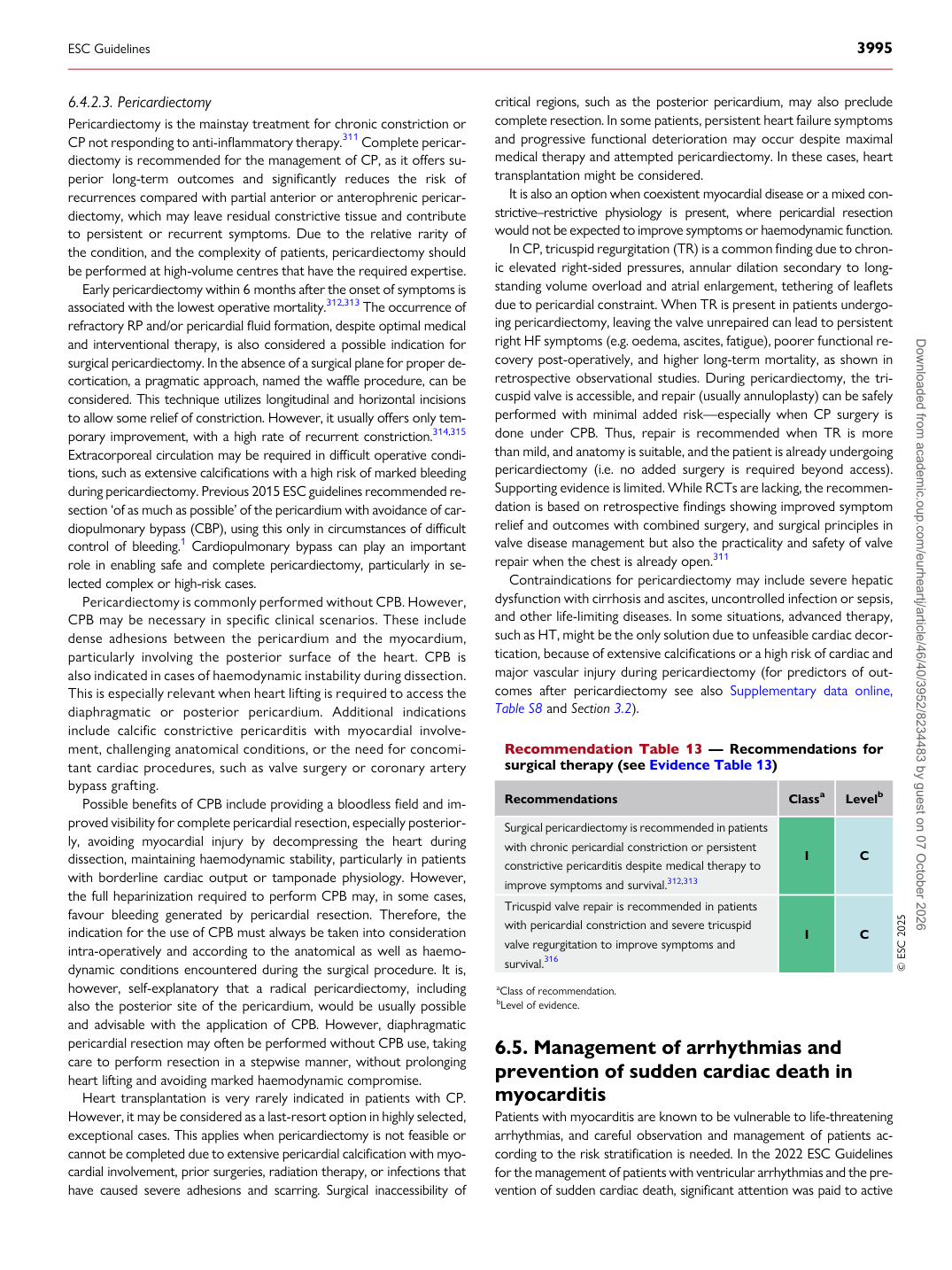
p.44 抽出テキスト
6.4.2.3 Pericardiectomy

Pericardiectomy is the mainstay treatment for chronic constriction or CP not responding to anti-inflammatory therapy.311 Complete pericardiectomy is recommended for the management of CP, as it offers superior long-term outcomes and significantly reduces the risk of recurrences compared with partial anterior or anterophrenic pericardiectomy, which may leave residual constrictive tissue and contribute to persistent or recurrent symptoms. Due to the relative rarity of the condition, and the complexity of patients, pericardiectomy should be performed at high-volume centres that have the required expertise. Early pericardiectomy within 6 months after the onset of symptoms is associated with the lowest operative mortality.312,313 The occurrence of refractory RP and/or pericardial fluid formation, despite optimal medical and interventional therapy, is also considered a possible indication for surgical pericardiectomy. In the absence of a surgical plane for proper decortication, a pragmatic approach, named the waffle procedure, can be considered. This technique utilizes longitudinal and horizontal incisions to allow some relief of constriction. However, it usually offers only temporary improvement, with a high rate of recurrent constriction.314,315 Extracorporeal circulation may be required in difficult operative conditions, such as extensive calcifications with a high risk of marked bleeding during pericardiectomy. Previous 2015 ESC guidelines recommended resection ‘of as much as possible’ of the pericardium with avoidance of cardiopulmonary bypass (CBP), using this only in circumstances of difficult control of bleeding.1 Cardiopulmonary bypass can play an important role in enabling safe and complete pericardiectomy, particularly in selected complex or high-risk cases. Pericardiectomy is commonly performed without CPB. However, CPB may be necessary in specific clinical scenarios. These include dense adhesions between the pericardium and the myocardium, particularly involving the posterior surface of the heart. CPB is also indicated in cases of haemodynamic instability during dissection. This is especially relevant when heart lifting is required to access the diaphragmatic or posterior pericardium. Additional indications include calcific constrictive pericarditis with myocardial involvement, challenging anatomical conditions, or the need for concomitant cardiac procedures, such as valve surgery or coronary artery bypass grafting. Possible benefits of CPB include providing a bloodless field and improved visibility for complete pericardial resection, especially posteriorly, avoiding myocardial injury by decompressing the heart during dissection, maintaining haemodynamic stability, particularly in patients with borderline cardiac output or tamponade physiology. However, the full heparinization required to perform CPB may, in some cases, favour bleeding generated by pericardial resection. Therefore, the indication for the use of CPB must always be taken into consideration intra-operatively and according to the anatomical as well as haemodynamic conditions encountered during the surgical procedure. It is, however, self-explanatory that a radical pericardiectomy, including also the posterior site of the pericardium, would be usually possible and advisable with the application of CPB. However, diaphragmatic pericardial resection may often be performed without CPB use, taking care to perform resection in a stepwise manner, without prolonging heart lifting and avoiding marked haemodynamic compromise. Heart transplantation is very rarely indicated in patients with CP. However, it may be considered as a last-resort option in highly selected, exceptional cases. This applies when pericardiectomy is not feasible or cannot be completed due to extensive pericardial calcification with myocardial involvement, prior surgeries, radiation therapy, or infections that have caused severe adhesions and scarring. Surgical inaccessibility of critical regions, such as the posterior pericardium, may also preclude complete resection. In some patients, persistent heart failure symptoms and progressive functional deterioration may occur despite maximal medical therapy and attempted pericardiectomy. In these cases, heart transplantation might be considered.

It is also an option when coexistent myocardial disease or a mixed constrictive–restrictive physiology is present, where pericardial resection would not be expected to improve symptoms or haemodynamic function. In CP, tricuspid regurgitation (TR) is a common finding due to chronic elevated right-sided pressures, annular dilation secondary to longstanding volume overload and atrial enlargement, tethering of leaflets due to pericardial constraint. When TR is present in patients undergoing pericardiectomy, leaving the valve unrepaired can lead to persistent right HF symptoms (e.g. oedema, ascites, fatigue), poorer functional recovery post-operatively, and higher long-term mortality, as shown in retrospective observational studies. During pericardiectomy, the tricuspid valve is accessible, and repair (usually annuloplasty) can be safely performed with minimal added risk—especially when CP surgery is done under CPB. Thus, repair is recommended when TR is more than mild, and anatomy is suitable, and the patient is already undergoing pericardiectomy (i.e. no added surgery is required beyond access). Supporting evidence is limited. While RCTs are lacking, the recommendation is based on retrospective findings showing improved symptom relief and outcomes with combined surgery, and surgical principles in valve disease management but also the practicality and safety of valve repair when the chest is already open.311 Contraindications for pericardiectomy may include severe hepatic dysfunction with cirrhosis and ascites, uncontrolled infection or sepsis, and other life-limiting diseases. In some situations, advanced therapy, such as HT, might be the only solution due to unfeasible cardiac decortication, because of extensive calcifications or a high risk of cardiac and major vascular injury during pericardiectomy (for predictors of outcomes after pericardiectomy see also Supplementary data online, Table S8 and Section 3.2).

6.5 Management of arrhythmias and

prevention of sudden cardiac death in myocarditis Patients with myocarditis are known to be vulnerable to life-threatening arrhythmias, and careful observation and management of patients according to the risk stratification is needed. In the 2022 ESC Guidelines for the management of patients with ventricular arrhythmias and the prevention of sudden cardiac death, significant attention was paid to active

Recommendation Table 13 — Recommendations for surgical therapy (see Evidence Table 13)

Recommendations Classa Levelb

Surgical pericardiectomy is recommended in patients with chronic pericardial constriction or persistent constrictive pericarditis despite medical therapy to improve symptoms and survival.312,313 I C Tricuspid valve repair is recommended in patients with pericardial constriction and severe tricuspid valve regurgitation to improve symptoms and survival.316 I C © ESC 2025 aClass of recommendation. bLevel of evidence.

ESC Guidelines                                                                                                                                                                                          3995

Downloaded from academic.oup.com/eurheartj/article/46/40/3952/8234483 by guest on 07 October 2026