p.40 抽出テキスト
Patients who develop a recurrence during corticosteroid tapering should continue colchicine and receive an NSAID on top of this treatment instead of increasing the dose of corticosteroids. Which medication should be tapered first (corticosteroids or NSAID) depends on the specific clinical scenario (age, kidney function, haemorrhagic risk, and use of oral anticoagulants). For patients with corticosteroid dependence, colchicine resistance, and evidence of elevated C-reactive protein (baseline or subsequent episode), clinical trials and an international registry supported the use of an anti-IL-1 agent (anakinra or rilonacept).108,275,282–284 An advantage of these agents is the rapid onset of action and the possibility of rapid withdrawal of corticosteroids.285 There is evidence of efficacy with anti-IL-1 agent (anakinra or rilonacept) monotherapy.108,275,282–284

However, concomitant use of colchicine could be helpful to reduce recurrences and prolong recurrence-free survival, providing a sequential block of the pro-inflammatory pathway leading to the generation of IL-1.286 Colchicine should be maintained and withdrawn as the last drug only after stable remission. Moreover, colchicine has the safest cardiovascular profile and is now proposed to prevent major adverse cardiac events (MACE) in patients with atherosclerotic cardiovascular diseases.248 In patients obtaining stable remission with a chronic low dose of corticosteroids (e.g. prednisone ≤5 mg or equivalent) plus colchicine, the decision of switching to IL-1 blocker treatment should be tailored to the patient on an individualized basis, taking into account several parameters (such as tolerability, age and sex issues, patient preference). The use of anti-IL-1 agents may be associated with a moderate increase in the overall risk of mild to moderate infections. Safety data on anti-IL-1 agents are reassuring when considering new malignancy risk, whereas their safe administration in patients with known active malignancies has not been well investigated to date. There is limited evidence for other drugs for pericarditis. Azathioprine has been empirically used in patients with recurrences and a lack of response to first- and second-level options such as aspirin/NSAID, colchicine, and corticosteroids.287 However, this drug seems more appropriate as a steroid-sparing agent, and has limited efficacy for those with acute pain. Intravenous immunoglobulins have also been tested in patients with refractory RP after failure of first and second options, as well as anti-IL-1 agents. These drugs may be efficacious either for infectious or non-infectious aetiologies, since they are able to clear infectious agents and modulate the immune response.288 Both corticosteroids and immunoglobulins have been

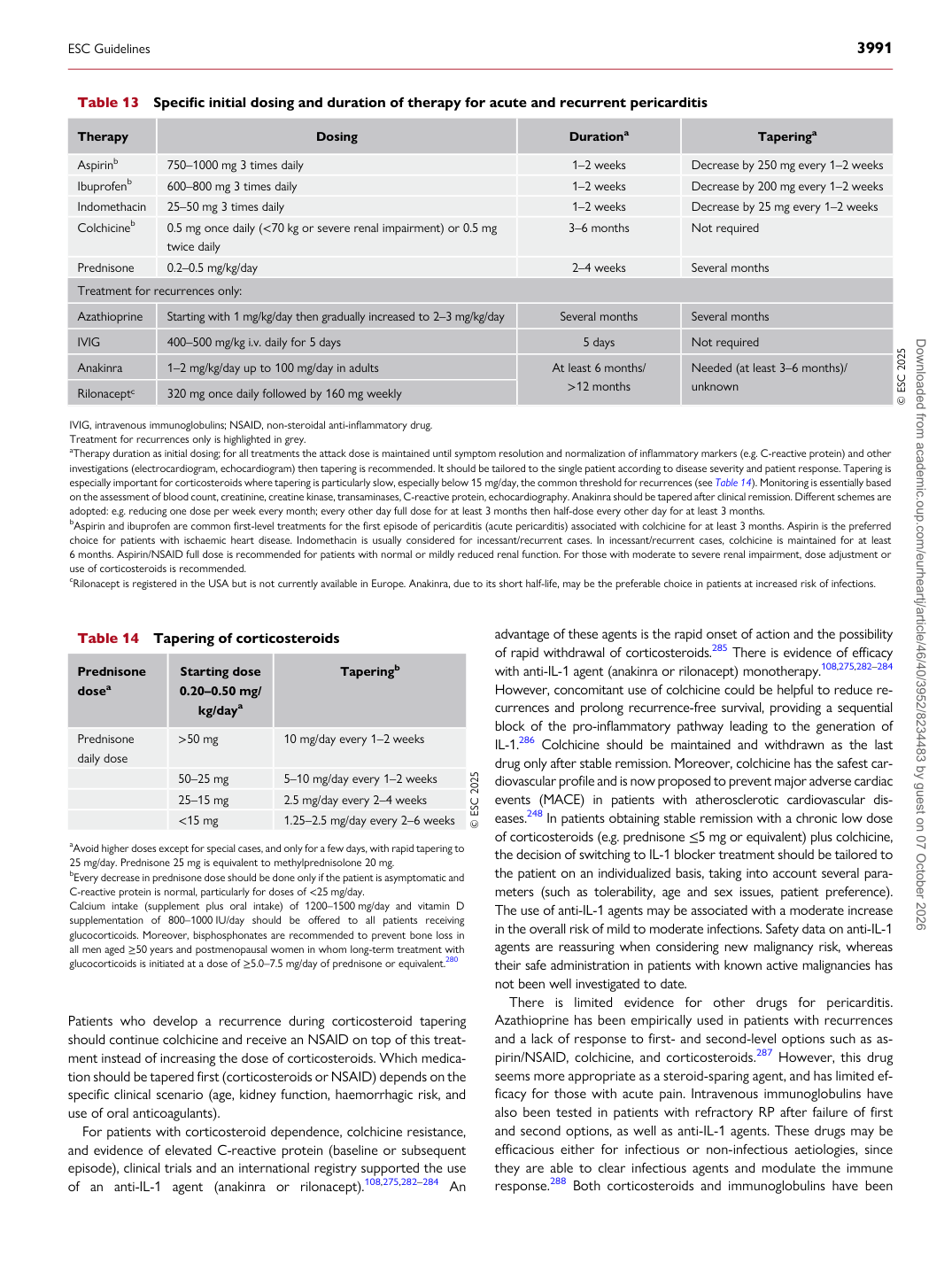
Table 13 Specific initial dosing and duration of therapy for acute and recurrent pericarditis

Therapy Dosing Durationa Taperinga Aspirinb 750–1000 mg 3 times daily 1–2 weeks Decrease by 250 mg every 1–2 weeks Ibuprofenb 600–800 mg 3 times daily 1–2 weeks Decrease by 200 mg every 1–2 weeks Indomethacin 25–50 mg 3 times daily 1–2 weeks Decrease by 25 mg every 1–2 weeks Colchicineb 0.5 mg once daily (<70 kg or severe renal impairment) or 0.5 mg twice daily 3–6 months Not required Prednisone 0.2–0.5 mg/kg/day 2–4 weeks Several months Treatment for recurrences only: Azathioprine Starting with 1 mg/kg/day then gradually increased to 2–3 mg/kg/day Several months Several months IVIG 400–500 mg/kg i.v. daily for 5 days 5 days Not required Anakinra 1–2 mg/kg/day up to 100 mg/day in adults At least 6 months/

>12 months Needed (at least 3–6 months)/

unknown Rilonaceptc 320 mg once daily followed by 160 mg weekly © ESC 2025

IVIG, intravenous immunoglobulins; NSAID, non-steroidal anti-inflammatory drug. Treatment for recurrences only is highlighted in grey. aTherapy duration as initial dosing; for all treatments the attack dose is maintained until symptom resolution and normalization of inflammatory markers (e.g. C-reactive protein) and other investigations (electrocardiogram, echocardiogram) then tapering is recommended. It should be tailored to the single patient according to disease severity and patient response. Tapering is especially important for corticosteroids where tapering is particularly slow, especially below 15 mg/day, the common threshold for recurrences (see Table 14). Monitoring is essentially based on the assessment of blood count, creatinine, creatine kinase, transaminases, C-reactive protein, echocardiography. Anakinra should be tapered after clinical remission. Different schemes are adopted: e.g. reducing one dose per week every month; every other day full dose for at least 3 months then half-dose every other day for at least 3 months. bAspirin and ibuprofen are common first-level treatments for the first episode of pericarditis (acute pericarditis) associated with colchicine for at least 3 months. Aspirin is the preferred choice for patients with ischaemic heart disease. Indomethacin is usually considered for incessant/recurrent cases. In incessant/recurrent cases, colchicine is maintained for at least 6 months. Aspirin/NSAID full dose is recommended for patients with normal or mildly reduced renal function. For those with moderate to severe renal impairment, dose adjustment or use of corticosteroids is recommended. cRilonacept is registered in the USA but is not currently available in Europe. Anakinra, due to its short half-life, may be the preferable choice in patients at increased risk of infections.

Table 14 Tapering of corticosteroids

Prednisone dosea Starting dose

0.20–0.50 mg/ kg/daya Taperingb

Prednisone daily dose >50 mg 10 mg/day every 1–2 weeks

50–25 mg 5–10 mg/day every 1–2 weeks 25–15 mg 2.5 mg/day every 2–4 weeks <15 mg 1.25–2.5 mg/day every 2–6 weeks © ESC 2025

aAvoid higher doses except for special cases, and only for a few days, with rapid tapering to 25 mg/day. Prednisone 25 mg is equivalent to methylprednisolone 20 mg. bEvery decrease in prednisone dose should be done only if the patient is asymptomatic and C-reactive protein is normal, particularly for doses of <25 mg/day. Calcium intake (supplement plus oral intake) of 1200–1500 mg/day and vitamin D supplementation of 800–1000 IU/day should be offered to all patients receiving glucocorticoids. Moreover, bisphosphonates are recommended to prevent bone loss in all men aged ≥50 years and postmenopausal women in whom long-term treatment with glucocorticoids is initiated at a dose of ≥5.0–7.5 mg/day of prednisone or equivalent.280

ESC Guidelines                                                                                                                                                                                          3991

Downloaded from academic.oup.com/eurheartj/article/46/40/3952/8234483 by guest on 07 October 2026