p.39 抽出テキスト
The efficacy of combined immunosuppression (prednisone with either cyclosporine or azathioprine), compared with placebo, was assessed in a single randomized controlled trial (RCT) in patients with biopsy-proven AM of unspecified aetiology, since infectious causes were not excluded by PCR.272 The trial was designed to determine whether immunosuppressive therapy improved LV function in patients with AM. There was no significant difference in survival between the two groups (P = 0.96). The study had several limitations, such as small sample size and incomplete analysis of EMB based only on histopathology. However, in specific histopathological forms of AM, such as GCM, immunosuppressive drugs are recommended (see Sections 9.2 and 9.3).

6.2.1.4 Subacute and chronic myocarditis

Chronic myocarditis may represent an intermediate stage between subacute myocarditis and inflammatory CMP. During chronic myocarditis, HF may develop, and guideline-directed medical therapy (GDMT) for HF is the cornerstone in the treatment of chronic myocarditis.12,259 Antiviral therapy has little benefit in the subacute and chronic stages of myocarditis,273 and the effects of immunomodulatory drugs on chronic myocarditis of unspecified aetiology are still controversial. 6.2.2 Pharmacological therapy for pericarditis

6.2.2.1. General principles The aims of medical therapy for pericarditis are to provide: (i) symptomatic care (mainly control of pericarditis chest pain); (ii) clinical remission; and (iii) prevention of complications, especially recurrences and constriction. Exercise restriction limits the heart rate and may be useful to reduce pericardial friction, which can be improved using drugs that reduce it (e.g. β-blockers or ivabradine for those who cannot receive or tolerate β-blockers) for patients with a resting heart rate of >75 b.p.m., and symptoms despite empirical anti-inflammatory therapy.274

6.2.2.1.1 Acute pericarditis (first episode). The mainstay of medical

therapy is empirical anti-inflammatory therapy using aspirin or NSAIDs at full anti-inflammatory doses with appropriate time intervals of administration (usually every 8 h) plus colchicine to reduce the risk of recurrences.24,25,108,275–278 Gastroprotection with a proton pump inhibitor is recommended using NSAIDs.279 When aspirin and NSAIDs are contraindicated, or for specific indications, corticosteroids should be considered at low to moderate doses plus colchicine (see Tables 13 and 14). In cases of incomplete response to aspirin/NSAIDs and colchicine, corticosteroids may be added at low to moderate doses as triple therapy.1 In cases of recurrence, every effort should be made not to increase the dose or to reinstate corticosteroids. The use of colchicine on top of empirical anti-inflammatory therapy is supported by most of the published evidence, with the single exception of a small open-label trial that was probably underpowered to test the study hypothesis for patients with AP.281 Specific dosing and duration of therapy are summarized in Table 13. Monitoring of serum C-reactive protein and CMR imaging is recommended to assess clinical remission, guide the treatment length, and evaluate the response to therapy in more complicated and difficult-to-treat cases. In uncomplicated cases, clinical follow-up with/without echocardiography is sufficient.

6.2.2.2 Incessant and recurrent pericarditis

In patients with incessant pericarditis or RP, the mainstay of therapy is always colchicine in association with aspirin/NSAID or low to moderate doses of corticosteroids. For more difficult cases, chest pain can be controlled by a combination of aspirin or an NSAID plus corticosteroids at low to moderate doses and colchicine (triple therapy). The i.v. route should be considered to ensure a clinical response or to control symptoms in more difficult or resistant cases.

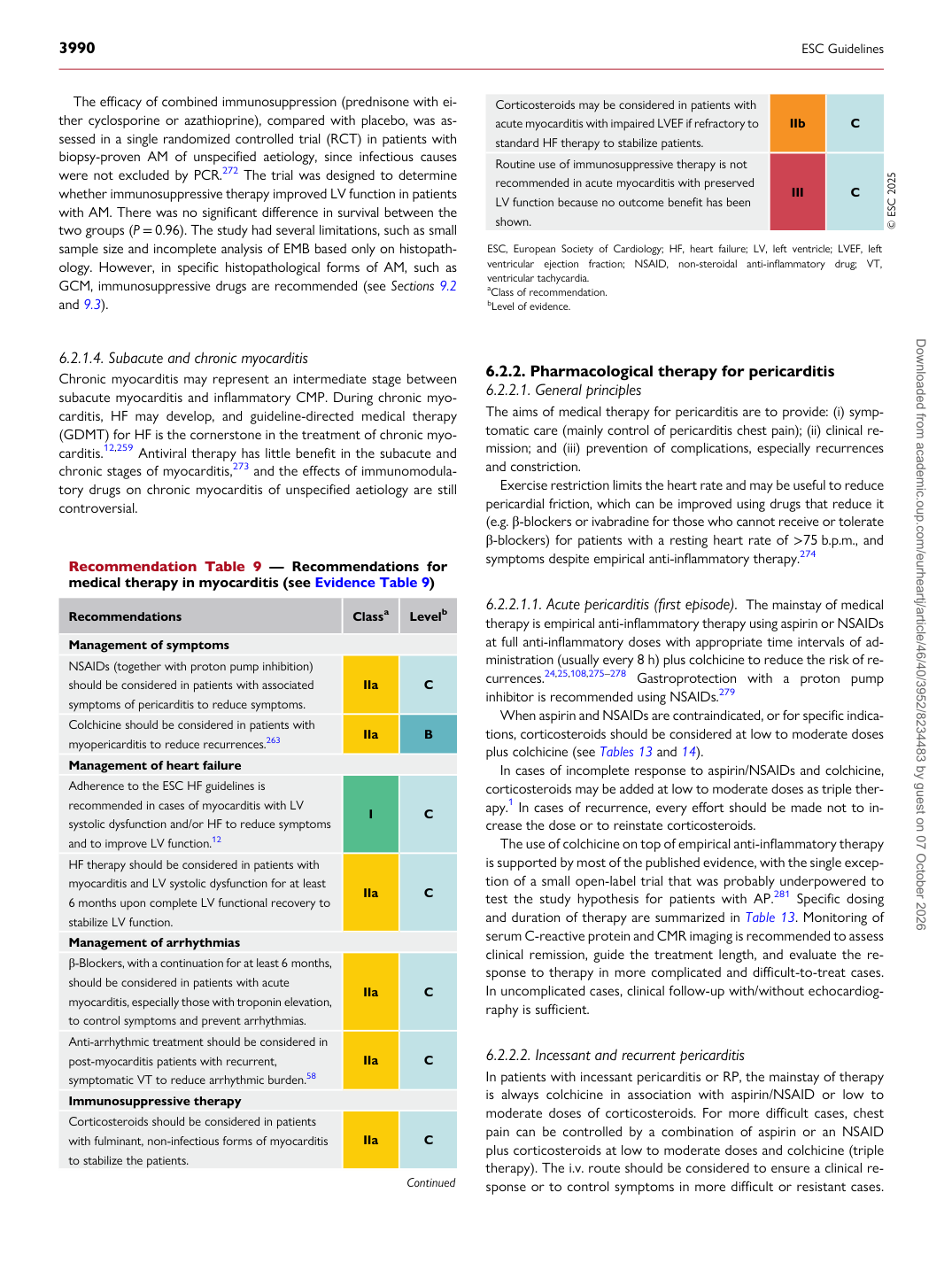
Recommendation Table 9 — Recommendations for medical therapy in myocarditis (see Evidence Table 9)

Recommendations Classa Levelb

Management of symptoms NSAIDs (together with proton pump inhibition) should be considered in patients with associated symptoms of pericarditis to reduce symptoms. IIa C Colchicine should be considered in patients with myopericarditis to reduce recurrences.263 IIa B Management of heart failure Adherence to the ESC HF guidelines is recommended in cases of myocarditis with LV systolic dysfunction and/or HF to reduce symptoms and to improve LV function.12 I C HF therapy should be considered in patients with myocarditis and LV systolic dysfunction for at least 6 months upon complete LV functional recovery to stabilize LV function. IIa C Management of arrhythmias β-Blockers, with a continuation for at least 6 months, should be considered in patients with acute myocarditis, especially those with troponin elevation, to control symptoms and prevent arrhythmias. IIa C Anti-arrhythmic treatment should be considered in post-myocarditis patients with recurrent, symptomatic VT to reduce arrhythmic burden.58 IIa C Immunosuppressive therapy Corticosteroids should be considered in patients with fulminant, non-infectious forms of myocarditis to stabilize the patients. IIa C

Continued Corticosteroids may be considered in patients with

acute myocarditis with impaired LVEF if refractory to standard HF therapy to stabilize patients. IIb C Routine use of immunosuppressive therapy is not recommended in acute myocarditis with preserved LV function because no outcome benefit has been shown. III C © ESC 2025

ESC, European Society of Cardiology; HF, heart failure; LV, left ventricle; LVEF, left ventricular ejection fraction; NSAID, non-steroidal anti-inflammatory drug; VT, ventricular tachycardia. aClass of recommendation. bLevel of evidence.

Downloaded from academic.oup.com/eurheartj/article/46/40/3952/8234483 by guest on 07 October 2026