p.30 抽出テキスト
but could help based on a strong clinical suspicion,73 e.g. miR721 was shown to have a discriminatory capacity.141 In specific circumstances, tumour necrosis factor alpha (TNF-α), IL-1β, IL-6, and IL-17A may be of value. Similarly, in some cases, evaluation of cardio-specific antibodies may be helpful, according to the local laboratory availability. These include organ-specific anti-heart autoantibodies and anti-intercalated disc autoantibodies, as well as non-organ-specific serum autoantibodies.10 These autoantibodies, especially if found at high titres, may have a negative prognostic value.73,142 Furthermore, a specific serum biomarker, i.e. the soluble form of the IL-1 receptor-like 1 (IL-1RL1), also known as ST2, was associated with a higher risk of severe HF among male myocarditis patients.143 Other biomarkers have been studied in myocarditis, including procollagen type III, gelsolin, soluble VCAM-1, galectin-3, serum alarmin S100A8/ S100A9, immunoglobulin free light chain, and heparin-binding protein, for both diagnostic and prognostic purposes. However, these biomarkers were evaluated among limited small cohorts and are clinically not routinely used.144,145

5.3 Genetics

Genetic testing is relatively new in the field of IMPS. There is a potential overlap with CMPs. Myocarditis and pericarditis will be discussed separately. There has been increasing evidence that gene variants coding for structural proteins, particularly desmosomal and sarcomeric proteins, may overlap with acute and recurrent myocarditis and affect disease severity.94,95 Furthermore, it has been shown that there is an overlap of gene variants predisposing to myocardial inflammation and inherited CMP (ARVC and NDLVC).13 In particular, myocardial inflammation may be detected in patients with inherited CMP using serum and imaging biomarkers.13 There is evidence that these patients are at higher risk for complicated myocarditis (Section 4.3.5).13,91,93,94 In a meta-analysis, the pooled prevalence of P/LP variants was 4.2% for uncomplicated myocarditis, whereas for complicated myocarditis the pooled prevalence was 22% and 45% in adults and children, respectively.95 Pathogenic/likely pathogenic variants in desmosomal genes were more common in uncomplicated myocarditis (64%), while variants in sarcomeric genes were more prevalent in complicated myocarditis (58% in adults and 71% in children).95 A case series demonstrated a high proportion of definite or probable pathogenic variants in patients with myocarditis with RV involvement or sustained VA.146 Furthermore, DSP variants have been reported in familial recurrent myocarditis.147 Another study demonstrated overlap of gene variants in myocarditis and inherited CMP.96

Identifying such gene variants has several clinical implications:

(1) While in myocarditis there is a recommendation to defer on im-

plantable cardioverter-defibrillator (ICD) placement during the acute phase of the disease, the threshold for ICD placement is lower in ARVC in cases of primary prevention.58 (2) Gene variants predisposing to myocarditis have relevant implica-

tions for patients.147,148 Details are given in the 2023 ESC Guidelines for the management of cardiomyopathies.13 (3) Cascade clinical and genetic screening for relatives and familial gen-

etic counselling should be offered.93,149 As scientific knowledge about gene variants and their potential pathophysiological role has been continuously increasing over recent years, comprehensive screening includes desmosomal and sarcomeric genes and some DCM-associated genes.64,91,96,146,150 For details, see 2023 ESC Guidelines for the management of cardiomyopathies.13 Nevertheless, it is not clear whether the inflammatory process acts as a trigger or is fully part of the pathophysiological process in inherited CMP.151

Pathogenic/likely pathogenic variants have been identified in patients with recurrent pericarditis (RP), especially young patients, with a family history, multiple recurrences, inflammatory phenotype, and refractory or dependent on medical treatments. Recurrent pericarditis has been associated with genetic variants for monogenic autoinflammatory diseases (e.g. FMF, TRAPS), but also with genes related to the inflammatory response (Figure 14).50,51,152,153 A recent study performed whole-exome sequencing in 108 patients with RP. Overall, about 15% of patients had variants in genes related to the inflammatory response, while up to 30% of patients carried variants in different cardiac genes, worthy of a deeper investigation.51 These data suggest a genetic predisposition in at least a subset of patients (positive family history of pericarditis or periodic fever, poor response to colchicine, multiple recurrences with inflammatory phenotype), and counselling may be offered.51,152 In these clinical scenarios, prolonged therapy with specific biological agents (e.g. anti-IL-1 agents) should be considered.

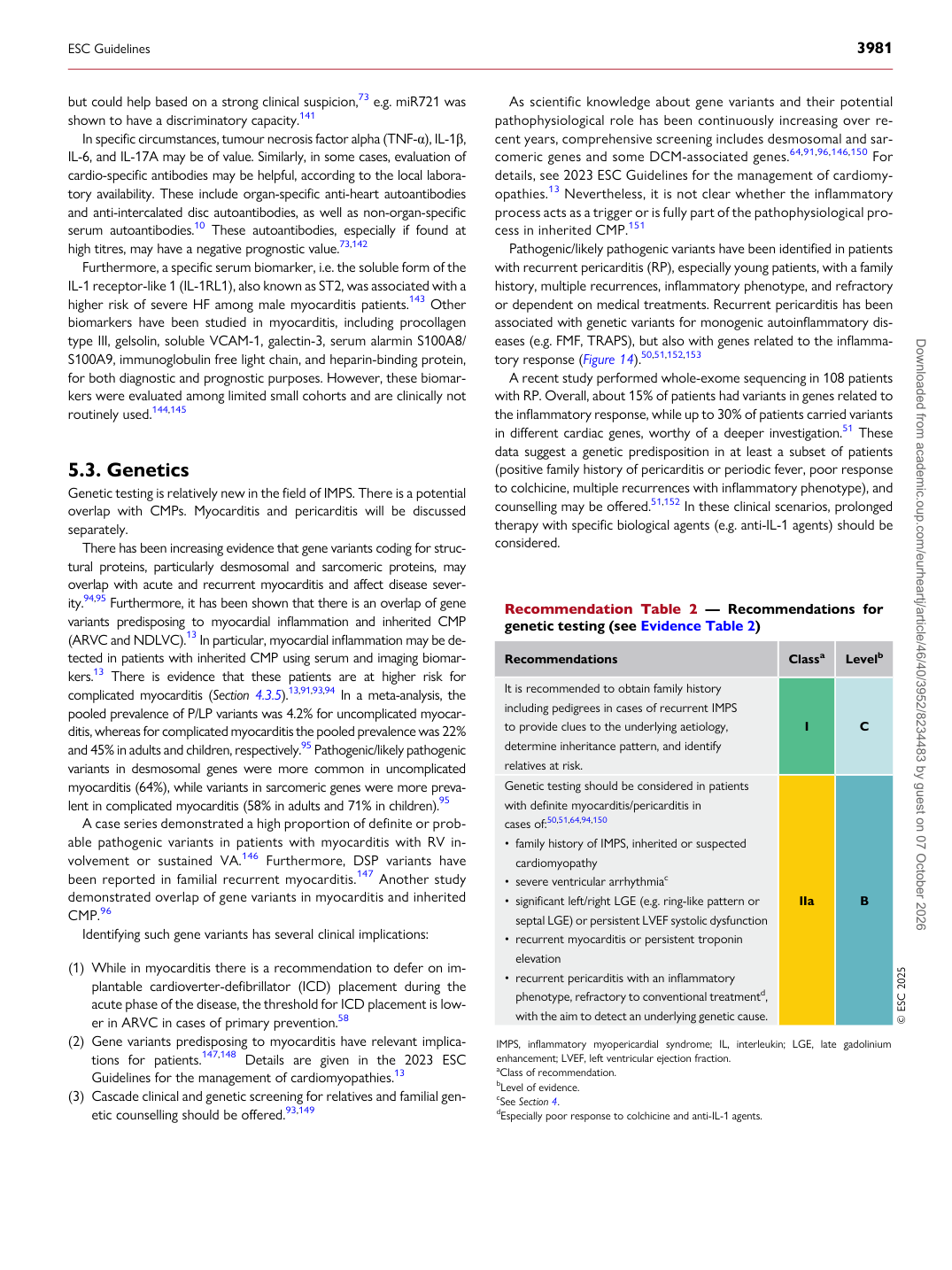
Recommendation Table 2 — Recommendations for genetic testing (see Evidence Table 2)

Recommendations Classa Levelb

It is recommended to obtain family history including pedigrees in cases of recurrent IMPS to provide clues to the underlying aetiology, determine inheritance pattern, and identify relatives at risk. I C Genetic testing should be considered in patients with definite myocarditis/pericarditis in cases of:50,51,64,94,150 • family history of IMPS, inherited or suspected cardiomyopathy • severe ventricular arrhythmiac • significant left/right LGE (e.g. ring-like pattern or septal LGE) or persistent LVEF systolic dysfunction • recurrent myocarditis or persistent troponin elevation • recurrent pericarditis with an inflammatory

phenotype, refractory to conventional treatmentd, with the aim to detect an underlying genetic cause. IIa B © ESC 2025

IMPS, inflammatory myopericardial syndrome; IL, interleukin; LGE, late gadolinium enhancement; LVEF, left ventricular ejection fraction. aClass of recommendation. bLevel of evidence. cSee Section 4. dEspecially poor response to colchicine and anti-IL-1 agents.

ESC Guidelines                                                                                                                                                                                          3981

Downloaded from academic.oup.com/eurheartj/article/46/40/3952/8234483 by guest on 07 October 2026