p.11 抽出テキスト
individualized duration of therapies according to clinical and imaging findings. The TF recommends establishing a multidisciplinary IMPS team to ensure optimal patient care in complicated cases. We firmly believe that recognizing IMPS will enhance the understanding of these inflammatory conditions and hope it will inspire further research to advance personalized diagnostic and therapeutic approaches.

3. Epidemiology, classification, stages, diagnostic criteria and aetiology

3.1 Epidemiology

Population-based studies of the incidence or prevalence of IMPS are limited, and most epidemiological studies assess disease burden and sequelae in selected patient groups, such as those admitted to hospital. However, such studies might underestimate the true disease burden. For example, the rate of patients diagnosed with acute myocarditis (AM) increases from 5% to 13% with the use of CMR among patients with angina-like symptoms and increased high-sensitivity troponin T (hs-TnT).16 A different registry reported an incidence of 6.3–8.6 per 100 000 inhabitants, mostly in young men.17 The current global burden of cardiovascular disease data reports a prevalence of 4.2–8.7 per 100 000 in the age range between 35 and 39 years.18 Men and younger patients are more likely to be diagnosed, although this could reflect the diagnostic bias towards these patient groups.19 In children <2 years of age, the sex distribution is balanced; in adolescents there is a male prevalence (about two-thirds of cases),20,21 which is also maintained in adult patients, suggesting the importance of hormonal factors. The incidence of acute pericarditis (AP) is estimated to be about 3– 32 cases per 100 000 person-years.22,23 Similar to myocarditis, men and younger individuals are more likely to be diagnosed. Recurrence occurs in about 20%–30% of patients within 18 months after a first episode of AP.24 The recurrence rate increases up to 50% after the first recurrence.25 Pericarditis is diagnosed in 0.2% of all cardiovascular in-hospital admissions and is responsible for 5% of emergency room admissions for chest pain.23 In the observational Epidémiologie de la Douleur Thoracique (EPIDOULTHO) study, 3% of patients received a final diagnosis of IMPS.26

3.2 Classification and stages

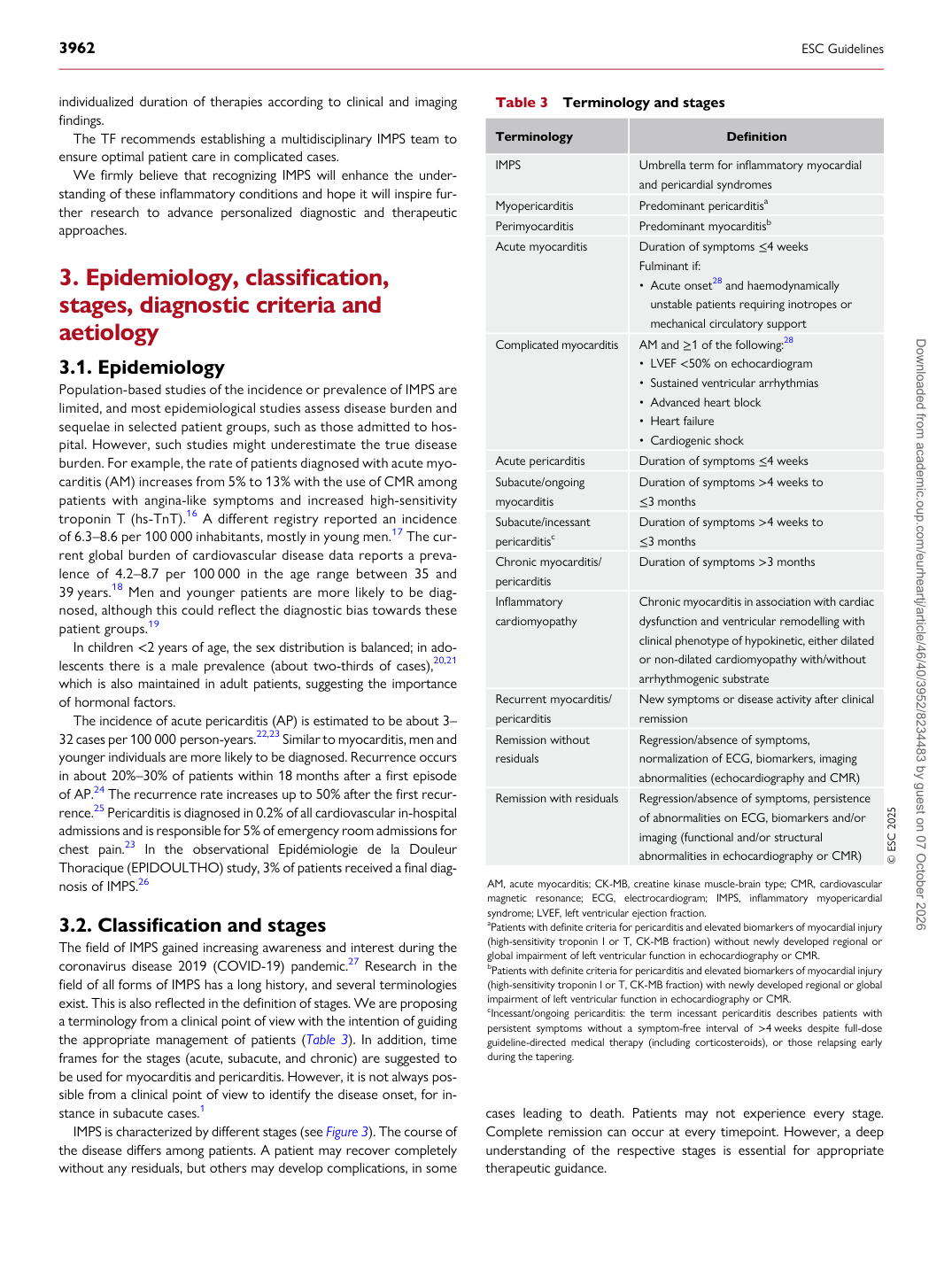
The field of IMPS gained increasing awareness and interest during the coronavirus disease 2019 (COVID-19) pandemic.27 Research in the field of all forms of IMPS has a long history, and several terminologies exist. This is also reflected in the definition of stages. We are proposing a terminology from a clinical point of view with the intention of guiding the appropriate management of patients (Table 3). In addition, time frames for the stages (acute, subacute, and chronic) are suggested to be used for myocarditis and pericarditis. However, it is not always possible from a clinical point of view to identify the disease onset, for instance in subacute cases.1 IMPS is characterized by different stages (see Figure 3). The course of the disease differs among patients. A patient may recover completely without any residuals, but others may develop complications, in some cases leading to death. Patients may not experience every stage. Complete remission can occur at every timepoint. However, a deep understanding of the respective stages is essential for appropriate therapeutic guidance.

Table 3 Terminology and stages

Terminology Definition

IMPS Umbrella term for inflammatory myocardial and pericardial syndromes Myopericarditis Predominant pericarditisa Perimyocarditis Predominant myocarditisb Acute myocarditis Duration of symptoms ≤4 weeks

Fulminant if: • Acute onset28 and haemodynamically unstable patients requiring inotropes or

mechanical circulatory support

Complicated myocarditis AM and ≥1 of the following:28

• LVEF <50% on echocardiogram • Sustained ventricular arrhythmias • Advanced heart block • Heart failure • Cardiogenic shock

Acute pericarditis Duration of symptoms ≤4 weeks Subacute/ongoing myocarditis Duration of symptoms >4 weeks to

≤3 months

Subacute/incessant pericarditisc Duration of symptoms >4 weeks to

≤3 months

Chronic myocarditis/ pericarditis Duration of symptoms >3 months Inflammatory cardiomyopathy Chronic myocarditis in association with cardiac

dysfunction and ventricular remodelling with clinical phenotype of hypokinetic, either dilated or non-dilated cardiomyopathy with/without arrhythmogenic substrate

Recurrent myocarditis/ pericarditis New symptoms or disease activity after clinical

remission

Remission without residuals Regression/absence of symptoms,

normalization of ECG, biomarkers, imaging abnormalities (echocardiography and CMR)

Remission with residuals Regression/absence of symptoms, persistence of abnormalities on ECG, biomarkers and/or

imaging (functional and/or structural abnormalities in echocardiography or CMR) © ESC 2025

AM, acute myocarditis; CK-MB, creatine kinase muscle-brain type; CMR, cardiovascular magnetic resonance; ECG, electrocardiogram; IMPS, inflammatory myopericardial syndrome; LVEF, left ventricular ejection fraction. aPatients with definite criteria for pericarditis and elevated biomarkers of myocardial injury (high-sensitivity troponin I or T, CK-MB fraction) without newly developed regional or global impairment of left ventricular function in echocardiography or CMR. bPatients with definite criteria for pericarditis and elevated biomarkers of myocardial injury (high-sensitivity troponin I or T, CK-MB fraction) with newly developed regional or global impairment of left ventricular function in echocardiography or CMR. cIncessant/ongoing pericarditis: the term incessant pericarditis describes patients with persistent symptoms without a symptom-free interval of >4 weeks despite full-dose guideline-directed medical therapy (including corticosteroids), or those relapsing early during the tapering. Downloaded from academic.oup.com/eurheartj/article/46/40/3952/8234483 by guest on 07 October 2026