p.9 抽出テキスト
Table 5 of the 2019 ESC/EAS Guidelines, and is now described (without changes vs the 2019 ESC/EAS Guidelines) in Recommendation Table 1. We further emphasize that the SCORE2 and SCORE2-OP riskestimating algorithms were derived from cohorts of participants without clinical ASCVD who were not receiving lipid-lowering therapy. As a result, these algorithms should not be used to estimate risk among persons with existing ASCVD or among persons currently on lipid-lowering therapy, and they should not be used to ‘re-assess’ risk using lipid measurements obtained after initiating Guidelinerecommended lipid-lowering therapy. Finally, this Task Force emphasizes that atherosclerosis is a chronic progressive disease that begins early in life and slowly progresses over time, and the cumulative exposure to higher LDL-C levels at younger ages is associated with a higher ASCVD risk later in life.34 Conversely, exposure to lower levels of atherogenic lipids at younger ages has the potential to reduce the lifetime risk of developing CVD35 and mitigate further progression of subclinical atherosclerosis.15 The discrepancy between our understanding of the biology of how atherosclerosis develops and the practical consequences of informing treatment decisions based on 10 year risk underscores the need to develop a new generation of risk- and benefit-estimating algorithms. These algorithms should: (i) accurately estimate the lifetime risk of having an acute CV event for all individuals regardless of age, and (ii) provide personalized guidance on the optimal timing and intensity of LDL-C lowering needed by each person to reduce their remaining lifetime risk of developing an atherosclerotic CV event. 4 New low-density lipoprotein

cholesterol-lowering therapies

Bempedoic acid is an oral small molecule that inhibits cholesterol synthesis by inhibiting the action of ATP-citrate lyase, a cytosolic enzyme upstream of the 3-hydroxy-3-methylglutaryl-coenzyme A reductase pathway.40 Bempedoic acid is a prodrug and the activating enzyme (very long-chain acyl-CoA synthetase-1) is not expressed in skeletal muscle.41 Treatment with bempedoic acid has muscle-related adverse events similar to placebo.40,42 Bempedoic acid (single dose available, 180 mg/day) reduces LDL-C levels by approximately 23% as monotherapy, approximately 18% when given on a background of statin therapy,40,42 and by 38% when given in a fixed-dose combination with ezetimibe.43,44 Treatment with bempedoic acid decreased C-reactive protein and did not result in increased haemoglobin A1c levels in patients with normoglycaemia or pre-diabetes.45 Mendelian randomization studies have demonstrated that a genetic variant mimicking the effect of ATP-citrate lyase inhibition and lowering plasma LDL-C levels by the same mechanism of action is associated with similar reductions in the risk of CVD as statins and other non-statin lipid-lowering drugs with proven benefit per unit decrease in LDL-C levels.46 The CLEAR Outcomes study was a randomized, double-blind, placebo-controlled study that aimed to determine bempedoic acid’s potential for CV risk reduction in statin-intolerant patients at high risk of developing major adverse CV events (MACE) during a median

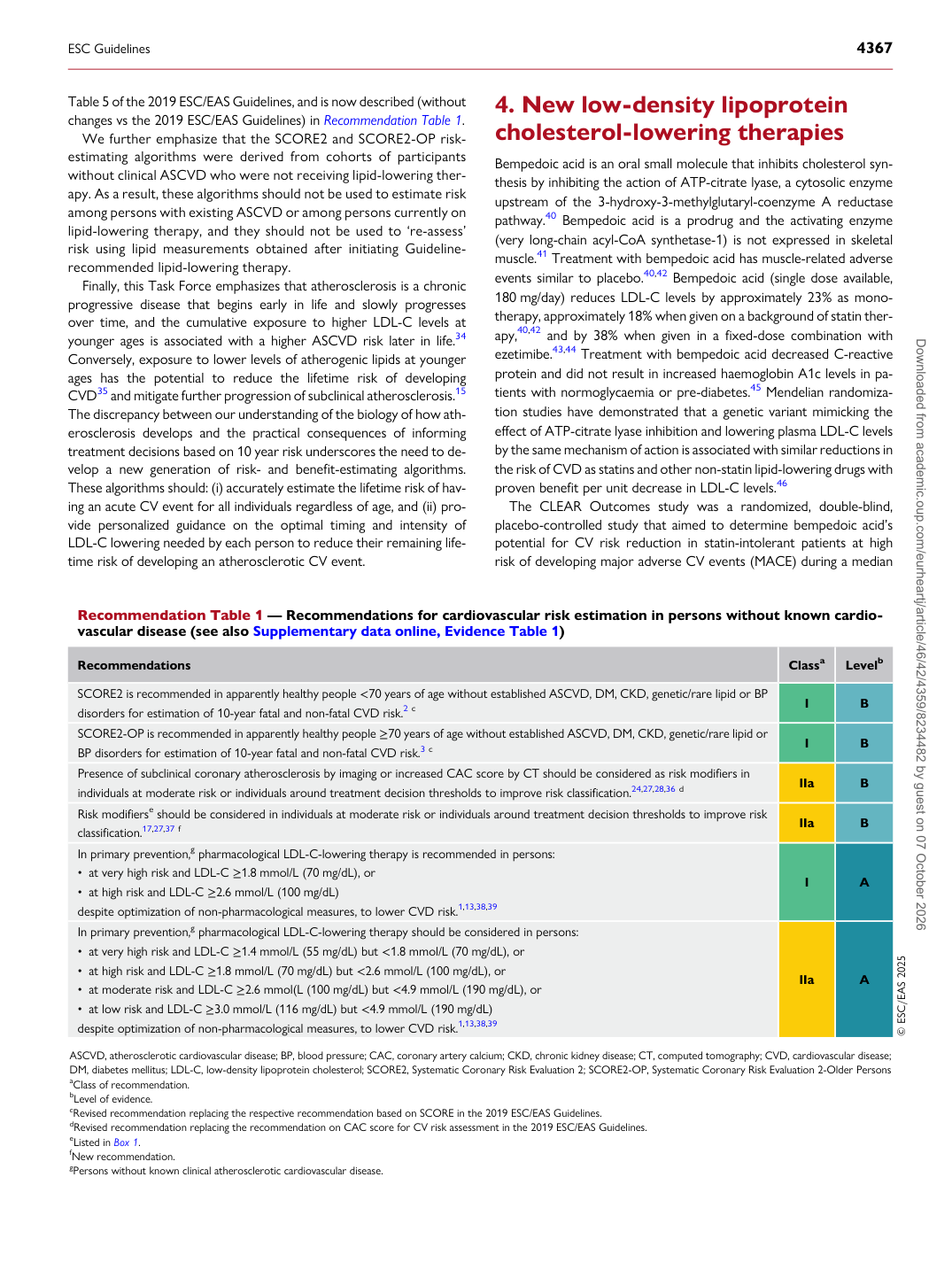
Recommendation Table 1 — Recommendations for cardiovascular risk estimation in persons without known cardiovascular disease (see also Supplementary data online, Evidence Table 1)

Recommendations Classa Levelb

SCORE2 is recommended in apparently healthy people <70 years of age without established ASCVD, DM, CKD, genetic/rare lipid or BP disorders for estimation of 10-year fatal and non-fatal CVD risk.2 c I B SCORE2-OP is recommended in apparently healthy people ≥70 years of age without established ASCVD, DM, CKD, genetic/rare lipid or BP disorders for estimation of 10-year fatal and non-fatal CVD risk.3 c I B Presence of subclinical coronary atherosclerosis by imaging or increased CAC score by CT should be considered as risk modifiers in individuals at moderate risk or individuals around treatment decision thresholds to improve risk classification.24,27,28,36 d IIa B Risk modifierse should be considered in individuals at moderate risk or individuals around treatment decision thresholds to improve risk classification.17,27,37 f IIa B In primary prevention,g pharmacological LDL-C-lowering therapy is recommended in persons: • at very high risk and LDL-C ≥1.8 mmol/L (70 mg/dL), or • at high risk and LDL-C ≥2.6 mmol/L (100 mg/dL) despite optimization of non-pharmacological measures, to lower CVD risk.1,13,38,39 I A In primary prevention,g pharmacological LDL-C-lowering therapy should be considered in persons: • at very high risk and LDL-C ≥1.4 mmol/L (55 mg/dL) but <1.8 mmol/L (70 mg/dL), or • at high risk and LDL-C ≥1.8 mmol/L (70 mg/dL) but <2.6 mmol/L (100 mg/dL), or • at moderate risk and LDL-C ≥2.6 mmol(L (100 mg/dL) but <4.9 mmol/L (190 mg/dL), or • at low risk and LDL-C ≥3.0 mmol/L (116 mg/dL) but <4.9 mmol/L (190 mg/dL) despite optimization of non-pharmacological measures, to lower CVD risk.1,13,38,39 IIa A © ESC/EAS 2025

ASCVD, atherosclerotic cardiovascular disease; BP, blood pressure; CAC, coronary artery calcium; CKD, chronic kidney disease; CT, computed tomography; CVD, cardiovascular disease; DM, diabetes mellitus; LDL-C, low-density lipoprotein cholesterol; SCORE2, Systematic Coronary Risk Evaluation 2; SCORE2-OP, Systematic Coronary Risk Evaluation 2-Older Persons aClass of recommendation. bLevel of evidence. cRevised recommendation replacing the respective recommendation based on SCORE in the 2019 ESC/EAS Guidelines. dRevised recommendation replacing the recommendation on CAC score for CV risk assessment in the 2019 ESC/EAS Guidelines. eListed in Box 1. fNew recommendation. gPersons without known clinical atherosclerotic cardiovascular disease.

ESC Guidelines                                                                                                                                                                                          4367

Downloaded from academic.oup.com/eurheartj/article/46/42/4359/8234482 by guest on 07 October 2026