p.6 抽出テキスト
therefore, lowering plasma LDL-C levels should be the main focus for preventing atherosclerotic CV events. In clinical practice, the concentration of circulating LDL-C that can become trapped within the artery wall is estimated by measuring plasma levels of LDL-C, which represent the total amount of cholesterol carried by low-density lipoproteins. The objective of estimating a person’s risk of having an atherosclerotic CV event is to identify individuals at elevated risk who may benefit from interventions to lower LDL-C and other modifiable causes of ASCVD. The clinical benefit of lowering LDL-C depends on the achieved LDL-C reduction; therefore, individuals with higher CV risk require more intense LDL-C lowering to achieve the same absolute level of residual CV risk while on treatment as compared with individuals with lower risk. For example, assuming an average 20% proportional (relative) reduction in risk per each mmol/L lower LDL-C,13 lowering LDL-C by 1 mmol/L (38.67 mg/dL) would reduce the risk of a person with a 20% absolute risk of having an acute atherosclerotic CV event to 16% (i.e. a 20% relative but 4% absolute risk reduction), whereas it would reduce the risk of a person with a 10% absolute risk to 8% (a 20% relative but 2% absolute risk reduction). This Focused Update continues to endorse the concept supported in the 2019 ESC/EAS Guidelines1 that a person’s estimated absolute risk of having an acute CV event should be used to guide the intensity of LDL-C lowering. We also acknowledge that the CV risk reduction achievable by a similar magnitude of lowering atherogenic lipid levels appears to be greater at younger ages.14,15 Numerous randomized trials have demonstrated that lowering LDL-C reduces the risk of both fatal and non-fatal myocardial infarctions (MI) and ischaemic strokes13 as well as ischaemic events in peripheral arterial territories.16 Therefore, because CVD morbidity (non-fatal MI and non-fatal stroke) combined with CVD mortality better reflects the total burden of ASCVD, and in line with the current 2021 ESC Guidelines on CVD prevention,17 this Focused Update endorses the use of risk scores such as SCORE2 and SCORE2-OP (instead of the SCORE algorithm) for estimation of the risk of experiencing an MI, ischaemic stroke, or fatal atherosclerotic CV event over the next 10 years in persons without known CVD aged between 40 and 89 years (Recommendation Table 1). While calculation of the SCORE was based on each person’s total cholesterol level, non-high-density lipoprotein (HDL)-cholesterol (which is calculated as total cholesterol minus HDL-C) is used as an input in the SCORE2 and SCORE2-OP risk algorithms. Moreover, while the SCORE algorithm assessed the 10 year risk of fatal CVD in persons aged up to 70 years, the SCORE2/SCORE2-OP algorithms (accessible at http://www.heartscore.org) can estimate 10 year risk for both fatal and non-fatal CV events also for apparently healthy people aged ≥70 years (up to 89 years). SCORE2 and SCORE2-OP are calibrated to four clusters of countries (low, moderate, high, and very high CVD risk) based on national CVD mortality rates;2,3 details and risk charts for these country clusters are in the 2021 ESC Guidelines on CVD prevention.17

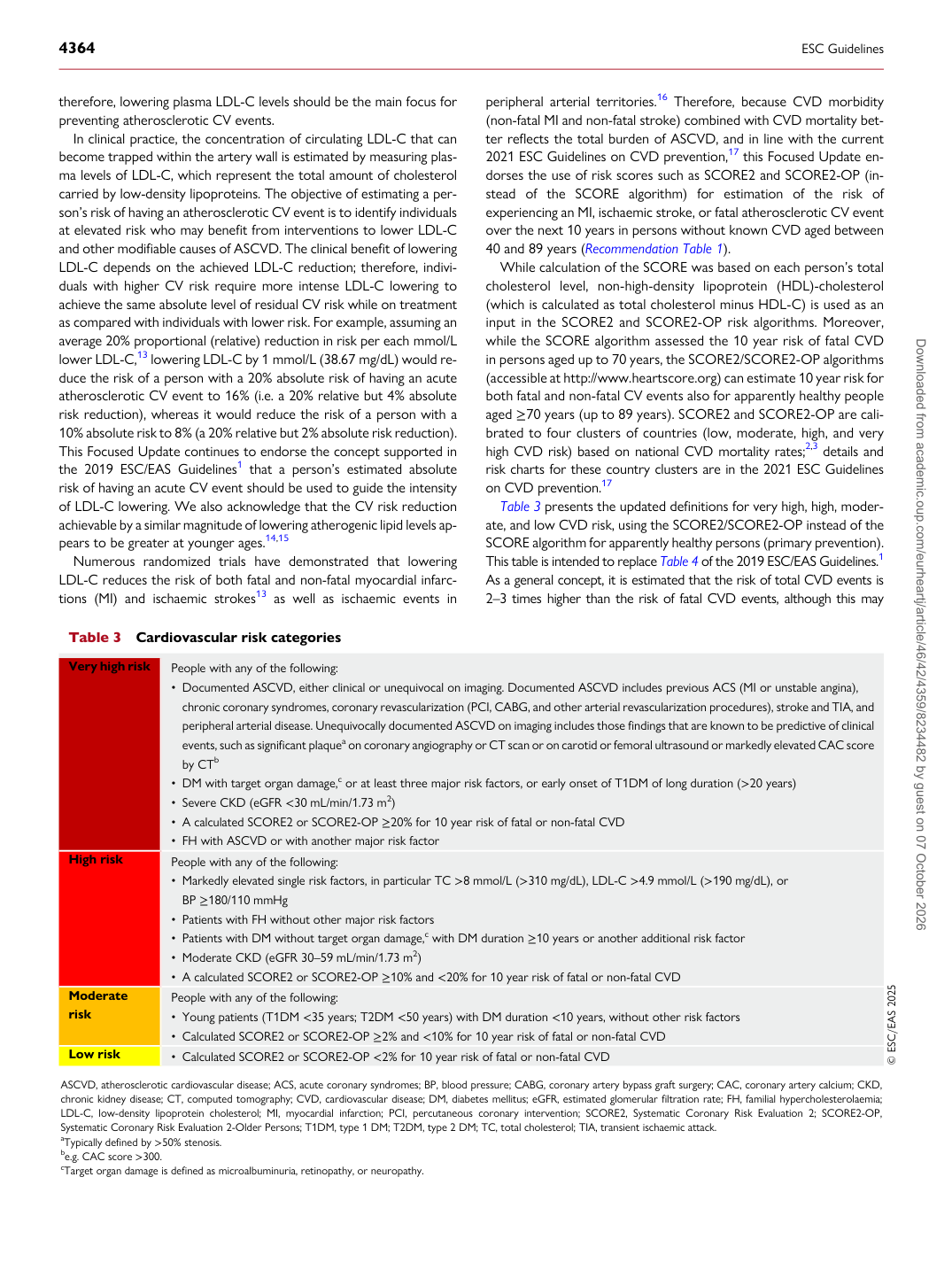
Table 3 presents the updated definitions for very high, high, moderate, and low CVD risk, using the SCORE2/SCORE2-OP instead of the SCORE algorithm for apparently healthy persons (primary prevention). This table is intended to replace Table 4 of the 2019 ESC/EAS Guidelines.1 As a general concept, it is estimated that the risk of total CVD events is 2–3 times higher than the risk of fatal CVD events, although this may

Table 3 Cardiovascular risk categories Very high risk People with any of the following:

• Documented ASCVD, either clinical or unequivocal on imaging. Documented ASCVD includes previous ACS (MI or unstable angina), chronic coronary syndromes, coronary revascularization (PCI, CABG, and other arterial revascularization procedures), stroke and TIA, and

peripheral arterial disease. Unequivocally documented ASCVD on imaging includes those findings that are known to be predictive of clinical events, such as significant plaquea on coronary angiography or CT scan or on carotid or femoral ultrasound or markedly elevated CAC score by CTb • DM with target organ damage,c or at least three major risk factors, or early onset of T1DM of long duration (>20 years) • Severe CKD (eGFR <30 mL/min/1.73 m2) • A calculated SCORE2 or SCORE2-OP ≥20% for 10 year risk of fatal or non-fatal CVD

• FH with ASCVD or with another major risk factor High risk People with any of the following:

• Markedly elevated single risk factors, in particular TC >8 mmol/L (>310 mg/dL), LDL-C >4.9 mmol/L (>190 mg/dL), or BP ≥180/110 mmHg • Patients with FH without other major risk factors • Patients with DM without target organ damage,c with DM duration ≥10 years or another additional risk factor

• Moderate CKD (eGFR 30–59 mL/min/1.73 m2) • A calculated SCORE2 or SCORE2-OP ≥10% and <20% for 10 year risk of fatal or non-fatal CVD Moderate risk People with any of the following: • Young patients (T1DM <35 years; T2DM <50 years) with DM duration <10 years, without other risk factors • Calculated SCORE2 or SCORE2-OP ≥2% and <10% for 10 year risk of fatal or non-fatal CVD Low risk • Calculated SCORE2 or SCORE2-OP <2% for 10 year risk of fatal or non-fatal CVD © ESC/EAS 2025

ASCVD, atherosclerotic cardiovascular disease; ACS, acute coronary syndromes; BP, blood pressure; CABG, coronary artery bypass graft surgery; CAC, coronary artery calcium; CKD, chronic kidney disease; CT, computed tomography; CVD, cardiovascular disease; DM, diabetes mellitus; eGFR, estimated glomerular filtration rate; FH, familial hypercholesterolaemia; LDL-C, low-density lipoprotein cholesterol; MI, myocardial infarction; PCI, percutaneous coronary intervention; SCORE2, Systematic Coronary Risk Evaluation 2; SCORE2-OP, Systematic Coronary Risk Evaluation 2-Older Persons; T1DM, type 1 DM; T2DM, type 2 DM; TC, total cholesterol; TIA, transient ischaemic attack. aTypically defined by >50% stenosis. be.g. CAC score >300. cTarget organ damage is defined as microalbuminuria, retinopathy, or neuropathy. Downloaded from academic.oup.com/eurheartj/article/46/42/4359/8234482 by guest on 07 October 2026