p.3 抽出テキスト
Tables of Recommendations

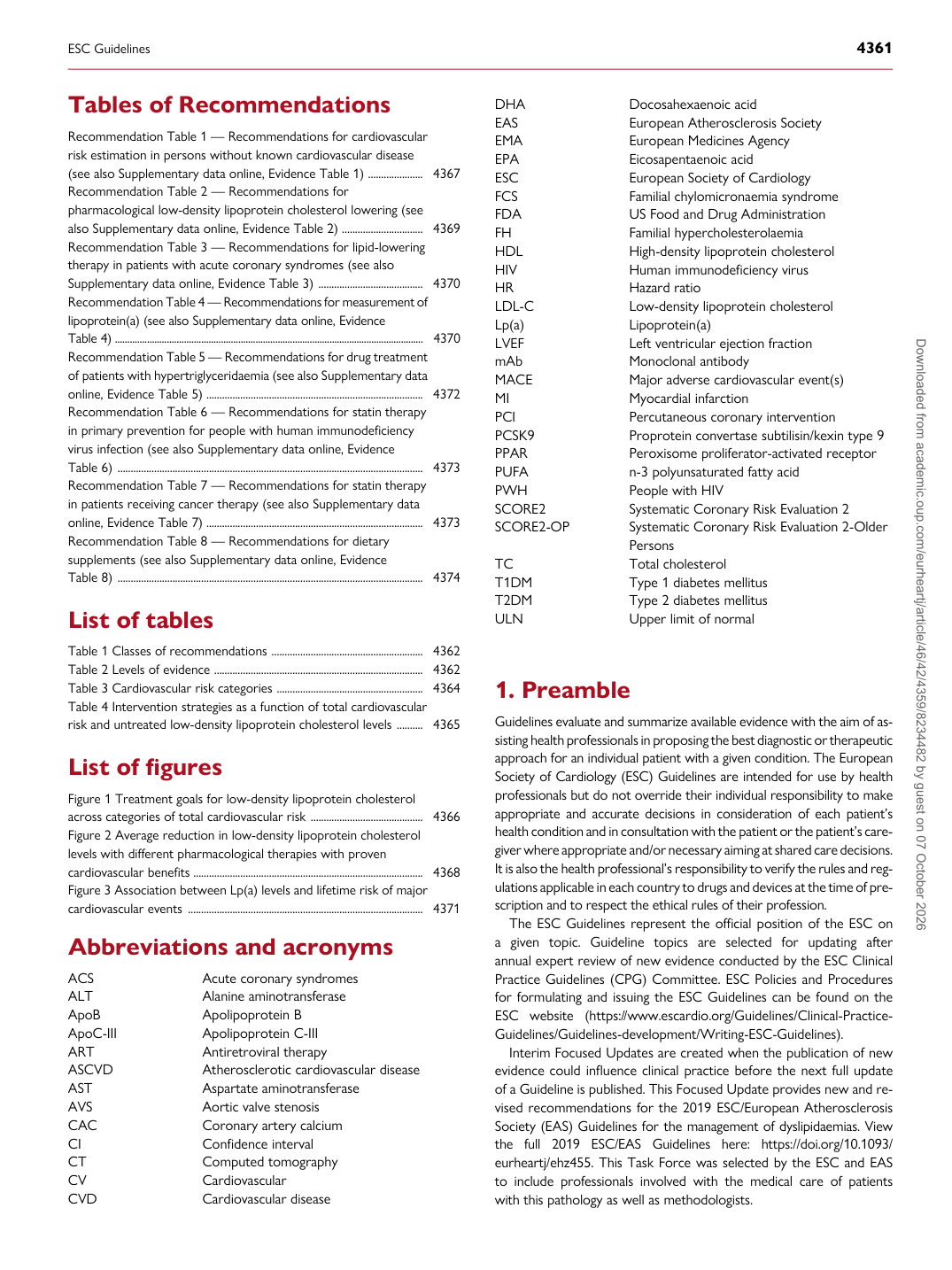
Recommendation Table 1 — Recommendations for cardiovascular risk estimation in persons without known cardiovascular disease (see also Supplementary data online, Evidence Table 1) ..................... 4367 Recommendation Table 2 — Recommendations for pharmacological low-density lipoprotein cholesterol lowering (see also Supplementary data online, Evidence Table 2) ............................... 4369 Recommendation Table 3 — Recommendations for lipid-lowering therapy in patients with acute coronary syndromes (see also Supplementary data online, Evidence Table 3) ........................................ 4370 Recommendation Table 4 — Recommendations for measurement of lipoprotein(a) (see also Supplementary data online, Evidence Table 4) ............................................................................................................................. 4370 Recommendation Table 5 — Recommendations for drug treatment of patients with hypertriglyceridaemia (see also Supplementary data online, Evidence Table 5) ................................................................................... 4372 Recommendation Table 6 — Recommendations for statin therapy in primary prevention for people with human immunodeficiency virus infection (see also Supplementary data online, Evidence Table 6) ..................................................................................................................... 4373 Recommendation Table 7 — Recommendations for statin therapy in patients receiving cancer therapy (see also Supplementary data online, Evidence Table 7) ................................................................................... 4373 Recommendation Table 8 — Recommendations for dietary supplements (see also Supplementary data online, Evidence Table 8) ..................................................................................................................... 4374

List of tables

Table 1 Classes of recommendations .......................................................... 4362 Table 2 Levels of evidence ................................................................................ 4362 Table 3 Cardiovascular risk categories ........................................................ 4364 Table 4 Intervention strategies as a function of total cardiovascular risk and untreated low-density lipoprotein cholesterol levels .......... 4365

List of figures

Figure 1 Treatment goals for low-density lipoprotein cholesterol across categories of total cardiovascular risk ........................................... 4366 Figure 2 Average reduction in low-density lipoprotein cholesterol levels with different pharmacological therapies with proven cardiovascular benefits ........................................................................................ 4368 Figure 3 Association between Lp(a) levels and lifetime risk of major cardiovascular events .......................................................................................... 4371

Abbreviations and acronyms

ACS Acute coronary syndromes ALT Alanine aminotransferase ApoB Apolipoprotein B ApoC-III Apolipoprotein C-III ART Antiretroviral therapy ASCVD Atherosclerotic cardiovascular disease AST Aspartate aminotransferase AVS Aortic valve stenosis CAC Coronary artery calcium CI Confidence interval CT Computed tomography CV Cardiovascular CVD Cardiovascular disease DHA Docosahexaenoic acid EAS European Atherosclerosis Society EMA European Medicines Agency EPA Eicosapentaenoic acid ESC European Society of Cardiology FCS Familial chylomicronaemia syndrome FDA US Food and Drug Administration FH Familial hypercholesterolaemia HDL High-density lipoprotein cholesterol HIV Human immunodeficiency virus HR Hazard ratio LDL-C Low-density lipoprotein cholesterol Lp(a) Lipoprotein(a) LVEF Left ventricular ejection fraction mAb Monoclonal antibody MACE Major adverse cardiovascular event(s) MI Myocardial infarction PCI Percutaneous coronary intervention PCSK9 Proprotein convertase subtilisin/kexin type 9 PPAR Peroxisome proliferator-activated receptor PUFA n-3 polyunsaturated fatty acid PWH People with HIV SCORE2 Systematic Coronary Risk Evaluation 2 SCORE2-OP Systematic Coronary Risk Evaluation 2-Older Persons TC Total cholesterol T1DM Type 1 diabetes mellitus T2DM Type 2 diabetes mellitus ULN Upper limit of normal

1 Preamble

Guidelines evaluate and summarize available evidence with the aim of assisting health professionals in proposing the best diagnostic or therapeutic approach for an individual patient with a given condition. The European Society of Cardiology (ESC) Guidelines are intended for use by health professionals but do not override their individual responsibility to make appropriate and accurate decisions in consideration of each patient’s health condition and in consultation with the patient or the patient’s caregiver where appropriate and/or necessary aiming at shared care decisions. It is also the health professional’s responsibility to verify the rules and regulations applicable in each country to drugs and devices at the time of prescription and to respect the ethical rules of their profession. The ESC Guidelines represent the official position of the ESC on a given topic. Guideline topics are selected for updating after annual expert review of new evidence conducted by the ESC Clinical Practice Guidelines (CPG) Committee. ESC Policies and Procedures for formulating and issuing the ESC Guidelines can be found on the ESC website (https://www.escardio.org/Guidelines/Clinical-Practice- Guidelines/Guidelines-development/Writing-ESC-Guidelines). Interim Focused Updates are created when the publication of new evidence could influence clinical practice before the next full update of a Guideline is published. This Focused Update provides new and revised recommendations for the 2019 ESC/European Atherosclerosis Society (EAS) Guidelines for the management of dyslipidaemias. View the full 2019 ESC/EAS Guidelines here: https://doi.org/10.1093/ eurheartj/ehz455. This Task Force was selected by the ESC and EAS to include professionals involved with the medical care of patients with this pathology as well as methodologists.

ESC Guidelines                                                                                                                                                                                          4361

Downloaded from academic.oup.com/eurheartj/article/46/42/4359/8234482 by guest on 07 October 2026