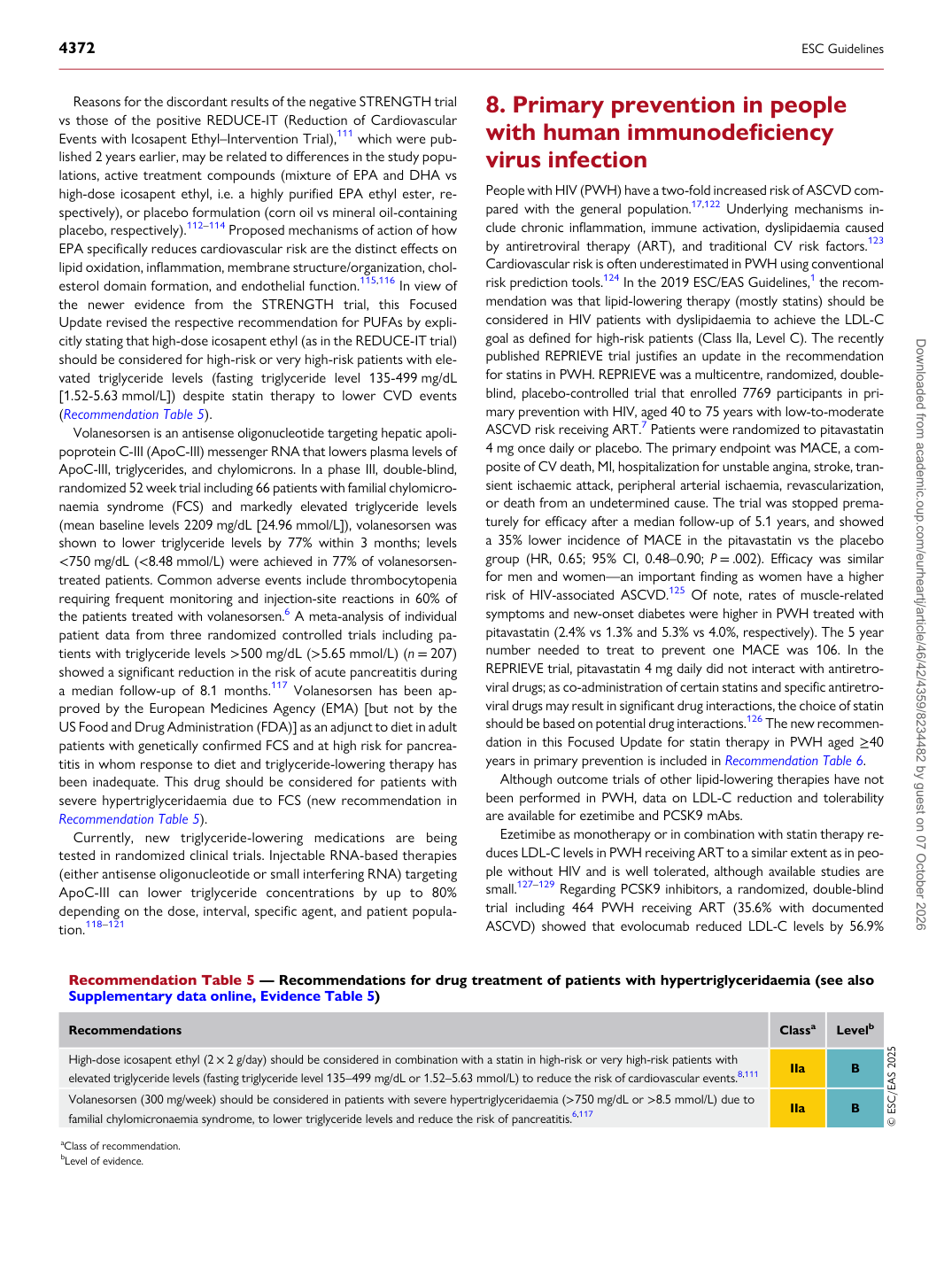
p.14 抽出テキスト
Reasons for the discordant results of the negative STRENGTH trial vs those of the positive REDUCE-IT (Reduction of Cardiovascular Events with Icosapent Ethyl–Intervention Trial),111 which were published 2 years earlier, may be related to differences in the study populations, active treatment compounds (mixture of EPA and DHA vs high-dose icosapent ethyl, i.e. a highly purified EPA ethyl ester, respectively), or placebo formulation (corn oil vs mineral oil-containing placebo, respectively).112–114 Proposed mechanisms of action of how EPA specifically reduces cardiovascular risk are the distinct effects on lipid oxidation, inflammation, membrane structure/organization, cholesterol domain formation, and endothelial function.115,116 In view of the newer evidence from the STRENGTH trial, this Focused Update revised the respective recommendation for PUFAs by explicitly stating that high-dose icosapent ethyl (as in the REDUCE-IT trial) should be considered for high-risk or very high-risk patients with elevated triglyceride levels (fasting triglyceride level 135-499 mg/dL [1.52-5.63 mmol/L]) despite statin therapy to lower CVD events (Recommendation Table 5). Volanesorsen is an antisense oligonucleotide targeting hepatic apolipoprotein C-III (ApoC-III) messenger RNA that lowers plasma levels of ApoC-III, triglycerides, and chylomicrons. In a phase III, double-blind, randomized 52 week trial including 66 patients with familial chylomicronaemia syndrome (FCS) and markedly elevated triglyceride levels (mean baseline levels 2209 mg/dL [24.96 mmol/L]), volanesorsen was shown to lower triglyceride levels by 77% within 3 months; levels <750 mg/dL (<8.48 mmol/L) were achieved in 77% of volanesorsentreated patients. Common adverse events include thrombocytopenia requiring frequent monitoring and injection-site reactions in 60% of the patients treated with volanesorsen.6 A meta-analysis of individual patient data from three randomized controlled trials including patients with triglyceride levels >500 mg/dL (>5.65 mmol/L) (n = 207) showed a significant reduction in the risk of acute pancreatitis during a median follow-up of 8.1 months.117 Volanesorsen has been approved by the European Medicines Agency (EMA) [but not by the US Food and Drug Administration (FDA)] as an adjunct to diet in adult patients with genetically confirmed FCS and at high risk for pancreatitis in whom response to diet and triglyceride-lowering therapy has been inadequate. This drug should be considered for patients with severe hypertriglyceridaemia due to FCS (new recommendation in Recommendation Table 5). Currently, new triglyceride-lowering medications are being tested in randomized clinical trials. Injectable RNA-based therapies (either antisense oligonucleotide or small interfering RNA) targeting ApoC-III can lower triglyceride concentrations by up to 80% depending on the dose, interval, specific agent, and patient population.118–121 8 Primary prevention in people

with human immunodeficiency virus infection

People with HIV (PWH) have a two-fold increased risk of ASCVD compared with the general population.17,122 Underlying mechanisms include chronic inflammation, immune activation, dyslipidaemia caused by antiretroviral therapy (ART), and traditional CV risk factors.123 Cardiovascular risk is often underestimated in PWH using conventional risk prediction tools.124 In the 2019 ESC/EAS Guidelines,1 the recommendation was that lipid-lowering therapy (mostly statins) should be considered in HIV patients with dyslipidaemia to achieve the LDL-C goal as defined for high-risk patients (Class IIa, Level C). The recently published REPRIEVE trial justifies an update in the recommendation for statins in PWH. REPRIEVE was a multicentre, randomized, doubleblind, placebo-controlled trial that enrolled 7769 participants in primary prevention with HIV, aged 40 to 75 years with low-to-moderate ASCVD risk receiving ART.7 Patients were randomized to pitavastatin 4 mg once daily or placebo. The primary endpoint was MACE, a composite of CV death, MI, hospitalization for unstable angina, stroke, transient ischaemic attack, peripheral arterial ischaemia, revascularization, or death from an undetermined cause. The trial was stopped prematurely for efficacy after a median follow-up of 5.1 years, and showed a 35% lower incidence of MACE in the pitavastatin vs the placebo group (HR, 0.65; 95% CI, 0.48–0.90; P = .002). Efficacy was similar for men and women—an important finding as women have a higher risk of HIV-associated ASCVD.125 Of note, rates of muscle-related symptoms and new-onset diabetes were higher in PWH treated with pitavastatin (2.4% vs 1.3% and 5.3% vs 4.0%, respectively). The 5 year number needed to treat to prevent one MACE was 106. In the REPRIEVE trial, pitavastatin 4 mg daily did not interact with antiretroviral drugs; as co-administration of certain statins and specific antiretroviral drugs may result in significant drug interactions, the choice of statin should be based on potential drug interactions.126 The new recommendation in this Focused Update for statin therapy in PWH aged ≥40 years in primary prevention is included in Recommendation Table 6. Although outcome trials of other lipid-lowering therapies have not been performed in PWH, data on LDL-C reduction and tolerability are available for ezetimibe and PCSK9 mAbs. Ezetimibe as monotherapy or in combination with statin therapy reduces LDL-C levels in PWH receiving ART to a similar extent as in people without HIV and is well tolerated, although available studies are small.127–129 Regarding PCSK9 inhibitors, a randomized, double-blind trial including 464 PWH receiving ART (35.6% with documented ASCVD) showed that evolocumab reduced LDL-C levels by 56.9%

Recommendation Table 5 — Recommendations for drug treatment of patients with hypertriglyceridaemia (see also Supplementary data online, Evidence Table 5)

Recommendations Classa Levelb

High-dose icosapent ethyl (2 × 2 g/day) should be considered in combination with a statin in high-risk or very high-risk patients with elevated triglyceride levels (fasting triglyceride level 135–499 mg/dL or 1.52–5.63 mmol/L) to reduce the risk of cardiovascular events.8,111 IIa B Volanesorsen (300 mg/week) should be considered in patients with severe hypertriglyceridaemia (>750 mg/dL or >8.5 mmol/L) due to familial chylomicronaemia syndrome, to lower triglyceride levels and reduce the risk of pancreatitis.6,117 IIa B © ESC/EAS 2025 aClass of recommendation. bLevel of evidence. Downloaded from academic.oup.com/eurheartj/article/46/42/4359/8234482 by guest on 07 October 2026