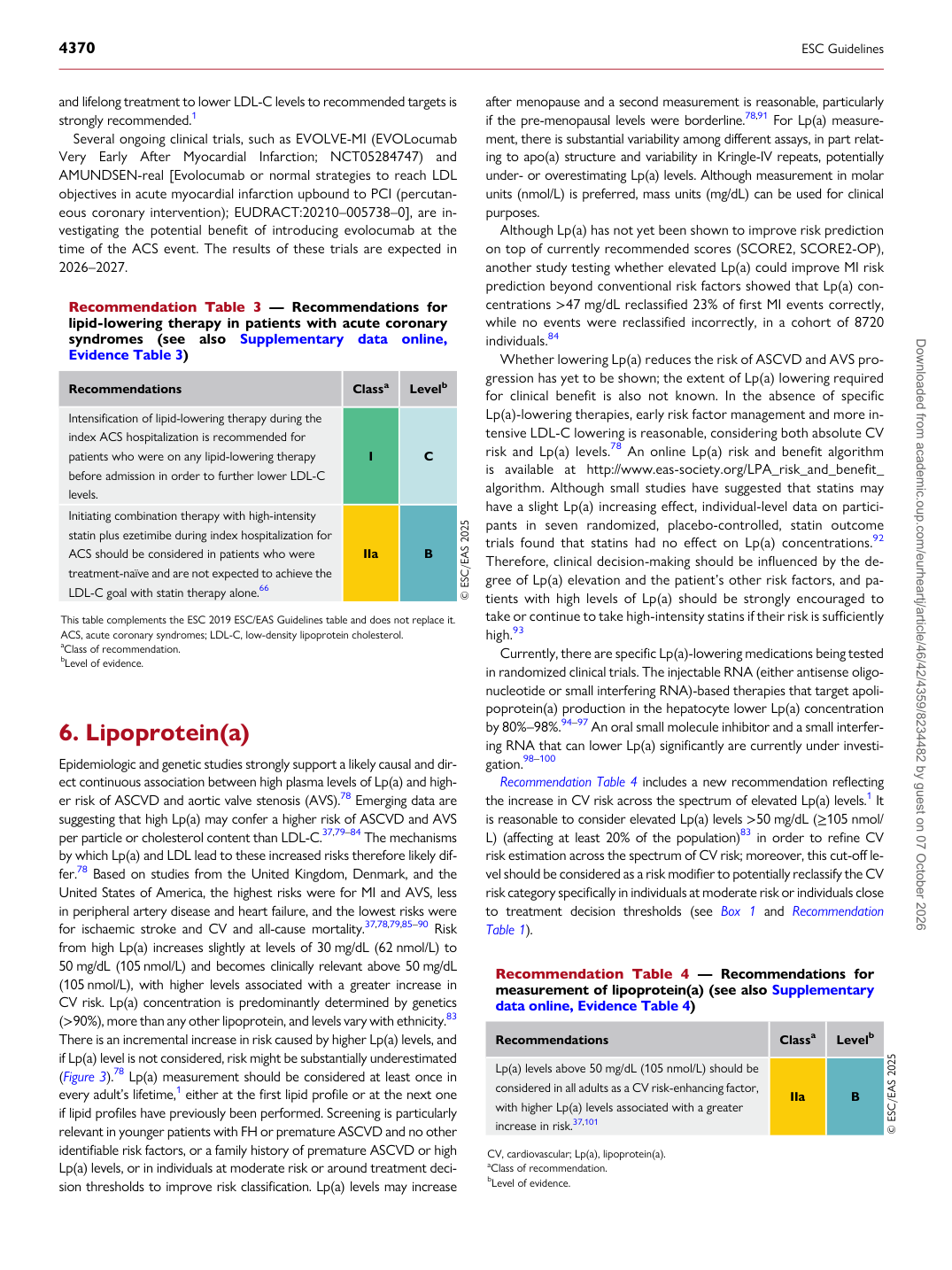
p.12 抽出テキスト
and lifelong treatment to lower LDL-C levels to recommended targets is strongly recommended.1 Several ongoing clinical trials, such as EVOLVE-MI (EVOLocumab Very Early After Myocardial Infarction; NCT05284747) and AMUNDSEN-real [Evolocumab or normal strategies to reach LDL objectives in acute myocardial infarction upbound to PCI (percutaneous coronary intervention); EUDRACT:20210–005738–0], are investigating the potential benefit of introducing evolocumab at the time of the ACS event. The results of these trials are expected in 2026–2027.

6 Lipoprotein(a)

Epidemiologic and genetic studies strongly support a likely causal and direct continuous association between high plasma levels of Lp(a) and higher risk of ASCVD and aortic valve stenosis (AVS).78 Emerging data are suggesting that high Lp(a) may confer a higher risk of ASCVD and AVS per particle or cholesterol content than LDL-C.37,79–84 The mechanisms by which Lp(a) and LDL lead to these increased risks therefore likely differ.78 Based on studies from the United Kingdom, Denmark, and the United States of America, the highest risks were for MI and AVS, less in peripheral artery disease and heart failure, and the lowest risks were for ischaemic stroke and CV and all-cause mortality.37,78,79,85–90 Risk from high Lp(a) increases slightly at levels of 30 mg/dL (62 nmol/L) to 50 mg/dL (105 nmol/L) and becomes clinically relevant above 50 mg/dL (105 nmol/L), with higher levels associated with a greater increase in CV risk. Lp(a) concentration is predominantly determined by genetics (>90%), more than any other lipoprotein, and levels vary with ethnicity.83 There is an incremental increase in risk caused by higher Lp(a) levels, and if Lp(a) level is not considered, risk might be substantially underestimated (Figure 3).78 Lp(a) measurement should be considered at least once in every adult’s lifetime,1 either at the first lipid profile or at the next one if lipid profiles have previously been performed. Screening is particularly relevant in younger patients with FH or premature ASCVD and no other identifiable risk factors, or a family history of premature ASCVD or high Lp(a) levels, or in individuals at moderate risk or around treatment decision thresholds to improve risk classification. Lp(a) levels may increase after menopause and a second measurement is reasonable, particularly if the pre-menopausal levels were borderline.78,91 For Lp(a) measurement, there is substantial variability among different assays, in part relating to apo(a) structure and variability in Kringle-IV repeats, potentially under- or overestimating Lp(a) levels. Although measurement in molar units (nmol/L) is preferred, mass units (mg/dL) can be used for clinical purposes.

Although Lp(a) has not yet been shown to improve risk prediction on top of currently recommended scores (SCORE2, SCORE2-OP), another study testing whether elevated Lp(a) could improve MI risk prediction beyond conventional risk factors showed that Lp(a) concentrations >47 mg/dL reclassified 23% of first MI events correctly, while no events were reclassified incorrectly, in a cohort of 8720 individuals.84 Whether lowering Lp(a) reduces the risk of ASCVD and AVS progression has yet to be shown; the extent of Lp(a) lowering required for clinical benefit is also not known. In the absence of specific Lp(a)-lowering therapies, early risk factor management and more intensive LDL-C lowering is reasonable, considering both absolute CV risk and Lp(a) levels.78 An online Lp(a) risk and benefit algorithm is available at http://www.eas-society.org/LPA_risk_and_benefit_ algorithm. Although small studies have suggested that statins may have a slight Lp(a) increasing effect, individual-level data on participants in seven randomized, placebo-controlled, statin outcome trials found that statins had no effect on Lp(a) concentrations.92 Therefore, clinical decision-making should be influenced by the degree of Lp(a) elevation and the patient’s other risk factors, and patients with high levels of Lp(a) should be strongly encouraged to take or continue to take high-intensity statins if their risk is sufficiently high.93 Currently, there are specific Lp(a)-lowering medications being tested in randomized clinical trials. The injectable RNA (either antisense oligonucleotide or small interfering RNA)-based therapies that target apolipoprotein(a) production in the hepatocyte lower Lp(a) concentration by 80%–98%.94–97 An oral small molecule inhibitor and a small interfering RNA that can lower Lp(a) significantly are currently under investigation.98–100 Recommendation Table 4 includes a new recommendation reflecting the increase in CV risk across the spectrum of elevated Lp(a) levels.1 It is reasonable to consider elevated Lp(a) levels >50 mg/dL (≥105 nmol/ L) (affecting at least 20% of the population)83 in order to refine CV risk estimation across the spectrum of CV risk; moreover, this cut-off level should be considered as a risk modifier to potentially reclassify the CV risk category specifically in individuals at moderate risk or individuals close to treatment decision thresholds (see Box 1 and Recommendation Table 1).

Recommendation Table 3 — Recommendations for lipid-lowering therapy in patients with acute coronary syndromes (see also Supplementary data online, Evidence Table 3)

Recommendations Classa Levelb

Intensification of lipid-lowering therapy during the index ACS hospitalization is recommended for patients who were on any lipid-lowering therapy before admission in order to further lower LDL-C levels. I C Initiating combination therapy with high-intensity statin plus ezetimibe during index hospitalization for ACS should be considered in patients who were treatment-naïve and are not expected to achieve the LDL-C goal with statin therapy alone.66 IIa B © ESC/EAS 2025

This table complements the ESC 2019 ESC/EAS Guidelines table and does not replace it. ACS, acute coronary syndromes; LDL-C, low-density lipoprotein cholesterol. aClass of recommendation. bLevel of evidence.

Recommendation Table 4 — Recommendations for measurement of lipoprotein(a) (see also Supplementary data online, Evidence Table 4)

Recommendations Classa Levelb

Lp(a) levels above 50 mg/dL (105 nmol/L) should be considered in all adults as a CV risk-enhancing factor, with higher Lp(a) levels associated with a greater increase in risk.37,101 IIa B © ESC/EAS 2025

CV, cardiovascular; Lp(a), lipoprotein(a). aClass of recommendation. bLevel of evidence. Downloaded from academic.oup.com/eurheartj/article/46/42/4359/8234482 by guest on 07 October 2026