p.11 抽出テキスト
aged ≥75 years without history of coronary artery disease was provided in the randomized, open-label EWTOPIA 75 (Ezetimibe Lipid-Lowering Trial on Prevention of Atherosclerotic Cardiovascular Disease in 75 or Older).52 As a general concept, this Task Force recommends to add non-statin therapies with proven cardiovascular benefit, such as ezetimibe, a PCSK9 mAb, or bempedoic acid, taken alone or in combination, to lower LDL-C if the LDL-C goals are not achieved with the maximum tolerated dose of a statin; the choice should be based on the magnitude of additional LDL-C lowering needed, patient preference, treatment availability, and cost.

5 Combination of lipid-lowering

therapies during index hospitalization for acute coronary syndromes

A clear association between intensive lipid-lowering therapies and better outcomes in patients after ACS was demonstrated two decades ago,56,57 supporting ‘the lower the better’ principle for LDL-C reduction in this clinical setting. Lipid-lowering therapy is one of the pillars of the management of these patients, both in the early post-ACS setting58 and in the chronic, stabilized period after an ACS.59 Patients experiencing ACS are at particularly elevated risk of recurrent CV events, especially within the first year after hospital discharge.60 Observational data show a 10% cumulative incidence of a second MI, a stroke, or CV death within the first 100 days after experiencing an MI,61 reaching 33% at 5 years.62 Even in an ideal post-ACS scenario, it can take up to 12 weeks for patients to receive optimal LDL-C-lowering therapy following the current stepwise approach that was recommended in the 2019 ESC/EAS Guidelines.1 This early post-ACS period corresponds to the most vulnerable phase after a major coronary event. Observational data show that Guideline-directed, intensive lipid-lowering therapy is infrequently prescribed, with few dose adjustments performed after hospital discharge,63 and that the majority of patients do not achieve their goals.17,64,65 The reasons for this are multifactorial and may include prescription inertia (prescription of lower-intensity statin), suboptimal patient adherence related to side effects of lipid-lowering therapies or reluctance to being treated with statins,59 and delays or losses to follow-up after discharge from index hospitalization.

The IMPROVE-IT (Improved Reduction of Outcomes: Vytorin Efficacy International Trial) study showed that the addition of ezetimibe to statin therapy (simvastatin 40 mg) within <10 days (median 5 days) after an ACS event resulted in incremental lowering of LDL-C levels and a modest but significant reduction of adverse CV events.66 Small studies have recently demonstrated that very intensive LDL-C-lowering treatment initiated in the acute phase after ACS is safe, feasible, and effective in getting more patients to recommended LDL-C goals.67–69 In addition, recent data from the HUYGENS70 (High-Resolution Assessment of Coronary Plaques in a Global Evolocumab Randomized Study) and PACMAN-AMI71 (Effects of the PCSK9 Antibody Alirocumab on Coronary Atherosclerosis in Patients With Acute Myocardial Infarction) trials reported improvements in coronary plaque size and composition in response to acute and very intensive LDL-C reduction in the vulnerable post-ACS population. A continuous reduction in CV adverse events has been described even when LDL-C reduction exceeded current Guideline-recommended treatment goals.72–74 Recent data from the SWEDEHEART (Swedish Web-system for Enhancement and Development of Evidence-based care in Heart disease Evaluated According to Recommended Therapies) Registry reported the lowest risk of CV events in those patients who achieved early and sustained LDL-C lowering to recommended goals after MI. A stepwise approach for LDL-C lowering after MI might therefore result in delayed goal attainment as compared with early intensification of treatment.75,76 These data support ‘the sooner, the lower, the better’ as a therapeutic strategy for LDL-C lowering in patients with ACS.58 As the extent of LDL-C reduction in response to pharmacological interventions is predictable based on baseline LDL-C levels, it is reasonable to assume that a significant proportion of ACS patients will not achieve their target goal with high-intensity statin treatment alone, prescribed at discharge.77 Therefore, and in line with the current 2023 ESC Guidelines for the management of patients with ACS,58 this Task Force proposes a strategy of early, intensive LDL-C lowering to be considered in all patients with ACS, with immediate initiation of statin therapy and combination treatment with one or more classes of non-statin therapy with proven CV benefit as needed, depending on each patient’s lipid-lowering therapy prior to the ACS event. The choice of drug for combination therapy should be based on the magnitude of additional LDL-C lowering required. Several drugs and drug combinations with various efficacies and onsets of action are available to enable such a ‘strike early and strong’ approach (Figure 2). Recommendation Table 3 includes two new recommendations for this clinical setting, for patients who present either with or without pre-existing lipid-lowering therapy at the time of the ACS event. Beyond the treatment in the acute ACS phase, LDL-C should be checked 4 to 6 weeks after initiation or intensification of lipid-lowering therapy,

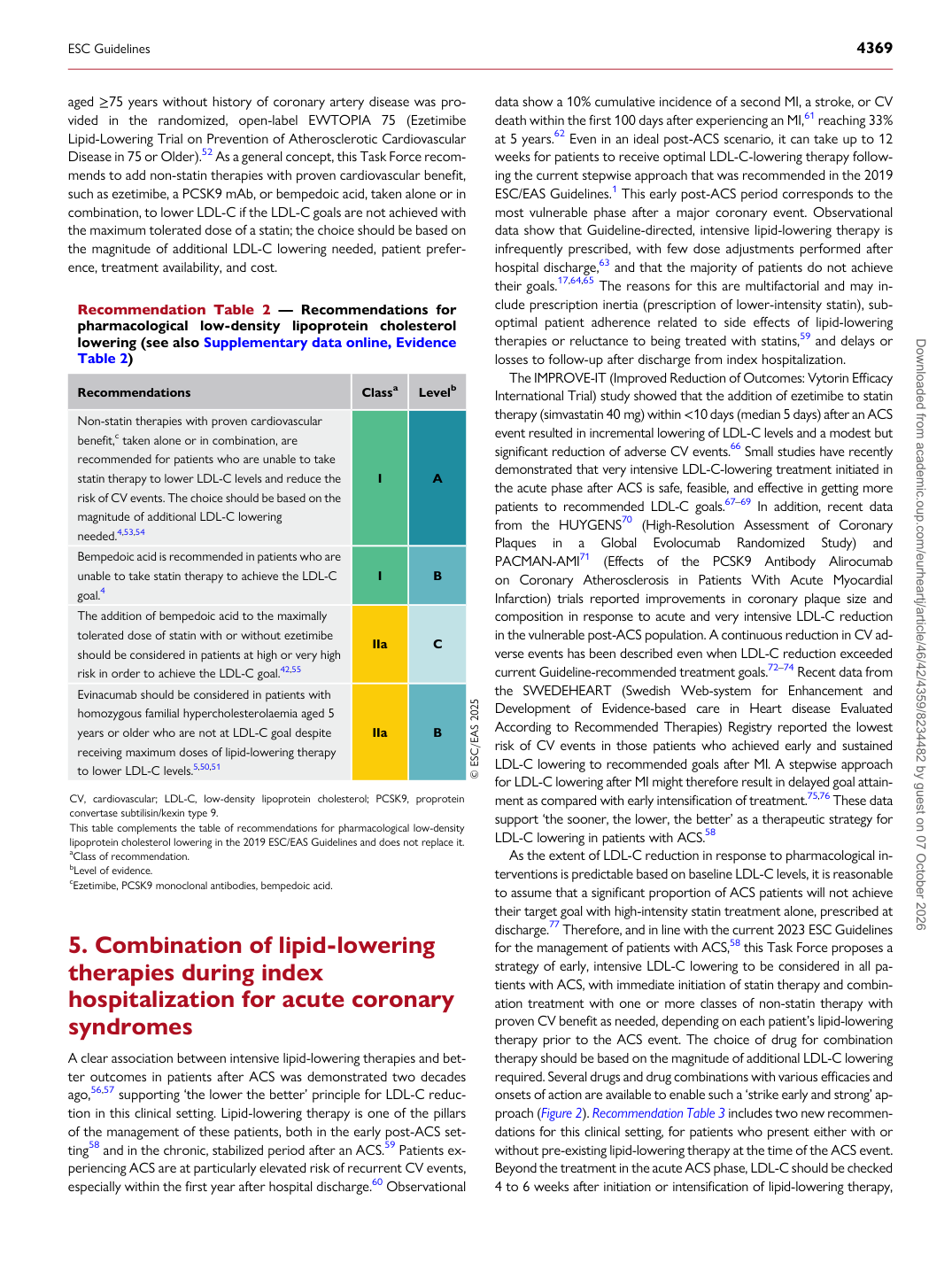
Recommendation Table 2 — Recommendations for pharmacological low-density lipoprotein cholesterol lowering (see also Supplementary data online, Evidence Table 2)

Recommendations Classa Levelb

Non-statin therapies with proven cardiovascular benefit,c taken alone or in combination, are recommended for patients who are unable to take statin therapy to lower LDL-C levels and reduce the risk of CV events. The choice should be based on the magnitude of additional LDL-C lowering needed.4,53,54 I A Bempedoic acid is recommended in patients who are unable to take statin therapy to achieve the LDL-C goal.4 I B The addition of bempedoic acid to the maximally tolerated dose of statin with or without ezetimibe should be considered in patients at high or very high risk in order to achieve the LDL-C goal.42,55 IIa C Evinacumab should be considered in patients with homozygous familial hypercholesterolaemia aged 5 years or older who are not at LDL-C goal despite receiving maximum doses of lipid-lowering therapy to lower LDL-C levels.5,50,51 IIa B © ESC/EAS 2025

CV, cardiovascular; LDL-C, low-density lipoprotein cholesterol; PCSK9, proprotein convertase subtilisin/kexin type 9. This table complements the table of recommendations for pharmacological low-density lipoprotein cholesterol lowering in the 2019 ESC/EAS Guidelines and does not replace it. aClass of recommendation. bLevel of evidence. cEzetimibe, PCSK9 monoclonal antibodies, bempedoic acid.

ESC Guidelines                                                                                                                                                                                          4369

Downloaded from academic.oup.com/eurheartj/article/46/42/4359/8234482 by guest on 07 October 2026