p.97 抽出テキスト
(27%–49%) to requiring a second intervention than patients undergoing surgical repair.1379,1380 However, need for re-intervention at follow-up (after initial treatment of AAD) seems to have a significant impact on survival for TAAD1381 but not for TBAD.1380

9.3.7.1 Follow-up after invasive treatment

Following surgery for AAS, imaging surveillance will focus on persistence/obliteration of the FL, anastomotic dehiscence, progressive dilatation of residual native aorta (with or without residual dissection), or graft infection. CCT is the most used modality, but in patients requiring frequent examinations CMR can be considered to reduce radiation.

Compared with outcomes of open surgery for aortic aneurysms, time to re-intervention in patients developing complications is significantly shorter,1159 also due to the faster average growth of the dissected aorta (about 1 mm per year).70 Considering the reported incidence rates (around 10%) of complications requiring re-operation, it is reasonable to follow patients every 6 months in the first year (including an early—within 1 month—echocardiography to follow native or prosthetic aortic valve function), then yearly up to the third post-operative

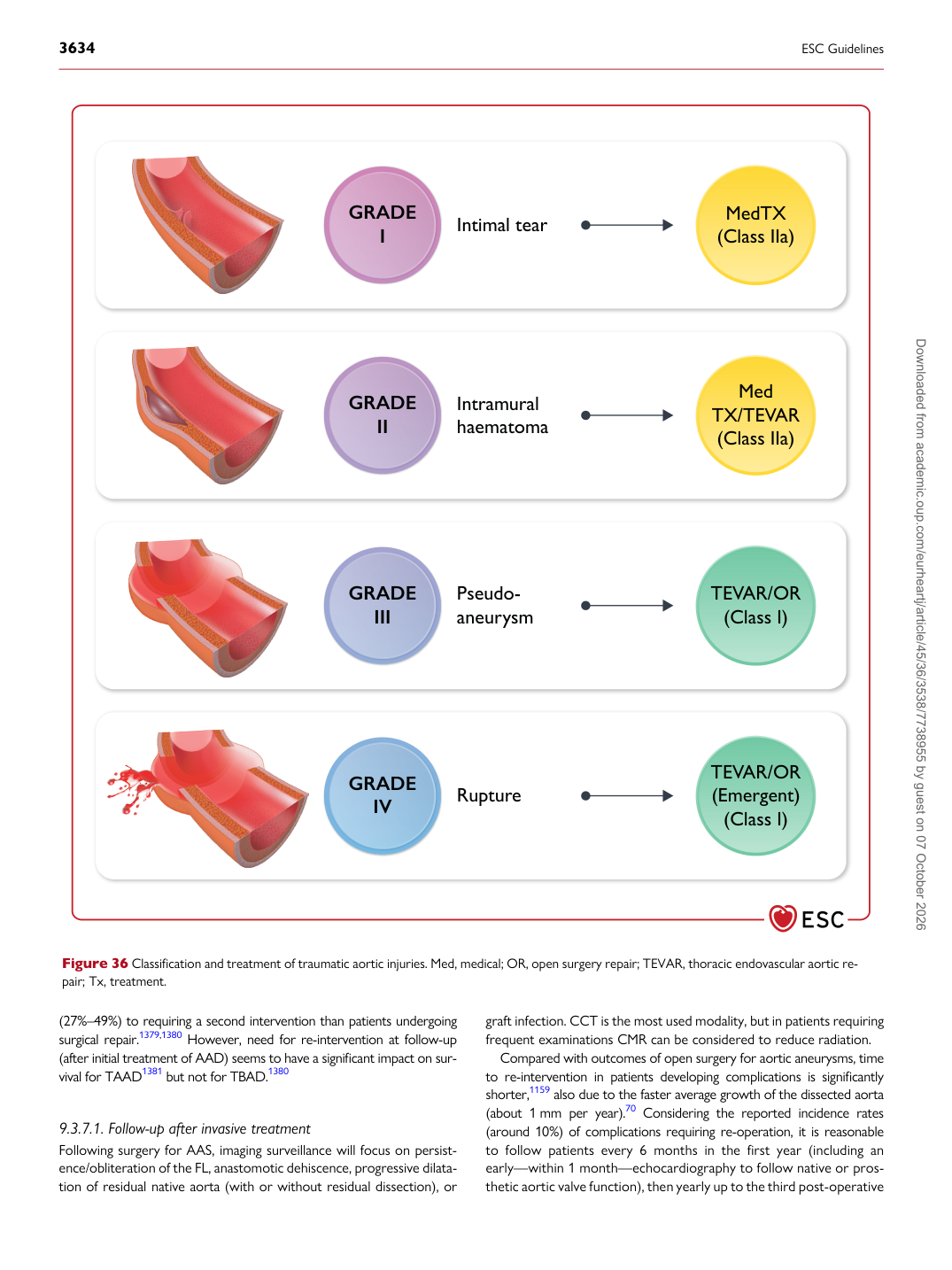
GRADE

I

GRADE

II

GRADE

III

GRADE

IV MedTX (Class IIa)

Med TX/TEVAR

(Class IIa)

TEVAR/OR

(Class I)

TEVAR/OR (Emergent)

(Class I)

Intimal tear

Intramural haematoma

Pseudoaneurysm

Rupture

Figure 36 Classification and treatment of traumatic aortic injuries. Med, medical; OR, open surgery repair; TEVAR, thoracic endovascular aortic repair; Tx, treatment. Downloaded from academic.oup.com/eurheartj/article/45/36/3538/7738955 by guest on 07 October 2026