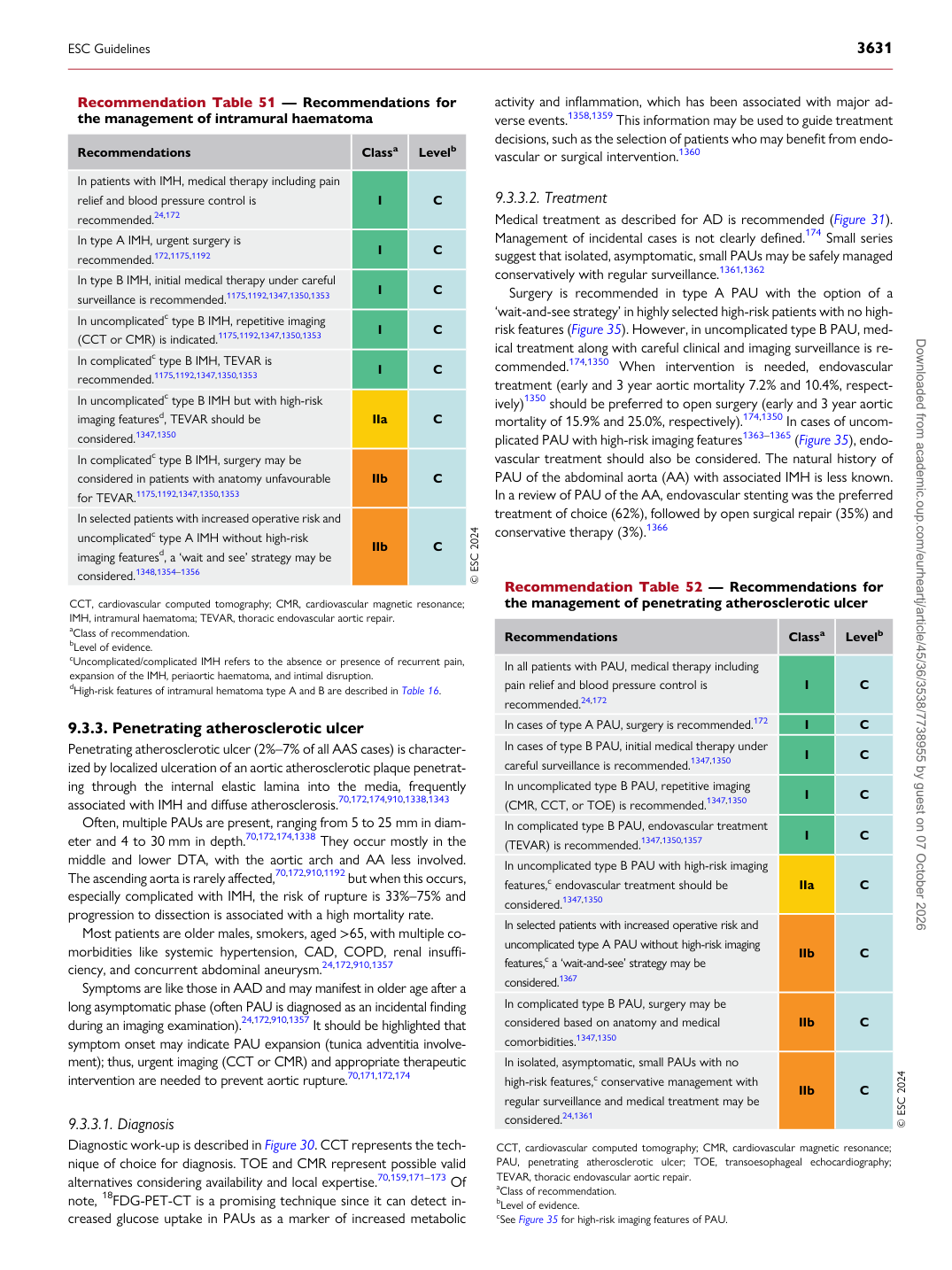
p.94 抽出テキスト
9.3.3 Penetrating atherosclerotic ulcer

Penetrating atherosclerotic ulcer (2%–7% of all AAS cases) is characterized by localized ulceration of an aortic atherosclerotic plaque penetrating through the internal elastic lamina into the media, frequently associated with IMH and diffuse atherosclerosis.70,172,174,910,1338,1343 Often, multiple PAUs are present, ranging from 5 to 25 mm in diameter and 4 to 30 mm in depth.70,172,174,1338 They occur mostly in the middle and lower DTA, with the aortic arch and AA less involved. The ascending aorta is rarely affected,70,172,910,1192 but when this occurs, especially complicated with IMH, the risk of rupture is 33%–75% and progression to dissection is associated with a high mortality rate. Most patients are older males, smokers, aged >65, with multiple comorbidities like systemic hypertension, CAD, COPD, renal insufficiency, and concurrent abdominal aneurysm.24,172,910,1357 Symptoms are like those in AAD and may manifest in older age after a long asymptomatic phase (often PAU is diagnosed as an incidental finding during an imaging examination).24,172,910,1357 It should be highlighted that symptom onset may indicate PAU expansion (tunica adventitia involvement); thus, urgent imaging (CCT or CMR) and appropriate therapeutic intervention are needed to prevent aortic rupture.70,171,172,174

9.3.3.1 Diagnosis

Diagnostic work-up is described in Figure 30. CCT represents the technique of choice for diagnosis. TOE and CMR represent possible valid alternatives considering availability and local expertise.70,159,171–173 Of note, 18FDG-PET-CT is a promising technique since it can detect increased glucose uptake in PAUs as a marker of increased metabolic activity and inflammation, which has been associated with major adverse events.1358,1359 This information may be used to guide treatment decisions, such as the selection of patients who may benefit from endovascular or surgical intervention.1360

9.3.3.2 Treatment

Medical treatment as described for AD is recommended (Figure 31). Management of incidental cases is not clearly defined.174 Small series suggest that isolated, asymptomatic, small PAUs may be safely managed conservatively with regular surveillance.1361,1362 Surgery is recommended in type A PAU with the option of a ‘wait-and-see strategy’ in highly selected high-risk patients with no highrisk features (Figure 35). However, in uncomplicated type B PAU, medical treatment along with careful clinical and imaging surveillance is recommended.174,1350 When intervention is needed, endovascular treatment (early and 3 year aortic mortality 7.2% and 10.4%, respectively)1350 should be preferred to open surgery (early and 3 year aortic mortality of 15.9% and 25.0%, respectively).174,1350 In cases of uncomplicated PAU with high-risk imaging features1363–1365 (Figure 35), endovascular treatment should also be considered. The natural history of PAU of the abdominal aorta (AA) with associated IMH is less known. In a review of PAU of the AA, endovascular stenting was the preferred treatment of choice (62%), followed by open surgical repair (35%) and conservative therapy (3%).1366

Recommendation Table 51 — Recommendations for the management of intramural haematoma

Recommendations Classa Levelb

In patients with IMH, medical therapy including pain relief and blood pressure control is recommended.24,172 I C In type A IMH, urgent surgery is recommended.172,1175,1192 I C In type B IMH, initial medical therapy under careful surveillance is recommended.1175,1192,1347,1350,1353 I C In uncomplicatedc type B IMH, repetitive imaging (CCT or CMR) is indicated.1175,1192,1347,1350,1353 I C In complicatedc type B IMH, TEVAR is recommended.1175,1192,1347,1350,1353 I C In uncomplicatedc type B IMH but with high-risk imaging featuresd, TEVAR should be considered.1347,1350 IIa C In complicatedc type B IMH, surgery may be considered in patients with anatomy unfavourable for TEVAR.1175,1192,1347,1350,1353 IIb C In selected patients with increased operative risk and uncomplicatedc type A IMH without high-risk imaging featuresd, a ‘wait and see’ strategy may be considered.1348,1354–1356 IIb C © ESC 2024

CCT, cardiovascular computed tomography; CMR, cardiovascular magnetic resonance; IMH, intramural haematoma; TEVAR, thoracic endovascular aortic repair. aClass of recommendation. bLevel of evidence. cUncomplicated/complicated IMH refers to the absence or presence of recurrent pain, expansion of the IMH, periaortic haematoma, and intimal disruption. dHigh-risk features of intramural hematoma type A and B are described in Table 16. Recommendation Table 52 — Recommendations for the management of penetrating atherosclerotic ulcer

Recommendations Classa Levelb

In all patients with PAU, medical therapy including pain relief and blood pressure control is recommended.24,172 I C In cases of type A PAU, surgery is recommended.172 I C In cases of type B PAU, initial medical therapy under careful surveillance is recommended.1347,1350 I C In uncomplicated type B PAU, repetitive imaging (CMR, CCT, or TOE) is recommended.1347,1350 I C In complicated type B PAU, endovascular treatment (TEVAR) is recommended.1347,1350,1357 I C In uncomplicated type B PAU with high-risk imaging features,c endovascular treatment should be considered.1347,1350 IIa C In selected patients with increased operative risk and uncomplicated type A PAU without high-risk imaging features,c a ‘wait-and-see’ strategy may be considered.1367 IIb C In complicated type B PAU, surgery may be considered based on anatomy and medical comorbidities.1347,1350 IIb C In isolated, asymptomatic, small PAUs with no high-risk features,c conservative management with regular surveillance and medical treatment may be considered.24,1361 IIb C © ESC 2024

CCT, cardiovascular computed tomography; CMR, cardiovascular magnetic resonance; PAU, penetrating atherosclerotic ulcer; TOE, transoesophageal echocardiography; TEVAR, thoracic endovascular aortic repair. aClass of recommendation. bLevel of evidence. cSee Figure 35 for high-risk imaging features of PAU.

ESC Guidelines                                                                                                                                                                                          3631

Downloaded from academic.oup.com/eurheartj/article/45/36/3538/7738955 by guest on 07 October 2026