p.92 抽出テキスト
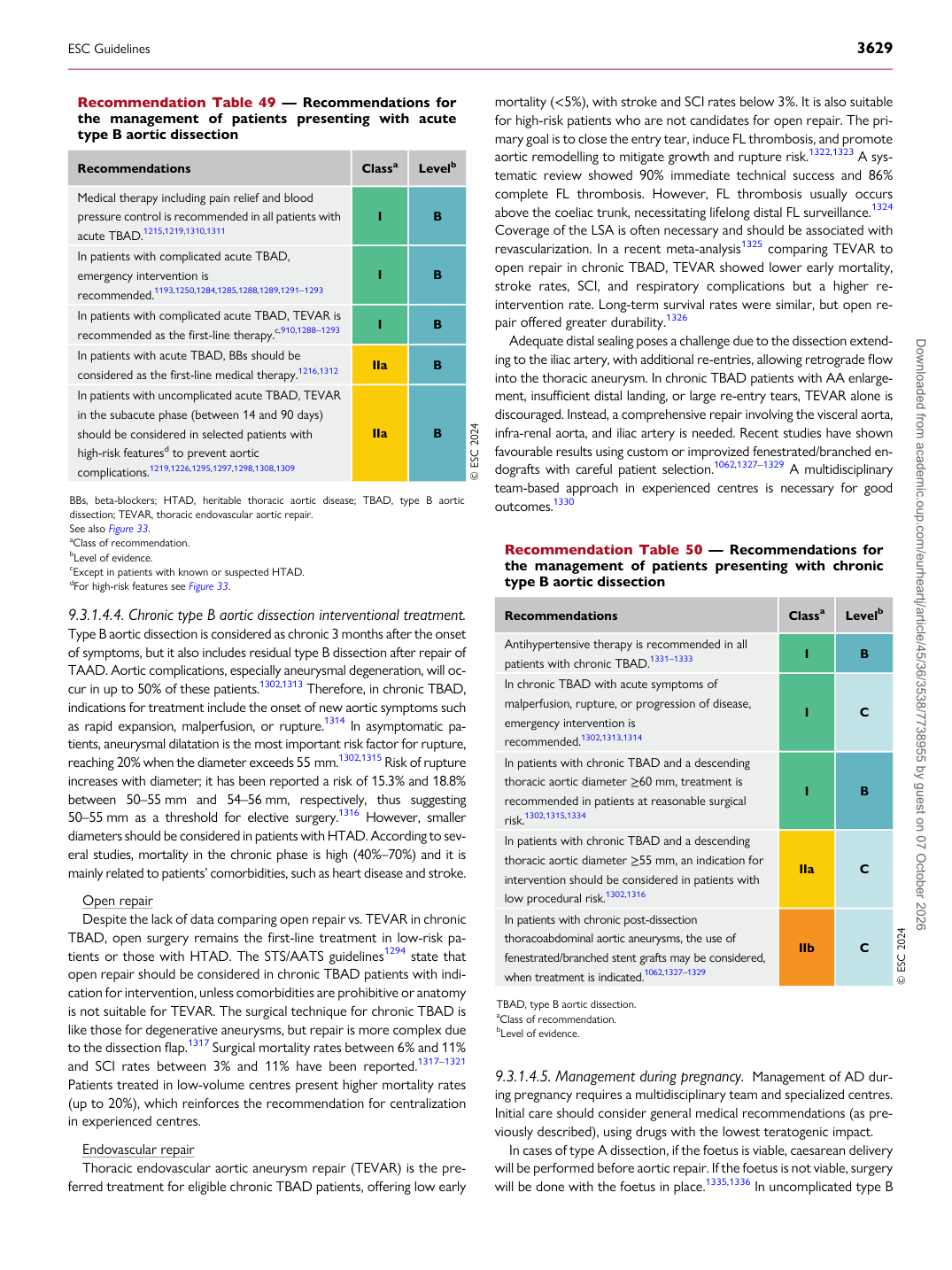
9.3.1.4.4. Chronic type B aortic dissection interventional treatment. Type B aortic dissection is considered as chronic 3 months after the onset of symptoms, but it also includes residual type B dissection after repair of TAAD. Aortic complications, especially aneurysmal degeneration, will occur in up to 50% of these patients.1302,1313 Therefore, in chronic TBAD, indications for treatment include the onset of new aortic symptoms such as rapid expansion, malperfusion, or rupture.1314 In asymptomatic patients, aneurysmal dilatation is the most important risk factor for rupture, reaching 20% when the diameter exceeds 55 mm.1302,1315 Risk of rupture increases with diameter; it has been reported a risk of 15.3% and 18.8% between 50–55 mm and 54–56 mm, respectively, thus suggesting 50–55 mm as a threshold for elective surgery.1316 However, smaller diameters should be considered in patients with HTAD. According to several studies, mortality in the chronic phase is high (40%–70%) and it is mainly related to patients’ comorbidities, such as heart disease and stroke. Open repair Despite the lack of data comparing open repair vs. TEVAR in chronic TBAD, open surgery remains the first-line treatment in low-risk patients or those with HTAD. The STS/AATS guidelines1294 state that open repair should be considered in chronic TBAD patients with indication for intervention, unless comorbidities are prohibitive or anatomy is not suitable for TEVAR. The surgical technique for chronic TBAD is like those for degenerative aneurysms, but repair is more complex due to the dissection flap.1317 Surgical mortality rates between 6% and 11% and SCI rates between 3% and 11% have been reported.1317–1321 Patients treated in low-volume centres present higher mortality rates (up to 20%), which reinforces the recommendation for centralization in experienced centres. Endovascular repair Thoracic endovascular aortic aneurysm repair (TEVAR) is the preferred treatment for eligible chronic TBAD patients, offering low early mortality (<5%), with stroke and SCI rates below 3%. It is also suitable for high-risk patients who are not candidates for open repair. The primary goal is to close the entry tear, induce FL thrombosis, and promote aortic remodelling to mitigate growth and rupture risk.1322,1323 A systematic review showed 90% immediate technical success and 86% complete FL thrombosis. However, FL thrombosis usually occurs above the coeliac trunk, necessitating lifelong distal FL surveillance.1324

Coverage of the LSA is often necessary and should be associated with revascularization. In a recent meta-analysis1325 comparing TEVAR to open repair in chronic TBAD, TEVAR showed lower early mortality, stroke rates, SCI, and respiratory complications but a higher reintervention rate. Long-term survival rates were similar, but open repair offered greater durability.1326 Adequate distal sealing poses a challenge due to the dissection extending to the iliac artery, with additional re-entries, allowing retrograde flow into the thoracic aneurysm. In chronic TBAD patients with AA enlargement, insufficient distal landing, or large re-entry tears, TEVAR alone is discouraged. Instead, a comprehensive repair involving the visceral aorta, infra-renal aorta, and iliac artery is needed. Recent studies have shown favourable results using custom or improvized fenestrated/branched endografts with careful patient selection.1062,1327–1329 A multidisciplinary team-based approach in experienced centres is necessary for good outcomes.1330

9.3.1.4.5 Management during pregnancy. Management of AD dur-

ing pregnancy requires a multidisciplinary team and specialized centres. Initial care should consider general medical recommendations (as previously described), using drugs with the lowest teratogenic impact. In cases of type A dissection, if the foetus is viable, caesarean delivery will be performed before aortic repair. If the foetus is not viable, surgery will be done with the foetus in place.1335,1336 In uncomplicated type B

Recommendation Table 49 — Recommendations for the management of patients presenting with acute type B aortic dissection

Recommendations Classa Levelb

Medical therapy including pain relief and blood pressure control is recommended in all patients with acute TBAD.1215,1219,1310,1311 I B In patients with complicated acute TBAD, emergency intervention is recommended.1193,1250,1284,1285,1288,1289,1291–1293 I B In patients with complicated acute TBAD, TEVAR is recommended as the first-line therapy.c,910,1288–1293 I B In patients with acute TBAD, BBs should be considered as the first-line medical therapy.1216,1312 IIa B In patients with uncomplicated acute TBAD, TEVAR in the subacute phase (between 14 and 90 days) should be considered in selected patients with high-risk featuresd to prevent aortic complications.1219,1226,1295,1297,1298,1308,1309 IIa B © ESC 2024

BBs, beta-blockers; HTAD, heritable thoracic aortic disease; TBAD, type B aortic dissection; TEVAR, thoracic endovascular aortic repair. See also Figure 33. aClass of recommendation. bLevel of evidence. cExcept in patients with known or suspected HTAD. dFor high-risk features see Figure 33. Recommendation Table 50 — Recommendations for the management of patients presenting with chronic type B aortic dissection

Recommendations Classa Levelb

Antihypertensive therapy is recommended in all patients with chronic TBAD.1331–1333 I B In chronic TBAD with acute symptoms of malperfusion, rupture, or progression of disease, emergency intervention is recommended.1302,1313,1314 I C In patients with chronic TBAD and a descending thoracic aortic diameter ≥60 mm, treatment is recommended in patients at reasonable surgical risk.1302,1315,1334 I B In patients with chronic TBAD and a descending thoracic aortic diameter ≥55 mm, an indication for intervention should be considered in patients with low procedural risk.1302,1316 IIa C In patients with chronic post-dissection thoracoabdominal aortic aneurysms, the use of fenestrated/branched stent grafts may be considered, when treatment is indicated.1062,1327–1329 IIb C © ESC 2024

TBAD, type B aortic dissection. aClass of recommendation. bLevel of evidence.

ESC Guidelines                                                                                                                                                                                          3629

Downloaded from academic.oup.com/eurheartj/article/45/36/3538/7738955 by guest on 07 October 2026