p.90 抽出テキスト
(Class I)

(Class IIa) (Class IIa)

(Class I)

Acute type A aortic dissection

Acute type B aortic dissection

Check for presence of acute type A aortic dissection complications

Aortic rupture

or CPR Tamponade

Consider pericardial drainage

Cerebral malperfusion

or stroke Mesenteric malperfusion Lower extremity

malperfusion

Invasive diagnostics  and/or percutaneous

malperfusion repair or TEVAR/EVAR

If not performed before aortic surgery and malperfusion persists, optional angiographic control and/or percutaneous malperfusion repair/TEVAR/EVAR

Direct admission to hybrid-OR with onsite aortic team Anaesthesiological monitoring and intraoperative TOE (if feasible) and preparation for surgery Immediate aortic surgery (ascending and consider aortic arch or FET based on extension)

Angiographic control and/or percutaneous malperfusion repair or TEVAR or EVAR

Check for presence of acute type B aortic dissection complications

If malperfusion persists

Aortic rupture/

tamponadea Cerebral malperfusion/strokea Mesenteric malperfusion Lower extremity

malperfusion

TEVAR or EVAR and/or percutaneous malperfusion repair

Static

thrombus

thrombus Dynamic Static + dynamic

F T

thrombus

Consider pericardial

drainage

In case of retrograde aortic dissection, immediate aortic surgery (ascending aorta, aortic arch or FET, based on extension)

Consider extra-anatomic bypass if lower extremity malperfusion persists

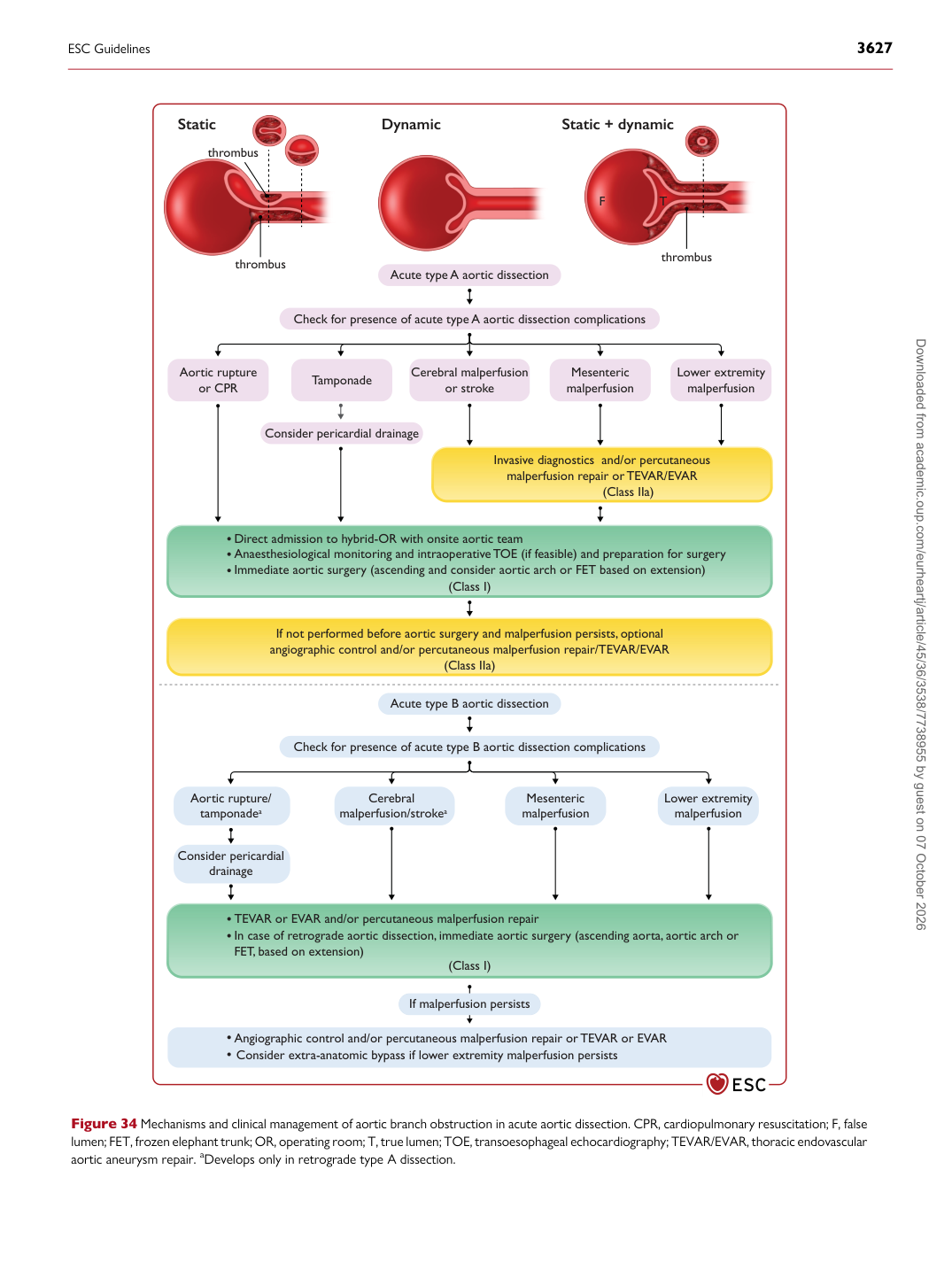
Figure 34 Mechanisms and clinical management of aortic branch obstruction in acute aortic dissection. CPR, cardiopulmonary resuscitation; F, false lumen; FET, frozen elephant trunk; OR, operating room; T, true lumen; TOE, transoesophageal echocardiography; TEVAR/EVAR, thoracic endovascular aortic aneurysm repair. aDevelops only in retrograde type A dissection.

ESC Guidelines                                                                                                                                                                                          3627

Downloaded from academic.oup.com/eurheartj/article/45/36/3538/7738955 by guest on 07 October 2026