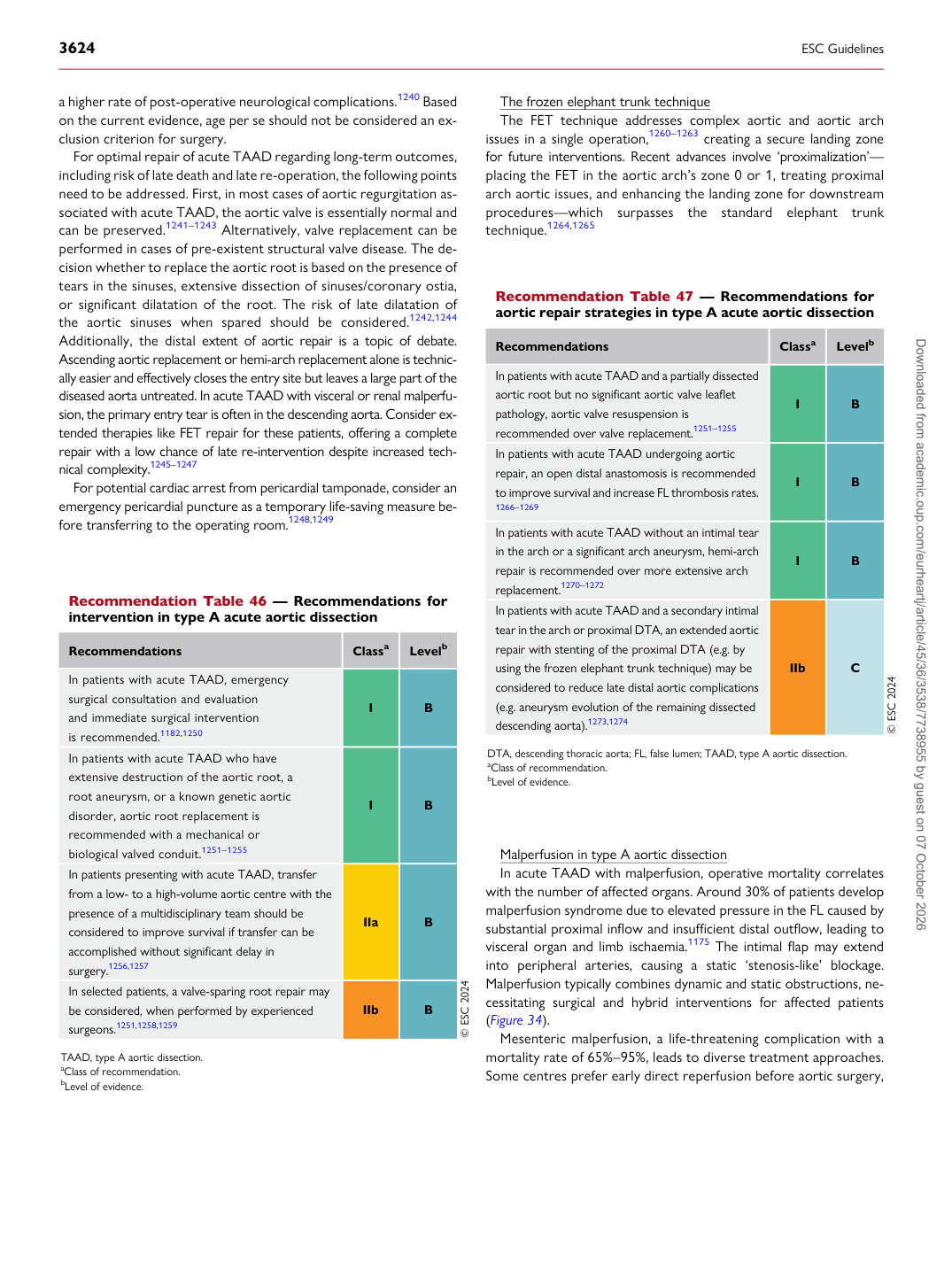
p.87 抽出テキスト
a higher rate of post-operative neurological complications.1240 Based on the current evidence, age per se should not be considered an exclusion criterion for surgery. For optimal repair of acute TAAD regarding long-term outcomes, including risk of late death and late re-operation, the following points need to be addressed. First, in most cases of aortic regurgitation associated with acute TAAD, the aortic valve is essentially normal and can be preserved.1241–1243 Alternatively, valve replacement can be performed in cases of pre-existent structural valve disease. The decision whether to replace the aortic root is based on the presence of tears in the sinuses, extensive dissection of sinuses/coronary ostia, or significant dilatation of the root. The risk of late dilatation of the aortic sinuses when spared should be considered.1242,1244 Additionally, the distal extent of aortic repair is a topic of debate. Ascending aortic replacement or hemi-arch replacement alone is technically easier and effectively closes the entry site but leaves a large part of the diseased aorta untreated. In acute TAAD with visceral or renal malperfusion, the primary entry tear is often in the descending aorta. Consider extended therapies like FET repair for these patients, offering a complete repair with a low chance of late re-intervention despite increased technical complexity.1245–1247 For potential cardiac arrest from pericardial tamponade, consider an emergency pericardial puncture as a temporary life-saving measure before transferring to the operating room.1248,1249 The frozen elephant trunk technique The FET technique addresses complex aortic and aortic arch issues in a single operation,1260–1263 creating a secure landing zone for future interventions. Recent advances involve ‘proximalization’— placing the FET in the aortic arch’s zone 0 or 1, treating proximal arch aortic issues, and enhancing the landing zone for downstream procedures—which surpasses the standard elephant trunk technique.1264,1265

Malperfusion in type A aortic dissection In acute TAAD with malperfusion, operative mortality correlates with the number of affected organs. Around 30% of patients develop malperfusion syndrome due to elevated pressure in the FL caused by substantial proximal inflow and insufficient distal outflow, leading to visceral organ and limb ischaemia.1175 The intimal flap may extend into peripheral arteries, causing a static ‘stenosis-like’ blockage. Malperfusion typically combines dynamic and static obstructions, necessitating surgical and hybrid interventions for affected patients (Figure 34). Mesenteric malperfusion, a life-threatening complication with a mortality rate of 65%–95%, leads to diverse treatment approaches. Some centres prefer early direct reperfusion before aortic surgery,

Recommendation Table 46 — Recommendations for intervention in type A acute aortic dissection

Recommendations Classa Levelb

In patients with acute TAAD, emergency surgical consultation and evaluation and immediate surgical intervention is recommended.1182,1250 I B In patients with acute TAAD who have extensive destruction of the aortic root, a root aneurysm, or a known genetic aortic disorder, aortic root replacement is recommended with a mechanical or biological valved conduit.1251–1255 I B In patients presenting with acute TAAD, transfer from a low- to a high-volume aortic centre with the presence of a multidisciplinary team should be considered to improve survival if transfer can be accomplished without significant delay in surgery.1256,1257 IIa B In selected patients, a valve-sparing root repair may be considered, when performed by experienced surgeons.1251,1258,1259 IIb B © ESC 2024

TAAD, type A aortic dissection. aClass of recommendation. bLevel of evidence. Recommendation Table 47 — Recommendations for aortic repair strategies in type A acute aortic dissection

Recommendations Classa Levelb

In patients with acute TAAD and a partially dissected aortic root but no significant aortic valve leaflet pathology, aortic valve resuspension is recommended over valve replacement.1251–1255 I B In patients with acute TAAD undergoing aortic repair, an open distal anastomosis is recommended to improve survival and increase FL thrombosis rates. 1266–1269 I B

In patients with acute TAAD without an intimal tear in the arch or a significant arch aneurysm, hemi-arch repair is recommended over more extensive arch replacement.1270–1272 I B In patients with acute TAAD and a secondary intimal tear in the arch or proximal DTA, an extended aortic repair with stenting of the proximal DTA (e.g. by using the frozen elephant trunk technique) may be considered to reduce late distal aortic complications (e.g. aneurysm evolution of the remaining dissected descending aorta).1273,1274 IIb C © ESC 2024

DTA, descending thoracic aorta; FL, false lumen; TAAD, type A aortic dissection. aClass of recommendation. bLevel of evidence. Downloaded from academic.oup.com/eurheartj/article/45/36/3538/7738955 by guest on 07 October 2026