p.86 抽出テキスト
Interventional treatment in acute TAAD and acute TBAD is described in the next sections and summarized in Figure 33.

9.3.1.4.2. Type A aortic dissection interventional treatment. Immediate surgical repair is recommended for acute TAAD, however, a high mortality rate (∼50% and 1%–2% per hour) within the first 48 h is described if managed medically only.1232 Despite advances in surgical and anaesthetic techniques, there is still a high risk of perioperative mortality (17%–25%) and neurological complications (18%).1233 In recent reports from the International Registry of Acute Aortic Dissection (IRAD), medically managed patients had a 23.7% mortality rate (0.5% per hour) compared with 4.4% (0.09% per hour) for those undergoing surgery.1234 Analyses of pre- and post-July 2007 IRAD data showed no difference in 48 h mortality for medically treated patients, but surgical mortality decreased (from 5.5% to 3.9%).1234 As surgical techniques have improved, data have shown improved post-operative survival rates.1235 The use of the GERAADA (German Registry of Acute Aortic Dissection Type A) score1236 should be considered in patients undergoing surgery to determine 30 day mortality (https://www.dgthg.de/de/GERAADA_ Score). Surgical intervention surpasses conservative therapy in long-term follow-up,1237 even for challenging cases. Thus, all acute TAAD patients should receive surgical treatment; however, cardiogenic shock secondary to pericardial tamponade, malperfusion of coronary arteries, mesenteric circulation, lower extremities, kidneys, or brain, and/ or coma are major predictors for post-operative mortality (Figure 32).1234,1238 Among octogenarians, in-hospital mortality was lower after surgery than with conservative treatment (37.9% vs. 55.2%), but with a non-significant difference due to small sample size.1239 While some have reported excellent surgical and quality of life (QoL) outcomes in elderly patients,1239 others found

(Class I)

(Class I) (Class I)

+

1

2 3

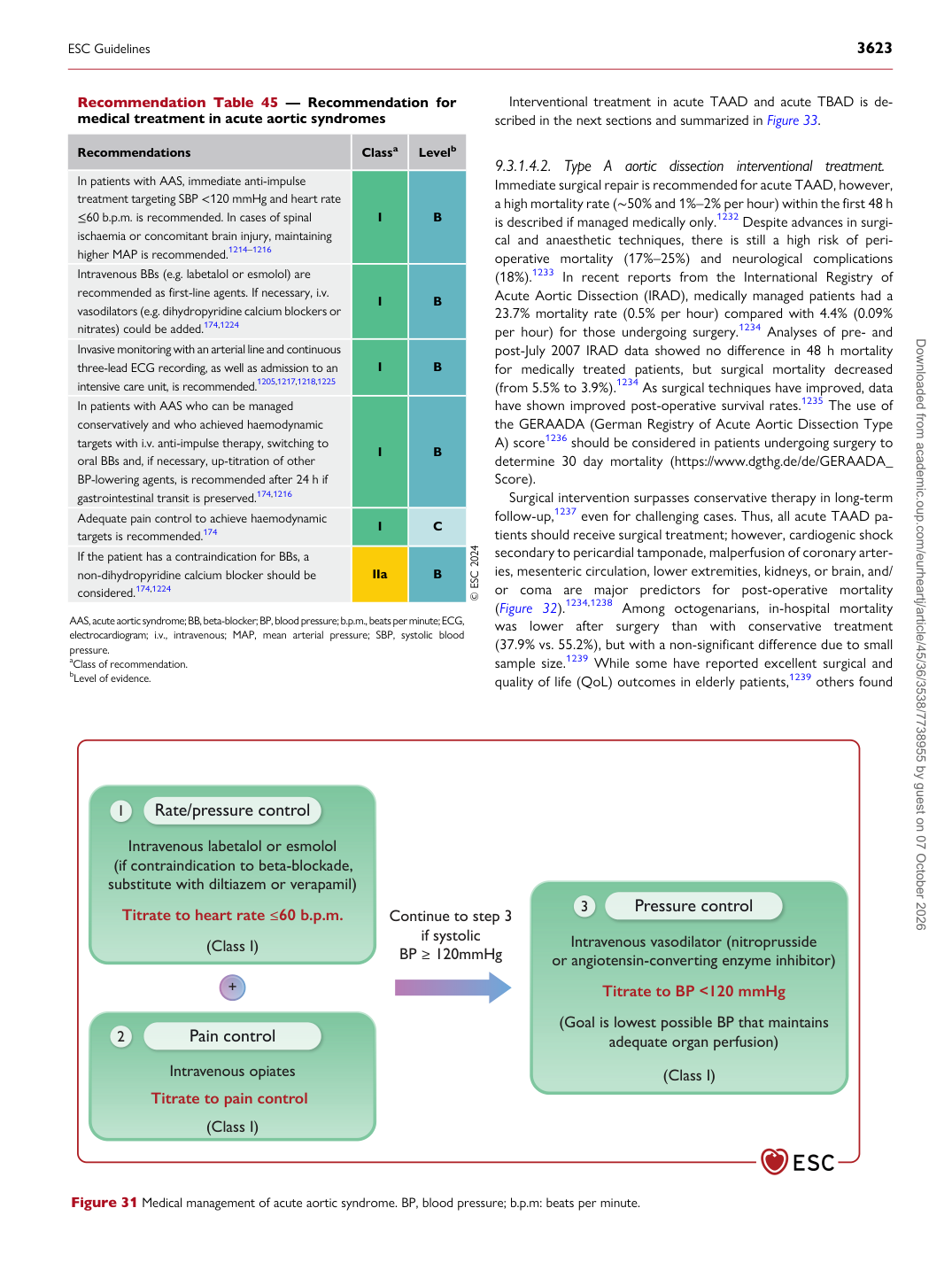
Intravenous labetalol or esmolol (if contraindication to beta-blockade, substitute with diltiazem or verapamil)

Titrate to heart rate ≤60 b.p.m.

Intravenous opiates Titrate to pain control Intravenous vasodilator (nitroprusside or angiotensin-converting enzyme inhibitor)

(Goal is lowest possible BP that maintains

adequate organ perfusion)

Continue to step 3

if systolic BP ≥ 120mmHg

Titrate to BP <120 mmHg

Rate/pressure control

Pain control Pressure control

Figure 31 Medical management of acute aortic syndrome. BP, blood pressure; b.p.m: beats per minute.

Recommendation Table 45 — Recommendation for medical treatment in acute aortic syndromes

Recommendations Classa Levelb

In patients with AAS, immediate anti-impulse treatment targeting SBP <120 mmHg and heart rate ≤60 b.p.m. is recommended. In cases of spinal ischaemia or concomitant brain injury, maintaining higher MAP is recommended.1214–1216 I B Intravenous BBs (e.g. labetalol or esmolol) are recommended as first-line agents. If necessary, i.v. vasodilators (e.g. dihydropyridine calcium blockers or nitrates) could be added.174,1224 I B Invasive monitoring with an arterial line and continuous three-lead ECG recording, as well as admission to an intensive care unit, is recommended.1205,1217,1218,1225 I B In patients with AAS who can be managed conservatively and who achieved haemodynamic targets with i.v. anti-impulse therapy, switching to oral BBs and, if necessary, up-titration of other BP-lowering agents, is recommended after 24 h if gastrointestinal transit is preserved.174,1216 I B Adequate pain control to achieve haemodynamic targets is recommended.174 I C If the patient has a contraindication for BBs, a non-dihydropyridine calcium blocker should be considered.174,1224 IIa B © ESC 2024

AAS, acute aortic syndrome; BB, beta-blocker; BP, blood pressure; b.p.m., beats per minute; ECG, electrocardiogram; i.v., intravenous; MAP, mean arterial pressure; SBP, systolic blood pressure. aClass of recommendation. bLevel of evidence.

ESC Guidelines                                                                                                                                                                                          3623

Downloaded from academic.oup.com/eurheartj/article/45/36/3538/7738955 by guest on 07 October 2026