p.78 抽出テキスト
work-up will depend on procedure risk, symptoms, and patient-specific CVRFs (see Sections 4 and 12, and the 2022 ESC Guidelines on cardiovascular assessment and management of patients undergoing non-cardiac surgery).1080 Coronary revascularization before elective aortic surgery in patients with stable cardiac symptoms cannot be recommended, since there is evidence that this strategy does not improve outcomes or reduce the 30 day MI rate.1080,1081 A complete vascular evaluation (that includes not only the AA but also the entire aorta: ascending, arch, and descending aorta) is mandatory to determine the best strategy in AAA management, CCT being, by consensus, the optimal pre-operative imaging modality.1082,1083 When CCT is contraindicated, consider CMR, though calcification assessment is challenging. Pre-operative planning should determine EVAR feasibility by sizing the aorto-iliac system, yet adherence to device-specific instructions remains uncertain.1084–1090 DUS assessment of the femoro-popliteal segment is advocated since femoropopliteal aneurysms are commonly associated with AAA.1091,1092 Additionally, the technique of choice should be discussed between the treating physician and the patient based on the patient’s life expectancy and preferences, operator and hospital volumes, and surveillance compliance.910,1093–1097 Elective AAA repair is not recommended in frail patients or those with life expectancy <2 years.1098,1099 The individual decision-making process in AAA patients is displayed in Figure 26. Different studies have demonstrated a significant short-term survival benefit for EVAR, but with similar long-term outcomes compared with open repair (up to 15 years)1100–1103 also reported in females.1104 However, loss of early benefit is associated with an increased rate of late complications occurring after 8 years, especially late ruptures.1079 These trials used earlier-generation EVAR devices, so the durability of the latest-generation devices remains uncertain. Recent data, however, suggest a reduced risk of late complications and fewer reinterventions.1105–1108

9.2.5.5.3 Open abdominal aorta aneurysm repair. Open AAA re-

pair through mid-line laparotomy (with <30 min clamping time) with a Dacron graft has been the preferred choice for years, despite notable CV morbidity1078,1100,1109–1113 and a 2%–5% mortality rate.1110,1111,1113,1114 In ruptured AAA, open repair results are worse than those of elective surgery, with an unchanged complication rate of around 48%.1115 Thus, endovascular repair is recommended to reduce peri-operative morbidity and mortality.1116–1118 Open AAA repair raises incisional hernia risk, particularly in obese patients, suggesting prophylactic mesh use in high-risk cases.1119–1121

9.2.5.5.4. Endovascular abdominal aorta aneurysm repair. Endovascular abdominal aorta aneurysm repair reduces peri-operative mortality to <1%, although it implies higher risk of re-intervention in the long term.1122–1124 Current devices offer features like active fixation, repositioning ability, low-profile design, and polymer-filled rings for improved sealing.1106,1125–1128 New devices demonstrate similar long-term outcomes with reduced re-intervention risk,1090 expanding treatment possibilities to 60%–70% of infrarenal AAA cases.1129,1130 In cases of juxta- or para-renal AAA (Figure 22), both open and endovascular treatment can be proposed in high-volume centres, with similar short- and long-term results. The choice between open surgical repair and endovascular repair depends on various factors, including the patient’s anatomy, overall health, and the extent of the aneurysm (see Table 15). In cases of complex endovascular treatment, a fenestrated or branch stent endograft should be considered.1096,1131 A percutaneous femoral approach is suitable since it provides quicker access, reduced invasiveness, and allows local anaesthesia. Some evidence supports the use of ultrasound-guided percutaneous access for EVAR due to a lower rate of access-related complications and a shorter operation time.1132–1135

As patients treated by EVAR are more prone to late complications (endoleaks, migration, or rupture) and re-interventions, lifelong surveillance is currently mandatory.1096,1136–1140

9.2.6 Endoleaks

Endoleaks are defined as the persistence of blood flow outside the graft but inside the aneurysm sac, preventing complete thrombosis (Figure 27). They are the most common complication, with an incidence up to one-third of either early or late procedures (those appearing after 1 year).1145 Chronic anticoagulation constitutes a risk factor for re-intervention, late conversion surgery, or mortality.1146 Endoleaks exposing the aneurysm sac to systemic pressure and expansion will require re-intervention to prevent rupture. Five types of endoleaks have been described, as detailed in Figure 27. Type I and type III require correction with a new (endovascular) procedure. Type II is present in about 25% of patients but may seal

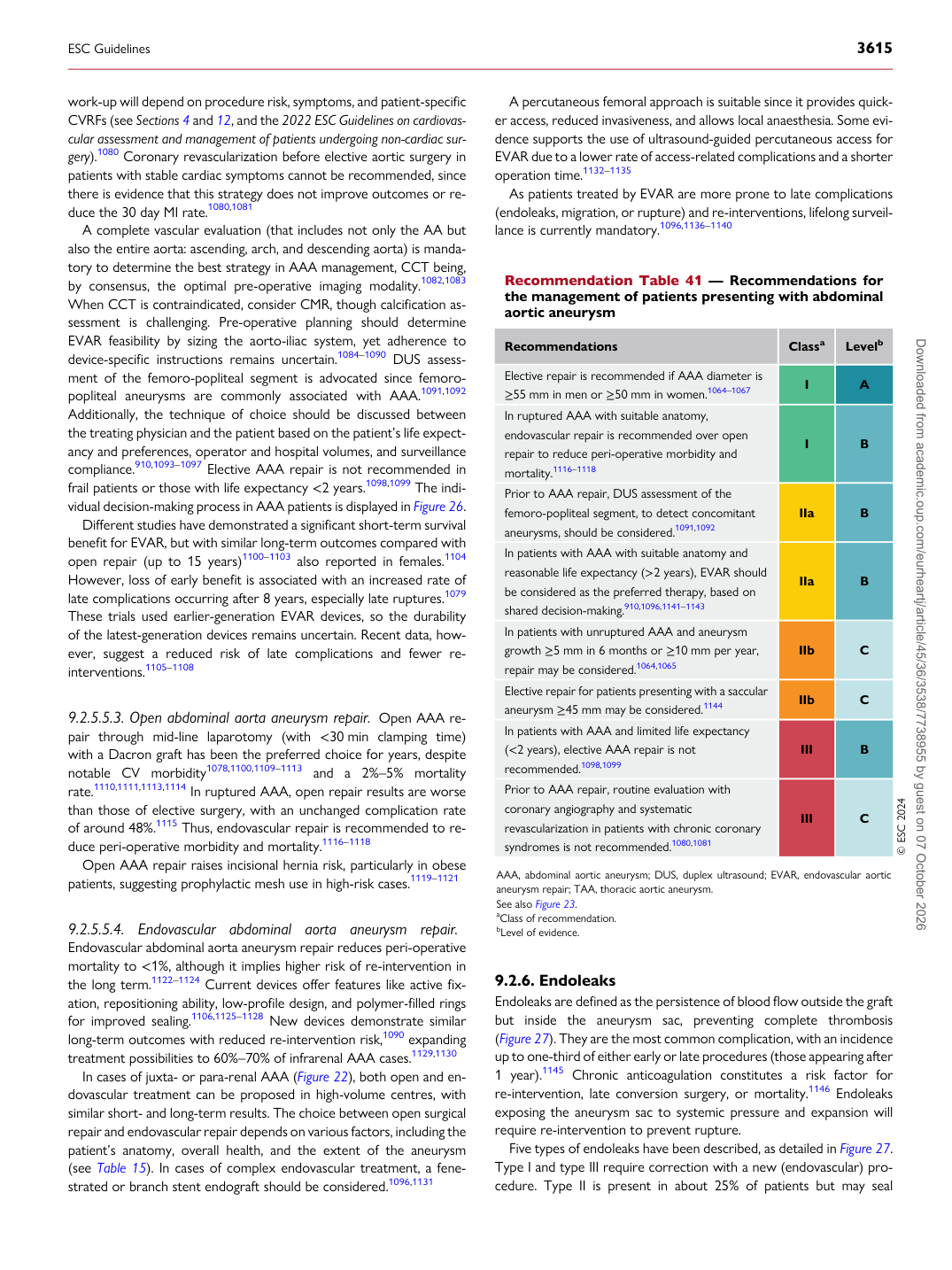
Recommendation Table 41 — Recommendations for the management of patients presenting with abdominal aortic aneurysm

Recommendations Classa Levelb

Elective repair is recommended if AAA diameter is ≥55 mm in men or ≥50 mm in women.1064–1067 I A In ruptured AAA with suitable anatomy, endovascular repair is recommended over open repair to reduce peri-operative morbidity and mortality.1116–1118 I B Prior to AAA repair, DUS assessment of the femoro-popliteal segment, to detect concomitant aneurysms, should be considered.1091,1092 IIa B In patients with AAA with suitable anatomy and reasonable life expectancy (>2 years), EVAR should be considered as the preferred therapy, based on shared decision-making.910,1096,1141–1143 IIa B In patients with unruptured AAA and aneurysm growth ≥5 mm in 6 months or ≥10 mm per year, repair may be considered.1064,1065 IIb C Elective repair for patients presenting with a saccular aneurysm ≥45 mm may be considered.1144 IIb C In patients with AAA and limited life expectancy (<2 years), elective AAA repair is not recommended.1098,1099 III B Prior to AAA repair, routine evaluation with coronary angiography and systematic revascularization in patients with chronic coronary syndromes is not recommended.1080,1081 III C © ESC 2024

AAA, abdominal aortic aneurysm; DUS, duplex ultrasound; EVAR, endovascular aortic aneurysm repair; TAA, thoracic aortic aneurysm. See also Figure 23. aClass of recommendation. bLevel of evidence.

ESC Guidelines                                                                                                                                                                                          3615

Downloaded from academic.oup.com/eurheartj/article/45/36/3538/7738955 by guest on 07 October 2026