p.76 抽出テキスト
9.2.5.5 Surgical treatment of abdominal aorta aneurysms

9.2.5.5.1. General considerations. Rupture remains the most feared AAA complication, and is associated with the maximum diameter,1063 as well as other risk factors (Figure 23). Different studies1064–1071 (including the United Kingdom Small Aneurysm Trial [UKSAT] and American Aneurysm Detection and Management [ADAM] trial) reported no benefits from open or endovascular interventions (despite lower peri-operative complication rates) in asymptomatic AAA patients with a maximal diameter <55 mm in men and <50 mm in women. Evidence that women are more likely to rupture under surveillance and at a smaller aortic diameter justified a lower (50 mm) threshold. Another interesting method to quantify the risk of rupture based on body size, which seems a better predictor in women, has been proposed.1072 However, in the absence of recent studies, thresholds for intervention have not changed in recent years. Considering the complexity of patient management, it is advisable to centralize complex procedures in centres with a high level of expertise in aortic diseases and a multidisciplinary team.

9.2.5.5.2 Pre-operative cardiovascular evaluation and choice of

treatment. Coronary artery disease is the leading cause of early mortality after AAA repair,937,1073 and is associated with a 5%–10% rate of peri-operative CV complications such as death, MI, or stroke.1074,1075 Since endovascular repair is associated with lower mortality (<1%) and CV complications,1076–1079 the need for pre-operative cardiac

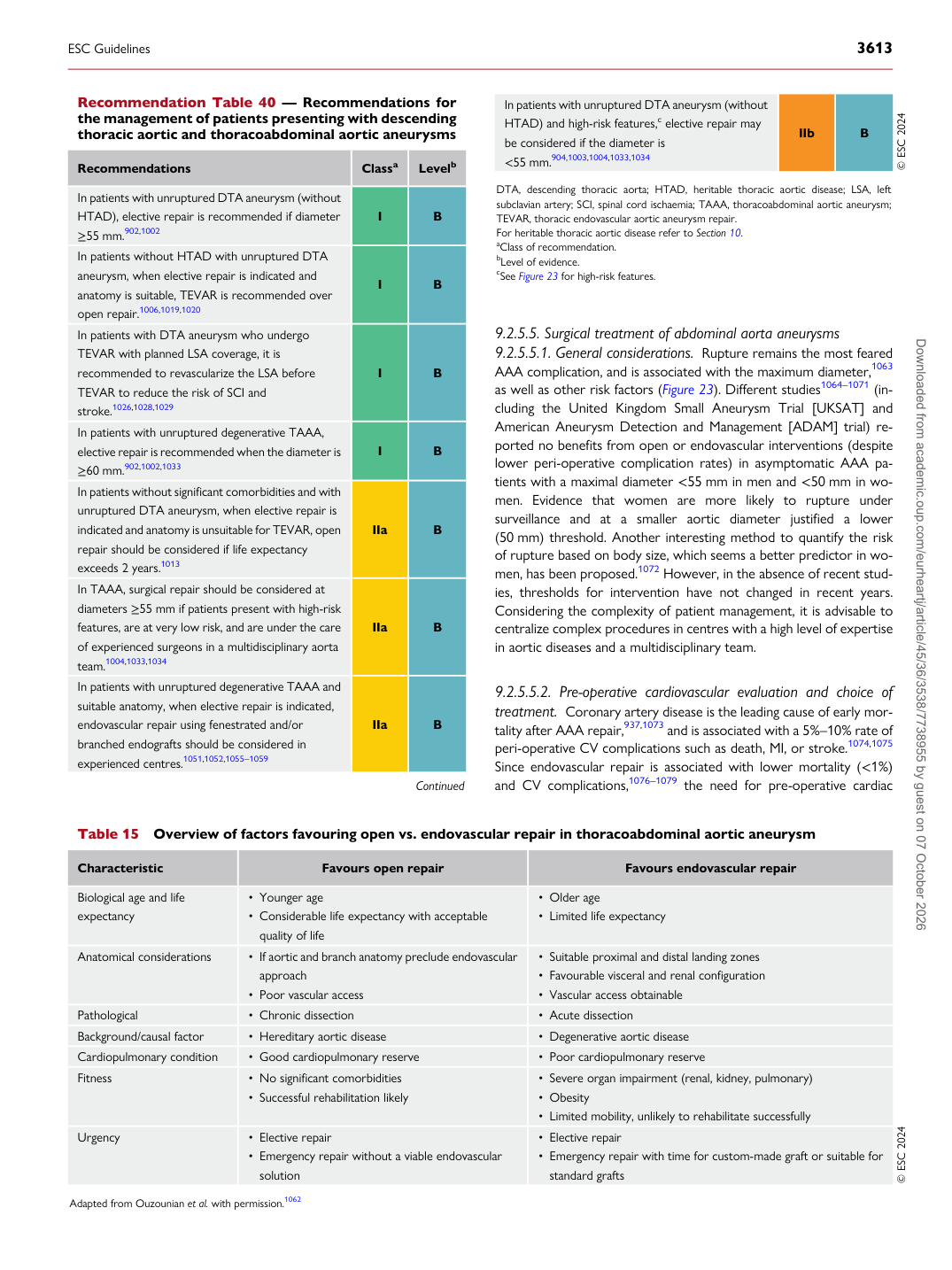
Recommendation Table 40 — Recommendations for the management of patients presenting with descending thoracic aortic and thoracoabdominal aortic aneurysms

Recommendations Classa Levelb

In patients with unruptured DTA aneurysm (without HTAD), elective repair is recommended if diameter ≥55 mm.902,1002 I B In patients without HTAD with unruptured DTA aneurysm, when elective repair is indicated and anatomy is suitable, TEVAR is recommended over open repair.1006,1019,1020 I B In patients with DTA aneurysm who undergo TEVAR with planned LSA coverage, it is recommended to revascularize the LSA before TEVAR to reduce the risk of SCI and stroke.1026,1028,1029 I B In patients with unruptured degenerative TAAA, elective repair is recommended when the diameter is ≥60 mm.902,1002,1033 I B In patients without significant comorbidities and with unruptured DTA aneurysm, when elective repair is indicated and anatomy is unsuitable for TEVAR, open repair should be considered if life expectancy exceeds 2 years.1013 IIa B In TAAA, surgical repair should be considered at diameters ≥55 mm if patients present with high-risk features, are at very low risk, and are under the care of experienced surgeons in a multidisciplinary aorta team.1004,1033,1034 IIa B In patients with unruptured degenerative TAAA and suitable anatomy, when elective repair is indicated, endovascular repair using fenestrated and/or branched endografts should be considered in experienced centres.1051,1052,1055–1059 IIa B

Continued In patients with unruptured DTA aneurysm (without

HTAD) and high-risk features,c elective repair may be considered if the diameter is <55 mm.904,1003,1004,1033,1034 IIb B © ESC 2024

DTA, descending thoracic aorta; HTAD, heritable thoracic aortic disease; LSA, left subclavian artery; SCI, spinal cord ischaemia; TAAA, thoracoabdominal aortic aneurysm; TEVAR, thoracic endovascular aortic aneurysm repair. For heritable thoracic aortic disease refer to Section 10. aClass of recommendation. bLevel of evidence. cSee Figure 23 for high-risk features.

Table 15 Overview of factors favouring open vs. endovascular repair in thoracoabdominal aortic aneurysm

Characteristic Favours open repair Favours endovascular repair

Biological age and life expectancy • Younger age • Considerable life expectancy with acceptable

quality of life • Older age • Limited life expectancy

Anatomical considerations • If aortic and branch anatomy preclude endovascular

approach • Poor vascular access • Suitable proximal and distal landing zones

• Favourable visceral and renal configuration • Vascular access obtainable

Pathological • Chronic dissection • Acute dissection Background/causal factor • Hereditary aortic disease • Degenerative aortic disease Cardiopulmonary condition • Good cardiopulmonary reserve • Poor cardiopulmonary reserve Fitness • No significant comorbidities

• Successful rehabilitation likely • Severe organ impairment (renal, kidney, pulmonary)

• Obesity • Limited mobility, unlikely to rehabilitate successfully

Urgency • Elective repair • Emergency repair without a viable endovascular

solution • Elective repair • Emergency repair with time for custom-made graft or suitable for

standard grafts © ESC 2024

Adapted from Ouzounian et al. with permission.1062

ESC Guidelines                                                                                                                                                                                          3613

Downloaded from academic.oup.com/eurheartj/article/45/36/3538/7738955 by guest on 07 October 2026