p.75 抽出テキスト
9.2.5.3 Surgical treatment of the thoracic descending aorta

9.2.5.3.1. General considerations. At 60 mm diameter, a DTA aneurysm has a 10% annual rupture risk, justifying intervention at ≥55 mm.902,1002 Intervention at a diameter <55 mm may not bring any further survival benefit except for women,904,1003 patients with connective tissue disorders,904 or rapid growth (≥10 mm per year or ≥5 mm every 6 months),1004 (for high-risk factors see Figure 23). This threshold may be increased in high surgical risk patients.1005 It is advisable to centralize complex procedures in centres with expertise in aortic diseases and a multidisciplinary team for effective patient management.

9.2.5.3.2 Open repair. Thoracic endovascular aortic aneurysm

repair is recommended as first-choice intervention for DTA aneurysms,1006–1010 thus open repair is limited to patients with unsuitable anatomy for TEVAR1011 or connective tissue disorders.1012 The early mortality benefit of TEVAR seems to decrease after 1 year, and thereafter long-term survival (10 years) seems better with open repair.1013 Therefore, open repair is advisable for young, healthy patients with unsuitable TEVAR anatomy and prolonged life expectancy, particularly when symptoms from aneurysm rupture or compression arise. However, open repair involves significant post-operative risks, necessitating thorough pre-operative evaluations for cardiac, pulmonary, renal function, carotid, and peripheral arterial diseases. Risks include stroke, mesenteric and renal ischaemia due to clamping duration,1014,1015 and paraplegia tied to the extent of aneurysmal disease.1016,1017 Outside experienced centres, outcomes have shown minimal improvement in recent years, with mortality rates around 10% and spinal cord ischaemia rates at 11%–15%.1016,1018

9.2.5.3.3 Endovascular repair. Comparative studies favour TEVAR

over open repair, showing lower mortality (6%) and morbidity.1006,1019,1020 However, TEVAR’s survival advantage is balanced by an increased risk of follow-up re-intervention. It reduces spinal cord injury risk (3%).1021–1024 Left subclavian artery (LSA) coverage during TEVAR for proximal sealing is required in up to 50% of cases.1025 This is associated with an increased risk of cerebrovascular events, spinal cord ischaemia (SCI), and upper-limb ischaemia,1026,1027 justifying previous surgical or concomitant endovascular (with branched or fenestrated grafts) revascularization of the LSA in an elective setting.1026,1028,1029 In cases of inadequate distal zone sealing, safe coverage of the coeliac artery has been proposed when sufficient collateral circulation exists,1030,1031 but results are controversial.1032

9.2.5.4 Surgical treatment of thoracoabdominal aorta aneurysms

9.2.5.4.1. General considerations. Since AAEs increase when TAAA diameter exceeds 60 mm,902,1002,1033 and there are more technical surgical challenges in TAAA repair (compared with DTA aneurysm or AAA), TAAA repair, in low-moderate surgical risk patients, is proposed if the aortic diameter is ≥60 mm. However, surgical repair should be considered at diameters ≥55 mm if patients present with high-risk features (Figure 24) or are at very low risk and under the care of experienced surgeons in a multidisciplinary aorta team.1004,1033,1034 HTAD, distal location, chronic dissection, and BAV903 are associated with rapid growth rate and will require closer follow-up.

9.2.5.4.2 Open repair. Open TAAA repair is a complex aortic pro-

cedure. Post-operative mortality risk increases with left ventricular (LV) dysfunction, renal insufficiency, and advanced age.1035–1037 Since organs and tissues distal to the aortic clamp will suffer from prolonged ischaemia, extracorporeal circulation is mandatory to reduce complications,1011,1038 especially SCI (2.5%–15%).1011,1039–1044 The mortality rate after open TAAA repair varies between 6% and 8% in high-volume centres1006,1011,1039 vs. 30% in less experienced centres,1045,1046 raising the recommendation to perform these complex procedures only in specialized institutions.

9.2.5.4.3 Endovascular repair. Endovascular repair is a promising al-

ternative for treating challenging aortic anatomy like juxta-renal AAA (Figure 22).1047,1048 The use of fenestrated and branched endografts has shown excellent results, allowing perfusion of visceral vessels.1049–1053 While direct comparison studies with open TAAA repair are lacking,1054 the increasing adoption of endovascular procedures is notable, especially for high-risk patients, with low post-operative mortality rates (<10%).1051,1052,1055–1058 A recent meta-analysis confirms these excellent outcomes, endorsing endovascular repair for TAAA.1059 The incidence of post-operative SCI (around 5%) is similar between endovascular and open repair.1052,1057,1060,1061 Thus, at mid-term follow-up, endovascular repair is durable with acceptable secondary re-intervention rates, which remain one of the major limitations.1052,1057,1058,1060,1061 Factors favouring endovascular vs. open repair in TAAA are presented in Table 15.

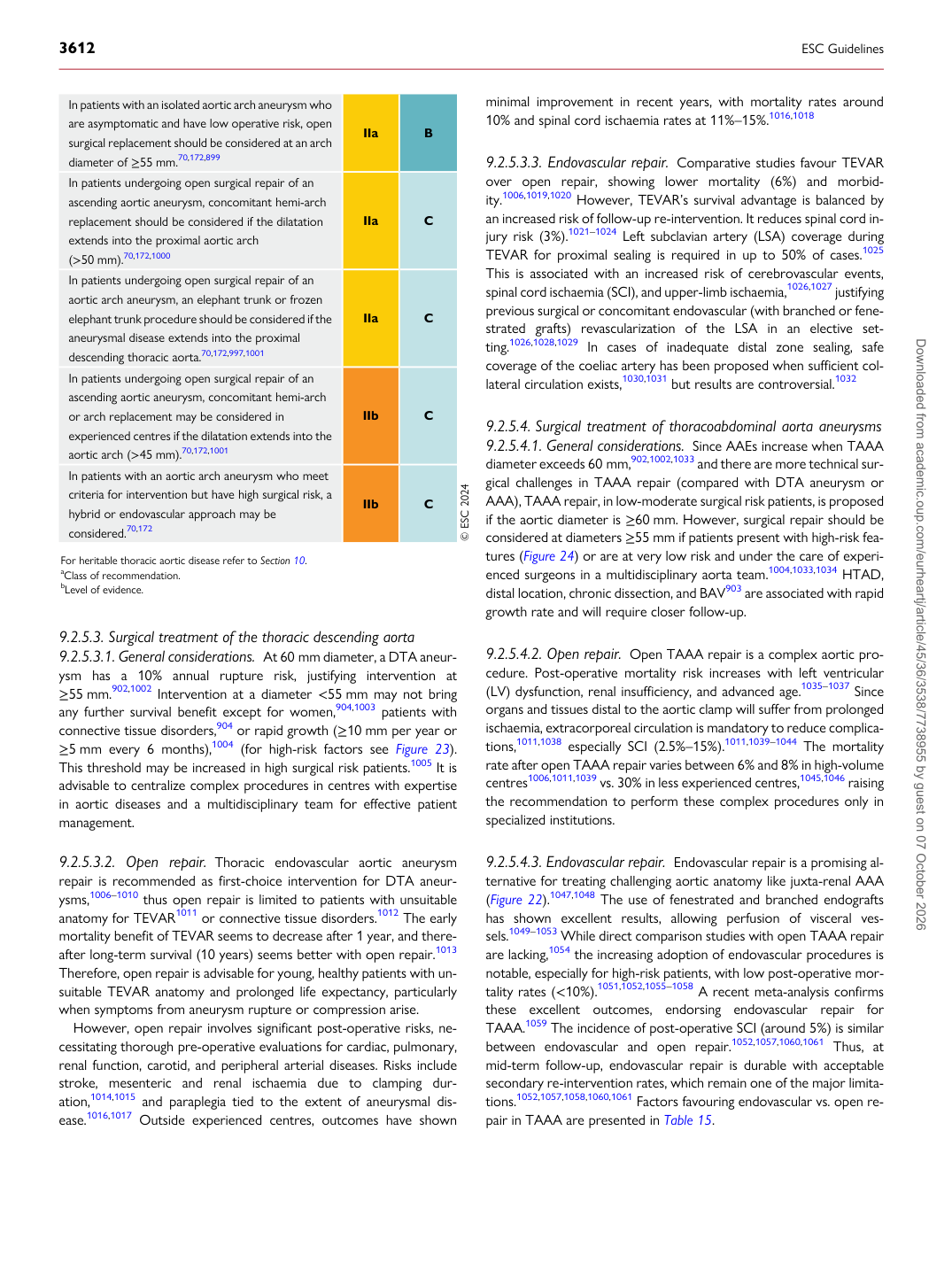
In patients with an isolated aortic arch aneurysm who are asymptomatic and have low operative risk, open surgical replacement should be considered at an arch diameter of ≥55 mm.70,172,899 IIa B In patients undergoing open surgical repair of an ascending aortic aneurysm, concomitant hemi-arch replacement should be considered if the dilatation extends into the proximal aortic arch (>50 mm).70,172,1000 IIa C In patients undergoing open surgical repair of an aortic arch aneurysm, an elephant trunk or frozen elephant trunk procedure should be considered if the aneurysmal disease extends into the proximal descending thoracic aorta.70,172,997,1001 IIa C In patients undergoing open surgical repair of an ascending aortic aneurysm, concomitant hemi-arch or arch replacement may be considered in experienced centres if the dilatation extends into the aortic arch (>45 mm).70,172,1001 IIb C In patients with an aortic arch aneurysm who meet criteria for intervention but have high surgical risk, a hybrid or endovascular approach may be considered.70,172 IIb C © ESC 2024

For heritable thoracic aortic disease refer to Section 10. aClass of recommendation. bLevel of evidence. Downloaded from academic.oup.com/eurheartj/article/45/36/3538/7738955 by guest on 07 October 2026