p.74 抽出テキスト
Although many risk factors associated with AAE have been described (such as elongation, angulation, and unfavourable biomechanics), aortic diameter is still the main determinant of aortic complications and death.974–976 AAE rates decreased with prophylactic aortic surgery over a decade,977 and additionally, surgical risk for ascending aortic/aortic root surgery dropped significantly.978–980 Now, experienced cardiac surgery centres report <1% mortality with elective surgery.980,981 Most acute type A aortic dissections (acute TAAD) occur at diameters below 55 mm. However, the risk exceeds 1% between 50 and 54 mm,982 with a critical point at 52–53 mm.153,981,983 Pre-dissection aortic diameter at the tubular level is 25%–30% smaller than post-dissection. Over 60% of non-MFS, non-BAV acute TAAD patients have a nondilated ascending aorta before dissection.984,985 Additionally, the ‘root phenotype’ has been reported to be more malignant than those with ascending phenotype, with higher velocity of progression and AAE risk.154,891,892,986 Novel parameters, like ascending aortic length (AAL) and the ascending-arch angle, correlate with acute TAAD risk.155,976 AAL ≥13 cm links to nearly five-fold higher yearly AAE rates compared with AAL <9 cm, with a threshold of >11 cm as a risk indicator.155 Indexing aortic diameters to anthropometric parameters has been suggested and a proportional increase in the risk of AAE has been retrospectively demonstrated for increasing diameter indexed to BSA,904 diameter indexed to patient height,153 or cross-sectional area indexed to patient height.154 However, these diameter-based indexing methods share the same limitations in risk prediction as the absolute diameter in the general population,984,985 whereas they can be advantageous in patients with small body size.153,154 These additional risk factors (beyond the diameter) are summarized in Figure 23.

9.2.5.2 Surgical treatment of aortic arch aneurysms

Surgery for arch aneurysms is challenging, primarily due to risks like hypothermic circulatory arrest and the need for brain protection, resulting in higher mortality and stroke rates. Isolated aortic arch surgery is appropriate for asymptomatic degenerative aortic arch aneurysms ≥55 mm in diameter or symptoms or signs of local compression. Hemi-arch or total arch replacement are frequently required in patients who have an indication for surgery on an adjacent aneurysm of the ascending aorta. In specific cases, supra-aortic vessel transposition via offpump debranching followed by TEVAR of the arch can be an alternative to traditional surgery, particularly when avoiding hypothermic circulatory arrest is a concern.992–996 When the disease involves the proximal descending aorta or future need for treatment of the descending aorta is anticipated, the frozen elephant trunk (FET) technique is a good option.997 Assessment of patency and morphology of the circle of Willis is recommended when treatment involves the aortic arch.998,999

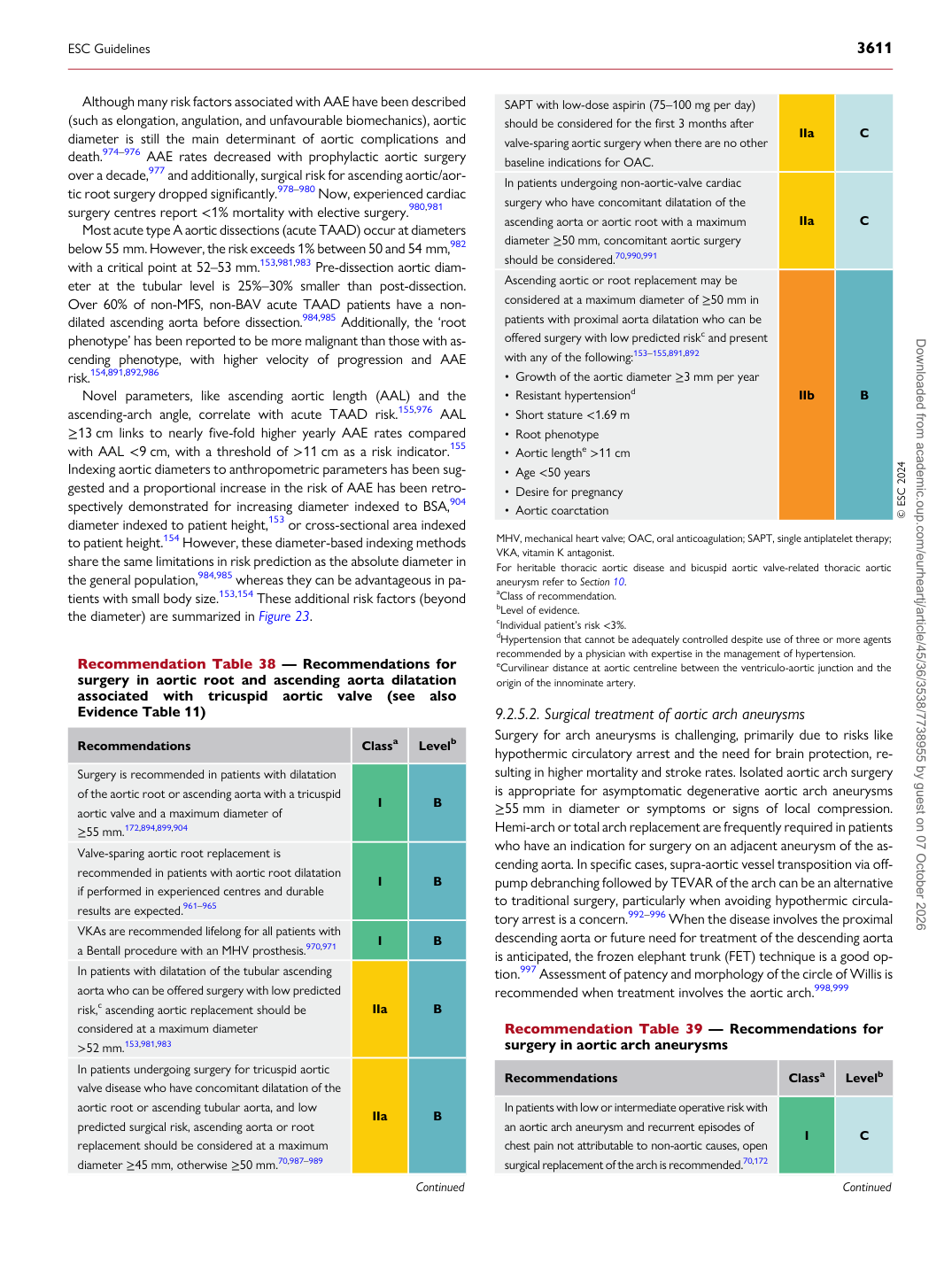
Recommendation Table 38 — Recommendations for surgery in aortic root and ascending aorta dilatation associated with tricuspid aortic valve (see also Evidence Table 11)

Recommendations Classa Levelb

Surgery is recommended in patients with dilatation of the aortic root or ascending aorta with a tricuspid aortic valve and a maximum diameter of ≥55 mm.172,894,899,904 I B Valve-sparing aortic root replacement is recommended in patients with aortic root dilatation if performed in experienced centres and durable results are expected.961–965 I B VKAs are recommended lifelong for all patients with a Bentall procedure with an MHV prosthesis.970,971 I B In patients with dilatation of the tubular ascending aorta who can be offered surgery with low predicted risk,c ascending aortic replacement should be considered at a maximum diameter >52 mm.153,981,983 IIa B In patients undergoing surgery for tricuspid aortic valve disease who have concomitant dilatation of the aortic root or ascending tubular aorta, and low predicted surgical risk, ascending aorta or root replacement should be considered at a maximum diameter ≥45 mm, otherwise ≥50 mm.70,987–989 IIa B

Continued SAPT with low-dose aspirin (75–100 mg per day)

should be considered for the first 3 months after valve-sparing aortic surgery when there are no other baseline indications for OAC. IIa C In patients undergoing non-aortic-valve cardiac surgery who have concomitant dilatation of the ascending aorta or aortic root with a maximum diameter ≥50 mm, concomitant aortic surgery should be considered.70,990,991 IIa C Ascending aortic or root replacement may be considered at a maximum diameter of ≥50 mm in patients with proximal aorta dilatation who can be offered surgery with low predicted riskc and present with any of the following:153–155,891,892 • Growth of the aortic diameter ≥3 mm per year • Resistant hypertensiond • Short stature <1.69 m • Root phenotype • Aortic lengthe >11 cm • Age <50 years • Desire for pregnancy • Aortic coarctation IIb B © ESC 2024

MHV, mechanical heart valve; OAC, oral anticoagulation; SAPT, single antiplatelet therapy; VKA, vitamin K antagonist. For heritable thoracic aortic disease and bicuspid aortic valve-related thoracic aortic aneurysm refer to Section 10. aClass of recommendation. bLevel of evidence. cIndividual patient’s risk <3%. dHypertension that cannot be adequately controlled despite use of three or more agents recommended by a physician with expertise in the management of hypertension. eCurvilinear distance at aortic centreline between the ventriculo-aortic junction and the origin of the innominate artery.

Recommendation Table 39 — Recommendations for surgery in aortic arch aneurysms

Recommendations Classa Levelb

In patients with low or intermediate operative risk with an aortic arch aneurysm and recurrent episodes of chest pain not attributable to non-aortic causes, open surgical replacement of the arch is recommended.70,172 I C

Continued

ESC Guidelines                                                                                                                                                                                          3611

Downloaded from academic.oup.com/eurheartj/article/45/36/3538/7738955 by guest on 07 October 2026