p.72 抽出テキスト
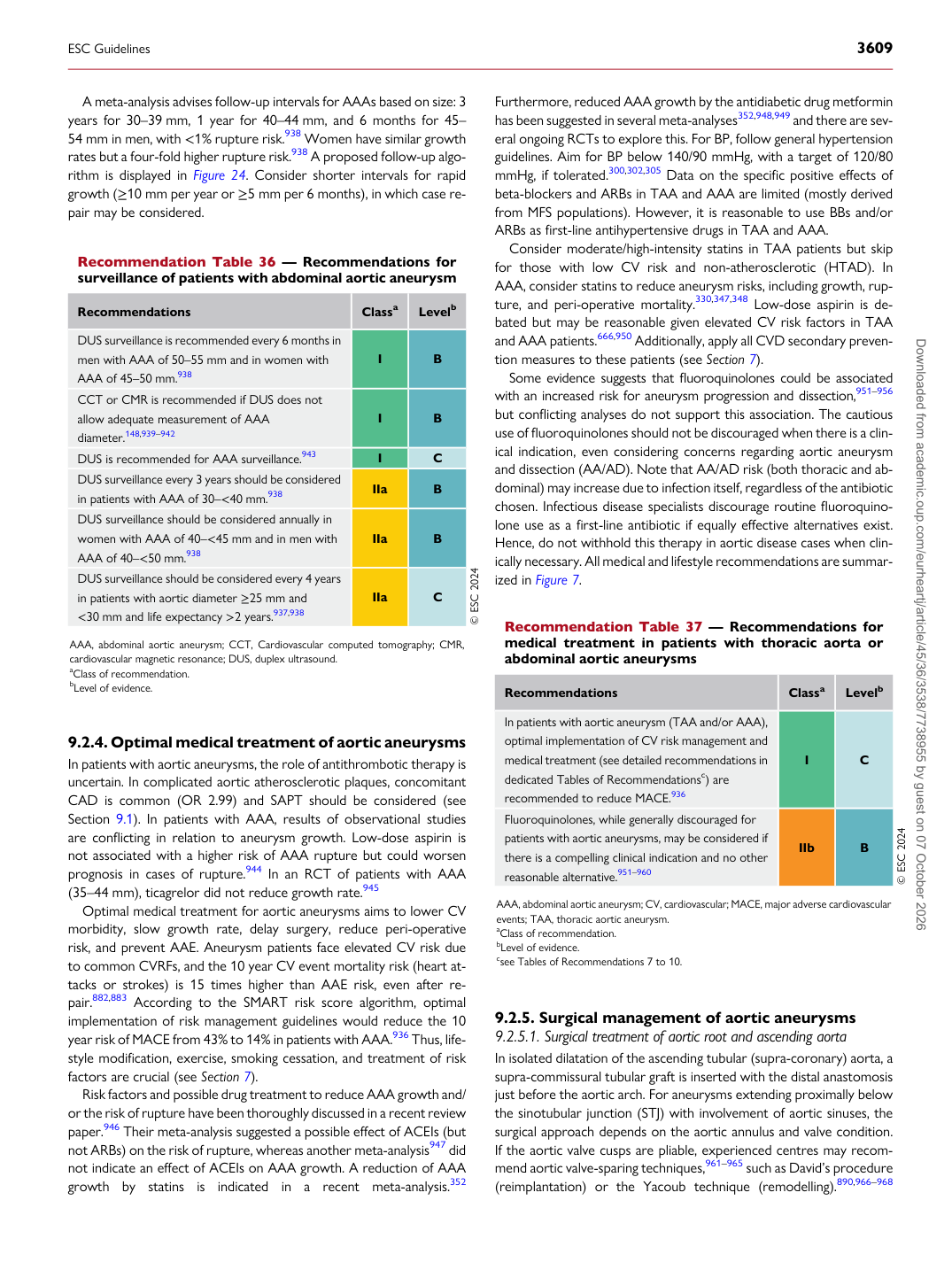
A meta-analysis advises follow-up intervals for AAAs based on size: 3 years for 30–39 mm, 1 year for 40–44 mm, and 6 months for 45– 54 mm in men, with <1% rupture risk.938 Women have similar growth rates but a four-fold higher rupture risk.938 A proposed follow-up algorithm is displayed in Figure 24. Consider shorter intervals for rapid growth (≥10 mm per year or ≥5 mm per 6 months), in which case repair may be considered.

9.2.4 Optimal medical treatment of aortic aneurysms

In patients with aortic aneurysms, the role of antithrombotic therapy is uncertain. In complicated aortic atherosclerotic plaques, concomitant CAD is common (OR 2.99) and SAPT should be considered (see Section 9.1). In patients with AAA, results of observational studies are conflicting in relation to aneurysm growth. Low-dose aspirin is not associated with a higher risk of AAA rupture but could worsen prognosis in cases of rupture.944 In an RCT of patients with AAA (35–44 mm), ticagrelor did not reduce growth rate.945 Optimal medical treatment for aortic aneurysms aims to lower CV morbidity, slow growth rate, delay surgery, reduce peri-operative risk, and prevent AAE. Aneurysm patients face elevated CV risk due to common CVRFs, and the 10 year CV event mortality risk (heart attacks or strokes) is 15 times higher than AAE risk, even after repair.882,883 According to the SMART risk score algorithm, optimal implementation of risk management guidelines would reduce the 10 year risk of MACE from 43% to 14% in patients with AAA.936 Thus, lifestyle modification, exercise, smoking cessation, and treatment of risk factors are crucial (see Section 7). Risk factors and possible drug treatment to reduce AAA growth and/ or the risk of rupture have been thoroughly discussed in a recent review paper.946 Their meta-analysis suggested a possible effect of ACEIs (but not ARBs) on the risk of rupture, whereas another meta-analysis947 did not indicate an effect of ACEIs on AAA growth. A reduction of AAA growth by statins is indicated in a recent meta-analysis.352 Furthermore, reduced AAA growth by the antidiabetic drug metformin has been suggested in several meta-analyses352,948,949 and there are several ongoing RCTs to explore this. For BP, follow general hypertension guidelines. Aim for BP below 140/90 mmHg, with a target of 120/80 mmHg, if tolerated.300,302,305 Data on the specific positive effects of beta-blockers and ARBs in TAA and AAA are limited (mostly derived from MFS populations). However, it is reasonable to use BBs and/or ARBs as first-line antihypertensive drugs in TAA and AAA.

Consider moderate/high-intensity statins in TAA patients but skip for those with low CV risk and non-atherosclerotic (HTAD). In AAA, consider statins to reduce aneurysm risks, including growth, rupture, and peri-operative mortality.330,347,348 Low-dose aspirin is debated but may be reasonable given elevated CV risk factors in TAA and AAA patients.666,950 Additionally, apply all CVD secondary prevention measures to these patients (see Section 7). Some evidence suggests that fluoroquinolones could be associated with an increased risk for aneurysm progression and dissection,951–956 but conflicting analyses do not support this association. The cautious use of fluoroquinolones should not be discouraged when there is a clinical indication, even considering concerns regarding aortic aneurysm and dissection (AA/AD). Note that AA/AD risk (both thoracic and abdominal) may increase due to infection itself, regardless of the antibiotic chosen. Infectious disease specialists discourage routine fluoroquinolone use as a first-line antibiotic if equally effective alternatives exist. Hence, do not withhold this therapy in aortic disease cases when clinically necessary. All medical and lifestyle recommendations are summarized in Figure 7.

9.2.5 Surgical management of aortic aneurysms

9.2.5.1. Surgical treatment of aortic root and ascending aorta In isolated dilatation of the ascending tubular (supra-coronary) aorta, a supra-commissural tubular graft is inserted with the distal anastomosis just before the aortic arch. For aneurysms extending proximally below the sinotubular junction (STJ) with involvement of aortic sinuses, the surgical approach depends on the aortic annulus and valve condition. If the aortic valve cusps are pliable, experienced centres may recommend aortic valve-sparing techniques,961–965 such as David’s procedure (reimplantation) or the Yacoub technique (remodelling).890,966–968

Recommendation Table 36 — Recommendations for surveillance of patients with abdominal aortic aneurysm

Recommendations Classa Levelb

DUS surveillance is recommended every 6 months in men with AAA of 50–55 mm and in women with AAA of 45–50 mm.938 I B CCT or CMR is recommended if DUS does not allow adequate measurement of AAA diameter.148,939–942 I B DUS is recommended for AAA surveillance.943 I C DUS surveillance every 3 years should be considered in patients with AAA of 30–<40 mm.938 IIa B DUS surveillance should be considered annually in women with AAA of 40–<45 mm and in men with AAA of 40–<50 mm.938 IIa B DUS surveillance should be considered every 4 years in patients with aortic diameter ≥25 mm and <30 mm and life expectancy >2 years.937,938 IIa C © ESC 2024

AAA, abdominal aortic aneurysm; CCT, Cardiovascular computed tomography; CMR, cardiovascular magnetic resonance; DUS, duplex ultrasound. aClass of recommendation. bLevel of evidence. Recommendation Table 37 — Recommendations for medical treatment in patients with thoracic aorta or abdominal aortic aneurysms

Recommendations Classa Levelb

In patients with aortic aneurysm (TAA and/or AAA), optimal implementation of CV risk management and medical treatment (see detailed recommendations in dedicated Tables of Recommendationsc) are recommended to reduce MACE.936 I C Fluoroquinolones, while generally discouraged for patients with aortic aneurysms, may be considered if there is a compelling clinical indication and no other reasonable alternative.951–960 IIb B © ESC 2024

AAA, abdominal aortic aneurysm; CV, cardiovascular; MACE, major adverse cardiovascular events; TAA, thoracic aortic aneurysm. aClass of recommendation. bLevel of evidence. csee Tables of Recommendations 7 to 10.

ESC Guidelines                                                                                                                                                                                          3609

Downloaded from academic.oup.com/eurheartj/article/45/36/3538/7738955 by guest on 07 October 2026