p.71 抽出テキスト
Surveillance of AAA

N

Y

Root or ascending dilatation with TAV or BAV (and normal valve function)

at first or susbsequent echocardiography

40–44 mma 45–49 mm 50–52 mm

Ascending Ascending

53–54 mm ≥55 mm

<3 mm/y ≥3 mm/y

<3 mm/y ≥3 mm/y

Surgery if low operative risk

(Class IIb)

Otherwise Surgery if low operative risk

(Class IIa)

Otherwise

Confirm by CCT or CMR

Confirm by CCT or CMR

Baseline CCT/CMR

and reimage by TTE in one year

Reimage by CCT/ CMR 6 months later to define projected growth rate

Reimage by TTE yearly (or every 6 months if growth rate ≥3 mm/y)

Reimage by TTE

every 2 or 3 years Reimage every 6 months

Confirm by CCT or CMR Confirm by CCT or CMR

Aortic diameter

Phenotype

High-risk featuresb Root

TAV

BAV

Growth rate

Growth rate Phenotype

TAV/BAV

Every 4 years

Every 4 years

Consider follow-up Follow-up

Every 3 years

Every 3 years Every 12

months

Every 12 months

Every 6 months Consider intervention

(Class I)

Every 6 months

Surgery (Class I) Surgery (Class I)

AAA size

(mm) Women

Men 25 30 35 40 45 50 55 Consider intervention

(Class I)

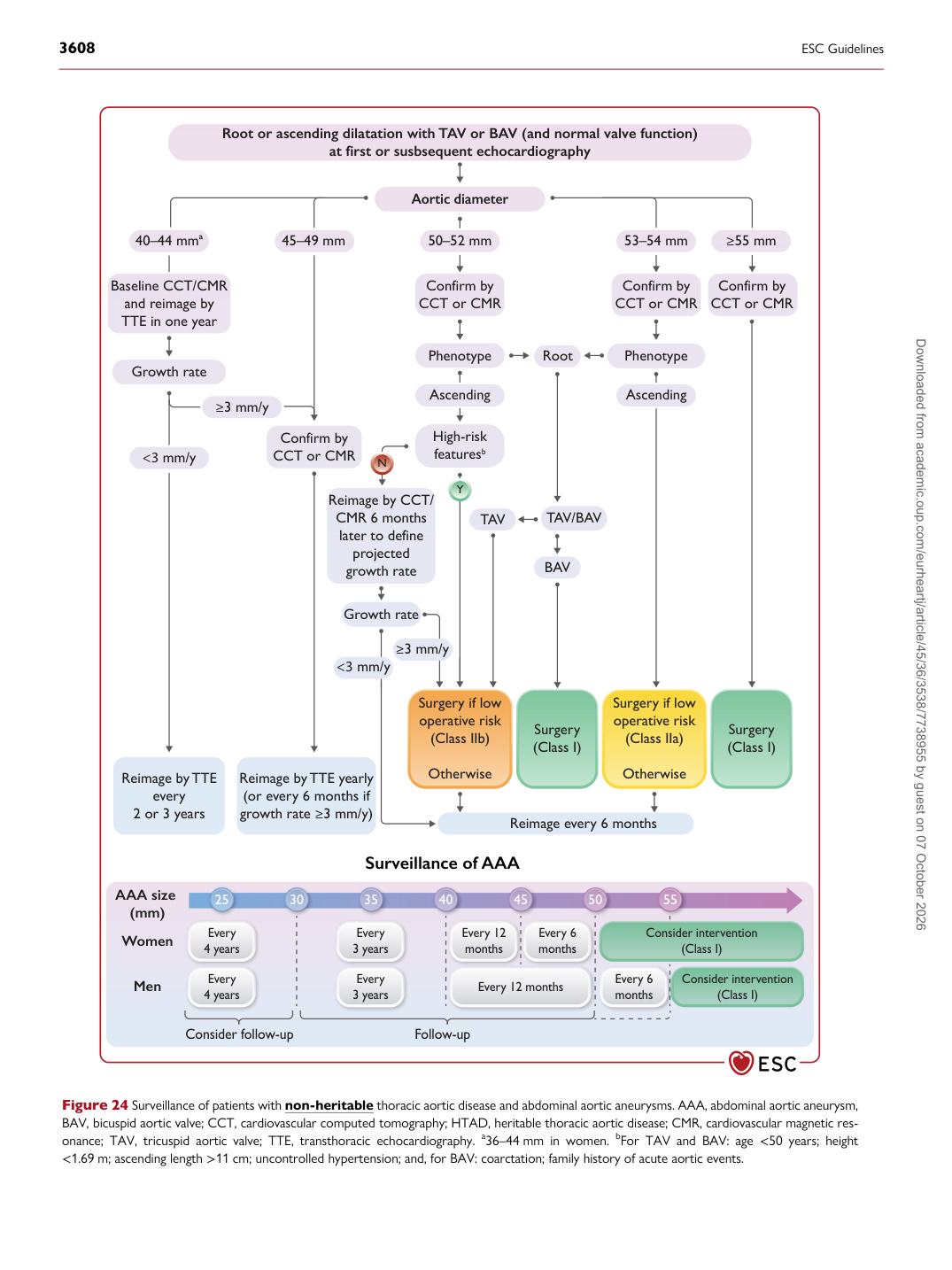
Figure 24 Surveillance of patients with non-heritable thoracic aortic disease and abdominal aortic aneurysms. AAA, abdominal aortic aneurysm, BAV, bicuspid aortic valve; CCT, cardiovascular computed tomography; HTAD, heritable thoracic aortic disease; CMR, cardiovascular magnetic resonance; TAV, tricuspid aortic valve; TTE, transthoracic echocardiography. a36–44 mm in women. bFor TAV and BAV: age <50 years; height <1.69 m; ascending length >11 cm; uncontrolled hypertension; and, for BAV: coarctation; family history of acute aortic events. Downloaded from academic.oup.com/eurheartj/article/45/36/3538/7738955 by guest on 07 October 2026