p.66 抽出テキスト
9.2 Aortic aneurysms

9.2.1. General concepts 9.2.1.1. Definitions Aortic dilatation, the second most frequent aortic disease after atherosclerosis, is defined as an aortic diameter >2 standard deviations of the predicted mean diameter depending on age, sex, and body size (z-score >2). However, in clinical practice, aortic root dilatation can be suspected in male adults when aortic diameter is >40 mm and in females at >36 mm,138,149,869 or with an indexed diameter/BSA (aortic size index [ASI]) >22 mm/m2. In extreme BSA and age values, use of z-scores is recommended (see Section 5.4 for their calculation). Arterial aneurysm is defined as a diameter >1.5 times (>50%) larger than the predicted one. This definition, as well as the use of z-scores, introduces the need for normal values and correction for age, sex, and body size. However, correcting for BSA can lead to underestimation in overweight patients,870 therefore a correction for height (aortic height index [AHI]) is becoming more popular.153 In terms of clinical risk, both ASI and AHI have been shown to improve risk stratification for AAE.153,871 Since in many cases of aortic dilatation the surgical indication is established before achieving this aneurysmal diameter, we strongly recommend the use of significant aortic dilation specifying the diameter or the indexed diameter value rather than the term ‘aneurysm’. Thoracic aortic aneurysms (TAAs) are more prevalent in men than in women (ratio 4:1);872 however, the growth rate is greater in women (0.96 ± 1.00 mm per year) than in men (0.45 ± 0.58 mm per year), and thus the risk of AAE.873 Aneurysms can be fusiform or saccular based on morphology. Saccular aneurysms relate to infection, penetrating atherosclerotic ulcer (PAU), trauma, or inflammatory diseases, while fusiform aneurysms connect with degenerative and connective tissue conditions. Although evidence about their natural course is limited, saccular aneurysms are considered more malignant in terms of AAE. Based on location, aortic aneurysms are classified into TAA and abdominal aortic aneurysm (AAA) (Figure 21). They differ in treating specialists, causes, age at onset, risk factors, and complications. However, this binary classification is artificial due to the prevalence of thoracoabdominal aortic aneurysms (TAAA) and tandem lesions (20%–30% of AAA patients also have TAA),874,875 emphasizing the importance of comprehensive aortic and vascular assessments at diagnosis. When detecting an aortic aneurysm at any site, it is advisable to conduct a thorough evaluation of the entire aorta initially and during subsequent follow-ups. Specifically, when diagnosing a TAA, it is crucial to assess the aortic valve, particularly in cases of BAV. Data on peripheral aneurysms in TAA, particularly in femoro-popliteal segments, is less clear compared with AAA. However, cerebral aneurysms, notably prevalent in women and those with HTAD, warrant thorough screening, particularly in symptomatic cases.876–878

9.2.2 Thoracic aortic aneurysms

9.2.2.1. Aetiology, risk factors, and natural history Thoracic aortic aneurysms occur in 5–10/100 000 person-years,884 with an approximate predominance of root and/or ascending aorta of ∼60%, arch of ∼10%, and descending aorta of ∼30%.885,886 Hypertension is the main risk factor (80%); however, genetics may be involved in 20% of cases.887 The decision to refer patients for genetic evaluation should consider age, family history, and presence of syndromic features,25,888 as reported in more detail in Section 10.1.

9.2.2.2 Ascending thoracic aorta and arch aneurysms

(1) Aortic root aneurysms (including sinuses of Valsalva: annuloaortic ectasia). They can be idiopathic, associated with HTAD (syndromic/non-syndromic), or found in 20%–30% of BAV patients (see Section 10).879,880 Patients are usually younger (30–50 years of age), with aortic regurgitation, and with a 1:1 sex ratio. (2) Supra-coronary aortic aneurysms (above sinuses of Valsalva). Caused by atherosclerosis in relation to hypertension affecting older patients (59–69 years) and males (ratio 3:1),880 or related to medial degeneration (isolated or associated with aortic valve disease, including BAV) (see Section 10). Primary bacterial infection or syphilis are uncommon. Arteritis is rare, but Takayasu’s and giant cell arteritis can lead to aneurysm formation. (3) Aortic arch aneurysms. Often accompanying adjacent ascend-

ing or descending aorta aneurysms, aortic arch aneurysms present surgical challenges due to potential neurological and CV risks. They are typically linked to atherosclerosis, with cystic medial degeneration primarily affecting ascending aorta-related arch aneurysms. Deceleration injuries or coarctation may extend into the aortic arch.889

Recommendation Table 34 — Recommendations for initial evaluation of thoracic aortic aneurysm and abdominal aortic aneurysm

Recommendations Classa Levelb

When an aortic aneurysm is identified at any location, assessment of the entire aorta is recommended at baseline and during follow-up.874,875 I C When a TAA is identified, assessment of the aortic valve (especially for BAV) is recommended.879,880 I C When an AAA is identified, evaluation of the presence of aneurysm in the femoro-popliteal arterial segment should be considered.876–878,881 IIa C Patients with aortic aneurysm are at increased risk of CVD, thus general CV prevention should be considered.26,882,883 IIa C © ESC 2024

AAA, abdominal aortic aneurysm; BAV, bicuspid aortic valve; CV, cardiovascular; CVD, cardiovascular disease; TAA, thoracic aortic aneurysm. aClass of recommendation. bLevel of evidence.

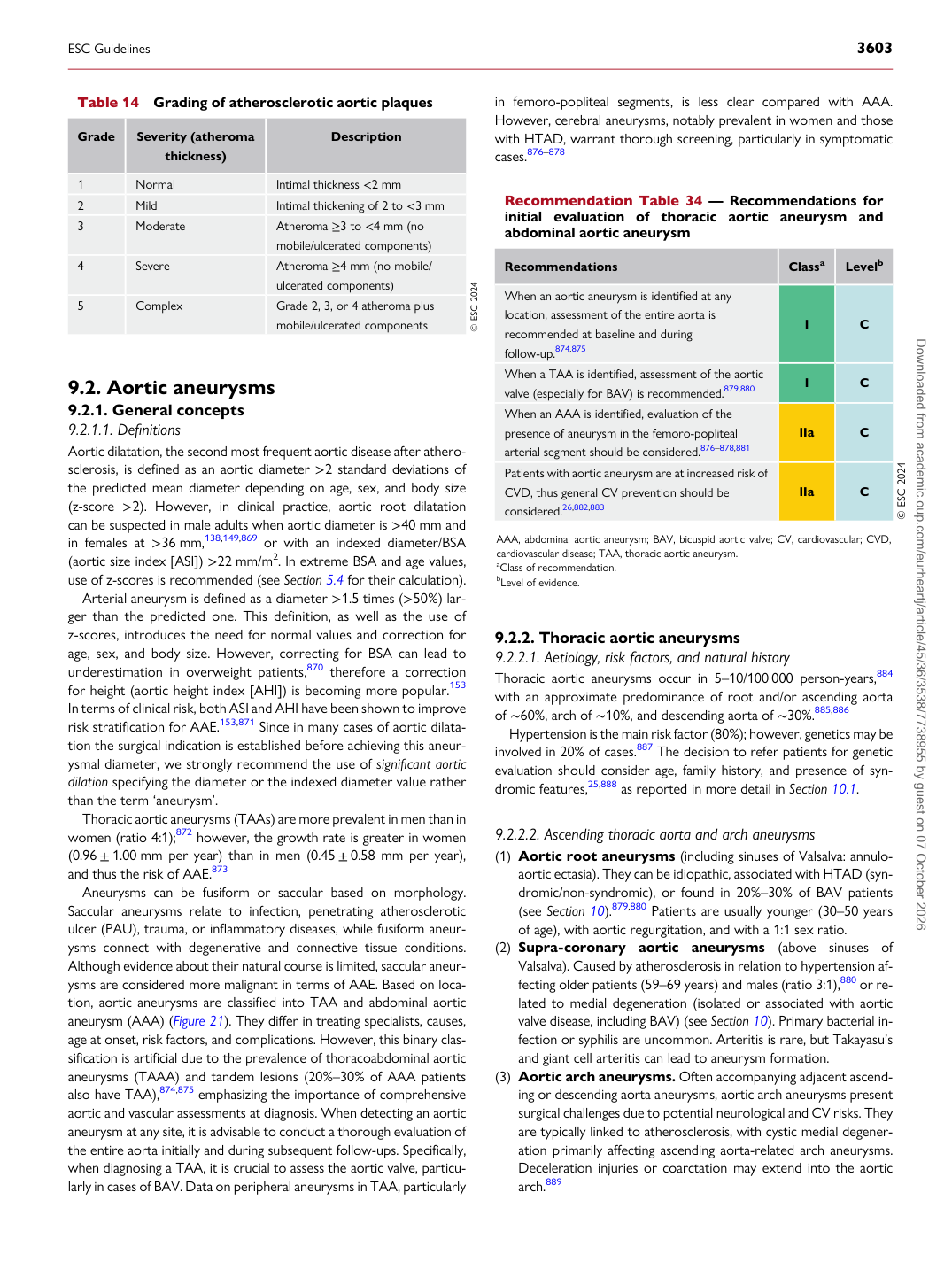
Table 14 Grading of atherosclerotic aortic plaques

Grade Severity (atheroma

thickness) Description

1 Normal Intimal thickness <2 mm

2 Mild Intimal thickening of 2 to <3 mm

3 Moderate Atheroma ≥3 to <4 mm (no

mobile/ulcerated components)

4 Severe Atheroma ≥4 mm (no mobile/

ulcerated components)

5 Complex Grade 2, 3, or 4 atheroma plus

mobile/ulcerated components © ESC 2024

ESC Guidelines                                                                                                                                                                                          3603

Downloaded from academic.oup.com/eurheartj/article/45/36/3538/7738955 by guest on 07 October 2026