p.61 抽出テキスト
8.3.2 Renal artery disease

8.3.2.1. Clinical presentation and diagnosis 8.3.2.1.1. Epidemiology. In >90% of cases, RAS is caused by atherosclerosis and typically involves the ostial renal arterial segment (Table 13).782 Above 65 years of age, overall prevalence of ≥60% RAS is 6.8%, with a higher prevalence in men (9.1%) than in women (5.5%).783 In patients with PAD, RAS prevalence ranges between 7% and 42%, influenced by diagnostic criteria.784

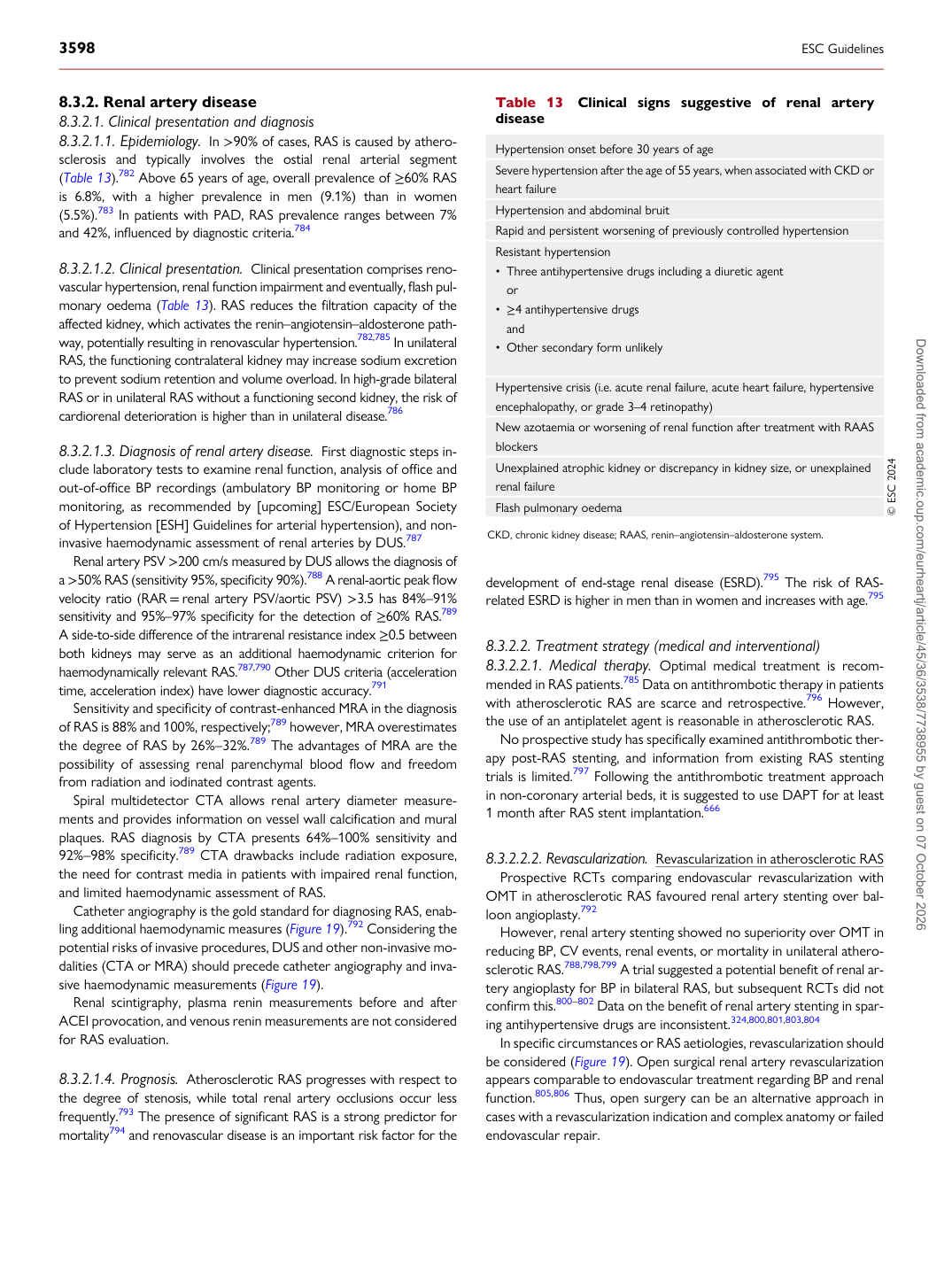
8.3.2.1.2 Clinical presentation. Clinical presentation comprises reno-

vascular hypertension, renal function impairment and eventually, flash pulmonary oedema (Table 13). RAS reduces the filtration capacity of the affected kidney, which activates the renin–angiotensin–aldosterone pathway, potentially resulting in renovascular hypertension.782,785 In unilateral RAS, the functioning contralateral kidney may increase sodium excretion to prevent sodium retention and volume overload. In high-grade bilateral RAS or in unilateral RAS without a functioning second kidney, the risk of cardiorenal deterioration is higher than in unilateral disease.786

8.3.2.1.3 Diagnosis of renal artery disease. First diagnostic steps in-

clude laboratory tests to examine renal function, analysis of office and out-of-office BP recordings (ambulatory BP monitoring or home BP monitoring, as recommended by [upcoming] ESC/European Society of Hypertension [ESH] Guidelines for arterial hypertension), and noninvasive haemodynamic assessment of renal arteries by DUS.787 Renal artery PSV >200 cm/s measured by DUS allows the diagnosis of a >50% RAS (sensitivity 95%, specificity 90%).788 A renal-aortic peak flow velocity ratio (RAR = renal artery PSV/aortic PSV) >3.5 has 84%–91% sensitivity and 95%–97% specificity for the detection of ≥60% RAS.789 A side-to-side difference of the intrarenal resistance index ≥0.5 between both kidneys may serve as an additional haemodynamic criterion for haemodynamically relevant RAS.787,790 Other DUS criteria (acceleration time, acceleration index) have lower diagnostic accuracy.791 Sensitivity and specificity of contrast-enhanced MRA in the diagnosis of RAS is 88% and 100%, respectively;789 however, MRA overestimates the degree of RAS by 26%–32%.789 The advantages of MRA are the possibility of assessing renal parenchymal blood flow and freedom from radiation and iodinated contrast agents. Spiral multidetector CTA allows renal artery diameter measurements and provides information on vessel wall calcification and mural plaques. RAS diagnosis by CTA presents 64%–100% sensitivity and 92%–98% specificity.789 CTA drawbacks include radiation exposure, the need for contrast media in patients with impaired renal function, and limited haemodynamic assessment of RAS. Catheter angiography is the gold standard for diagnosing RAS, enabling additional haemodynamic measures (Figure 19).792 Considering the potential risks of invasive procedures, DUS and other non-invasive modalities (CTA or MRA) should precede catheter angiography and invasive haemodynamic measurements (Figure 19). Renal scintigraphy, plasma renin measurements before and after ACEI provocation, and venous renin measurements are not considered for RAS evaluation.

8.3.2.1.4 Prognosis. Atherosclerotic RAS progresses with respect to

the degree of stenosis, while total renal artery occlusions occur less frequently.793 The presence of significant RAS is a strong predictor for mortality794 and renovascular disease is an important risk factor for the development of end-stage renal disease (ESRD).795 The risk of RASrelated ESRD is higher in men than in women and increases with age.795

8.3.2.2 Treatment strategy (medical and interventional)

8.3.2.2.1. Medical therapy. Optimal medical treatment is recommended in RAS patients.785 Data on antithrombotic therapy in patients with atherosclerotic RAS are scarce and retrospective.796 However, the use of an antiplatelet agent is reasonable in atherosclerotic RAS. No prospective study has specifically examined antithrombotic therapy post-RAS stenting, and information from existing RAS stenting trials is limited.797 Following the antithrombotic treatment approach in non-coronary arterial beds, it is suggested to use DAPT for at least 1 month after RAS stent implantation.666

8.3.2.2.2 Revascularization. Revascularization in atherosclerotic RAS

Prospective RCTs comparing endovascular revascularization with OMT in atherosclerotic RAS favoured renal artery stenting over balloon angioplasty.792 However, renal artery stenting showed no superiority over OMT in reducing BP, CV events, renal events, or mortality in unilateral atherosclerotic RAS.788,798,799 A trial suggested a potential benefit of renal artery angioplasty for BP in bilateral RAS, but subsequent RCTs did not confirm this.800–802 Data on the benefit of renal artery stenting in sparing antihypertensive drugs are inconsistent.324,800,801,803,804 In specific circumstances or RAS aetiologies, revascularization should be considered (Figure 19). Open surgical renal artery revascularization appears comparable to endovascular treatment regarding BP and renal function.805,806 Thus, open surgery can be an alternative approach in cases with a revascularization indication and complex anatomy or failed endovascular repair.

Table 13 Clinical signs suggestive of renal artery disease

Hypertension onset before 30 years of age Severe hypertension after the age of 55 years, when associated with CKD or heart failure Hypertension and abdominal bruit Rapid and persistent worsening of previously controlled hypertension Resistant hypertension • Three antihypertensive drugs including a diuretic agent or • ≥4 antihypertensive drugs

and • Other secondary form unlikely

Hypertensive crisis (i.e. acute renal failure, acute heart failure, hypertensive encephalopathy, or grade 3–4 retinopathy) New azotaemia or worsening of renal function after treatment with RAAS blockers Unexplained atrophic kidney or discrepancy in kidney size, or unexplained renal failure Flash pulmonary oedema © ESC 2024

CKD, chronic kidney disease; RAAS, renin–angiotensin–aldosterone system. Downloaded from academic.oup.com/eurheartj/article/45/36/3538/7738955 by guest on 07 October 2026