p.60 抽出テキスト
>25 mmHg SBP difference doubles prevalence and independently predicts mortality.32,758 As obstructive disease progresses, particularly affecting vertebral vessels, the risk of ischaemia or steal symptoms significantly rises. Visual disturbances, syncope, ataxia, vertigo, dysphasia, dysarthria, and facial sensory deficits during arm movements may indicate subclavian steal syndrome, correlating with inter-arm BP difference.760 Brachiocephalic occlusive disease can lead to stroke or TIA in carotid and vertebral territories, manifesting as exercise-induced fatigue, pain, and arm claudication. Severe cases, especially with distal disease, may result in rest pain and digital ischaemia with necrosis. Duplex ultrasound assessment of subclavian arteries enables the detection of SS via intrastenotic high-velocity flows (50% stenosis: peak systolic velocity [PSV] ≥230 cm/s, PSV ratio [PSVr] ≥2.2; 70% stenosis PSV ≥340 cm/s and PSVr ≥3.0) or monophasic post-stenotic waveforms.761 The majority of patients (>90%) with at least 50% proximal SS have either intermittent or continuous flow reversal in the vertebral artery, though not all will be symptomatic.760,762 When subclavian steal syndrome is suspected, flow reversal should be assessed in the ipsilateral extracranial vertebral artery by hyperaemia testing and if available transcranial Doppler.762 Severe stenosis or occlusion of the right brachiocephalic trunk is associated with reduced flow velocities in the ipsilateral subclavian artery and the CCA. Abnormal or doubtful DUS should lead to anatomic imaging (CTA/MRA).763 CTA is excellent for supra-aortic lesions and can provide extravascular information, especially when thoracic outlet syndrome is a differential diagnosis. MRA provides both functional and morphological information useful to distinguish antegrade from retrograde perfusion and to estimate stenosis severity.764 DSA is performed if endovascular therapy is indicated. PET is useful for the diagnosis of arteritis but not for assessment of atherosclerotic lesions in clinical practice.

8.3.1.2 Treatment strategy (medical and interventional)

Optimal medical treatment is recommended in all patients with symptomatic UEAD to reduce CV risk.32 Revascularization is indicated in symptomatic patients with TIA/stroke, coronary subclavian steal syndrome, ipsilateral haemodialysis access dysfunction, or impaired HRQoL. Revascularization should be considered in asymptomatic patients with planned coronary artery bypass grafting (CABG) using the internal mammary artery and those with ipsilateral haemodialysis access, as well as asymptomatic patients with significant bilateral SS/occlusion for adequate BP surveillance. For revascularization, both endovascular and surgical procedures are available. There are no RCTs comparing endovascular vs. open repair but individual studies, including the Danish Vascular Registry, indicate similar long-term symptom resolution but higher general complication rates and hospital length of stay for open surgery.765 The risk of severe complications, including vertebrobasilar stroke, is low with both approaches. The post-procedural stroke rate is reported at 1.3% for endovascular therapy765 and 0.9%–2.4% after open surgery.765–767 Percutaneous angioplasty for subclavian arterial stenosis is often used with stenting. There is no conclusive evidence to determine whether stenting is more effective than balloon angioplasty.768 Similar results were reported for endovascular therapy of the innominate artery.769 In heavily calcified ostial lesions, balloon-expandable stents give more radial force than nitinol stents. An endovascular approach is often the default strategy. However, in selected patients with low operative risk, with subclavian artery occlusion or after endovascular therapy failure, surgical subclavian–carotid transposition is safe with excellent long-term patency results (5 year patency 96%).766 Carotid–subclavian bypass surgery with a prosthetic graft showed long-term benefit with low operative mortality and morbidity, especially in patients with extensive disease or re-occlusion after stenting (5 year patency 97%).770 Other options are extrathoracic extra-anatomic bypass procedures (axillo-axillary, carotid–axillary, or carotid–carotid bypass);771,772 however, axillo-axillary bypasses may occlude at 1 year in 14% of cases.773 The transthoracic approach is an option in patients with multivessel disease involving the aortic arch and several supra-aortic vessels.767

While critical hand ischaemia owing to below-the-elbow atherosclerotic occlusive disease is relatively uncommon, interventions are associated with a high rate of success, major amputations are rare, and many can be treated non-operatively.756 In appropriately selected patients, both endovascular and open interventions have a high rate of success.755,756 In symptomatic patients with contraindications for endovascular therapy or open surgery, prostanoid infusion or thoracic sympathectomy may be considered.774

8.3.1.3 Follow-up

Patients with UEAD should be followed up to ensure optimal CV prevention. Tighter follow-up is required in symptomatic patients to reassess indication for revascularization as a large proportion of symptoms resolve spontaneously.775 After revascularization, patients should be followed up to allow early detection and treatment of impending late procedural failure.

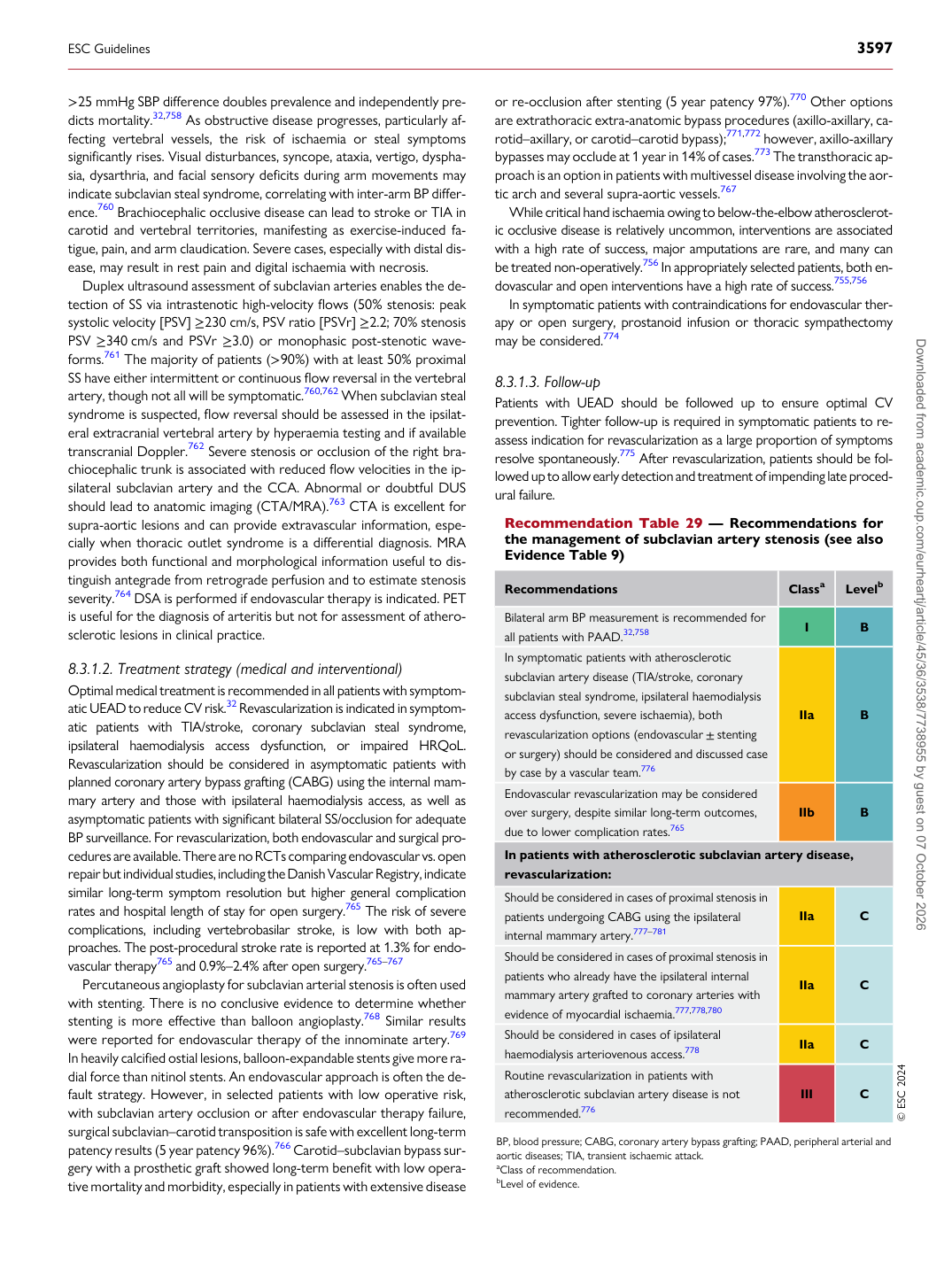
Recommendation Table 29 — Recommendations for the management of subclavian artery stenosis (see also Evidence Table 9)

Recommendations Classa Levelb

Bilateral arm BP measurement is recommended for all patients with PAAD.32,758 I B In symptomatic patients with atherosclerotic subclavian artery disease (TIA/stroke, coronary subclavian steal syndrome, ipsilateral haemodialysis access dysfunction, severe ischaemia), both revascularization options (endovascular ± stenting or surgery) should be considered and discussed case by case by a vascular team.776 IIa B Endovascular revascularization may be considered over surgery, despite similar long-term outcomes, due to lower complication rates.765 IIb B In patients with atherosclerotic subclavian artery disease, revascularization: Should be considered in cases of proximal stenosis in patients undergoing CABG using the ipsilateral internal mammary artery.777–781 IIa C Should be considered in cases of proximal stenosis in patients who already have the ipsilateral internal mammary artery grafted to coronary arteries with evidence of myocardial ischaemia.777,778,780 IIa C Should be considered in cases of ipsilateral haemodialysis arteriovenous access.778 IIa C Routine revascularization in patients with atherosclerotic subclavian artery disease is not recommended.776 III C © ESC 2024

BP, blood pressure; CABG, coronary artery bypass grafting; PAAD, peripheral arterial and aortic diseases; TIA, transient ischaemic attack. aClass of recommendation. bLevel of evidence.

ESC Guidelines                                                                                                                                                                                          3597

Downloaded from academic.oup.com/eurheartj/article/45/36/3538/7738955 by guest on 07 October 2026