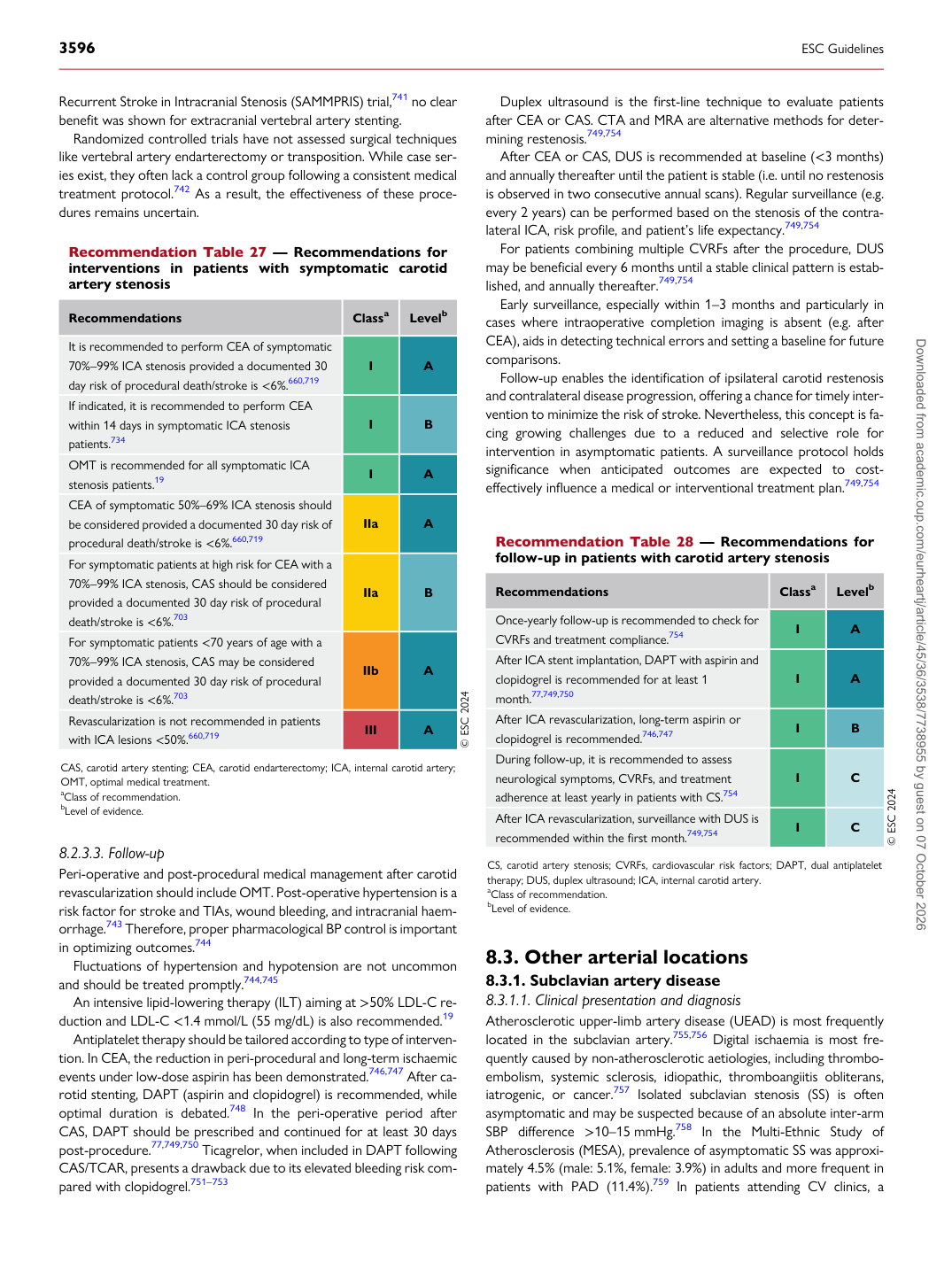
p.59 抽出テキスト
Recurrent Stroke in Intracranial Stenosis (SAMMPRIS) trial,741 no clear benefit was shown for extracranial vertebral artery stenting. Randomized controlled trials have not assessed surgical techniques like vertebral artery endarterectomy or transposition. While case series exist, they often lack a control group following a consistent medical treatment protocol.742 As a result, the effectiveness of these procedures remains uncertain.

8.2.3.3 Follow-up

Peri-operative and post-procedural medical management after carotid revascularization should include OMT. Post-operative hypertension is a risk factor for stroke and TIAs, wound bleeding, and intracranial haemorrhage.743 Therefore, proper pharmacological BP control is important in optimizing outcomes.744 Fluctuations of hypertension and hypotension are not uncommon and should be treated promptly.744,745 An intensive lipid-lowering therapy (ILT) aiming at >50% LDL-C reduction and LDL-C <1.4 mmol/L (55 mg/dL) is also recommended.19 Antiplatelet therapy should be tailored according to type of intervention. In CEA, the reduction in peri-procedural and long-term ischaemic events under low-dose aspirin has been demonstrated.746,747 After carotid stenting, DAPT (aspirin and clopidogrel) is recommended, while optimal duration is debated.748 In the peri-operative period after CAS, DAPT should be prescribed and continued for at least 30 days post-procedure.77,749,750 Ticagrelor, when included in DAPT following CAS/TCAR, presents a drawback due to its elevated bleeding risk compared with clopidogrel.751–753 Duplex ultrasound is the first-line technique to evaluate patients after CEA or CAS. CTA and MRA are alternative methods for determining restenosis.749,754

After CEA or CAS, DUS is recommended at baseline (<3 months) and annually thereafter until the patient is stable (i.e. until no restenosis is observed in two consecutive annual scans). Regular surveillance (e.g. every 2 years) can be performed based on the stenosis of the contralateral ICA, risk profile, and patient’s life expectancy.749,754 For patients combining multiple CVRFs after the procedure, DUS may be beneficial every 6 months until a stable clinical pattern is established, and annually thereafter.749,754 Early surveillance, especially within 1–3 months and particularly in cases where intraoperative completion imaging is absent (e.g. after CEA), aids in detecting technical errors and setting a baseline for future comparisons. Follow-up enables the identification of ipsilateral carotid restenosis and contralateral disease progression, offering a chance for timely intervention to minimize the risk of stroke. Nevertheless, this concept is facing growing challenges due to a reduced and selective role for intervention in asymptomatic patients. A surveillance protocol holds significance when anticipated outcomes are expected to costeffectively influence a medical or interventional treatment plan.749,754

8.3 Other arterial locations

8.3.1. Subclavian artery disease 8.3.1.1. Clinical presentation and diagnosis Atherosclerotic upper-limb artery disease (UEAD) is most frequently located in the subclavian artery.755,756 Digital ischaemia is most frequently caused by non-atherosclerotic aetiologies, including thromboembolism, systemic sclerosis, idiopathic, thromboangiitis obliterans, iatrogenic, or cancer.757 Isolated subclavian stenosis (SS) is often asymptomatic and may be suspected because of an absolute inter-arm SBP difference >10–15 mmHg.758 In the Multi-Ethnic Study of Atherosclerosis (MESA), prevalence of asymptomatic SS was approximately 4.5% (male: 5.1%, female: 3.9%) in adults and more frequent in patients with PAD (11.4%).759 In patients attending CV clinics, a

Recommendation Table 27 — Recommendations for interventions in patients with symptomatic carotid artery stenosis

Recommendations Classa Levelb

It is recommended to perform CEA of symptomatic 70%–99% ICA stenosis provided a documented 30 day risk of procedural death/stroke is <6%.660,719 I A If indicated, it is recommended to perform CEA within 14 days in symptomatic ICA stenosis patients.734 I B OMT is recommended for all symptomatic ICA stenosis patients.19 I A CEA of symptomatic 50%–69% ICA stenosis should be considered provided a documented 30 day risk of procedural death/stroke is <6%.660,719 IIa A For symptomatic patients at high risk for CEA with a 70%–99% ICA stenosis, CAS should be considered provided a documented 30 day risk of procedural death/stroke is <6%.703 IIa B For symptomatic patients <70 years of age with a 70%–99% ICA stenosis, CAS may be considered provided a documented 30 day risk of procedural death/stroke is <6%.703 IIb A Revascularization is not recommended in patients with ICA lesions <50%.660,719 III A © ESC 2024

CAS, carotid artery stenting; CEA, carotid endarterectomy; ICA, internal carotid artery; OMT, optimal medical treatment. aClass of recommendation. bLevel of evidence. Recommendation Table 28 — Recommendations for follow-up in patients with carotid artery stenosis

Recommendations Classa Levelb

Once-yearly follow-up is recommended to check for CVRFs and treatment compliance.754 I A After ICA stent implantation, DAPT with aspirin and clopidogrel is recommended for at least 1 month.77,749,750 I A After ICA revascularization, long-term aspirin or clopidogrel is recommended.746,747 I B During follow-up, it is recommended to assess neurological symptoms, CVRFs, and treatment adherence at least yearly in patients with CS.754 I C After ICA revascularization, surveillance with DUS is recommended within the first month.749,754 I C © ESC 2024

CS, carotid artery stenosis; CVRFs, cardiovascular risk factors; DAPT, dual antiplatelet therapy; DUS, duplex ultrasound; ICA, internal carotid artery. aClass of recommendation. bLevel of evidence. Downloaded from academic.oup.com/eurheartj/article/45/36/3538/7738955 by guest on 07 October 2026