p.58 抽出テキスト
8.2.3.2 Interventional treatment

8.2.3.2.1. Open surgery. Optimal medical treatment is recommended for all symptomatic patients with CS. In recently symptomatic patients with <50% stenosis, CEA (plus OMT) did not prevent stroke. However, surgery reduced stroke risk in patients with moderate (50%–69%) and severe (70%–99%) stenosis. The benefit from surgery increased with increasing severity of stenosis, except for ‘nearocclusion’ lesions (95%–99% stenosis with distal ICA collapse or a narrow calibre lumen with ‘trickle flow’).660,717–720 Some features are associated with a higher increase of stroke in symptomatic patients (50%–99% stenosis) medically treated: age (>75 years), symptoms within 14 days, male sex, hemispheric (vs. retinal) symptoms, cortical (vs. lacunar) stroke, increasing comorbidities, irregular stenosis, stenosis severity, contralateral occlusion, tandem intracranial stenosis, and failure to recruit intracranial collaterals.721 Large-scale registries suggest that CEA can be performed safely in the first 7 days after TIA/minor stroke.722–724 However, not all patients benefit from urgent revascularization, and controversy exists over the safety of performing CEA within the first 48 h after symptom onset due to an increased risk of haemorrhagic transformation. Higher-risk patients include those with acute carotid occlusion, a persisting major neurological deficit, an area of middle cerebral artery infarction exceeding one-third, evidence of pre-existing parenchymal haemorrhage, and signs of impaired consciousness.724,725 The choice to perform carotid revascularization within 48 h from symptom onset is still debatable.726

8.2.3.2.2 Endovascular therapy vs. open surgery. Contemporary

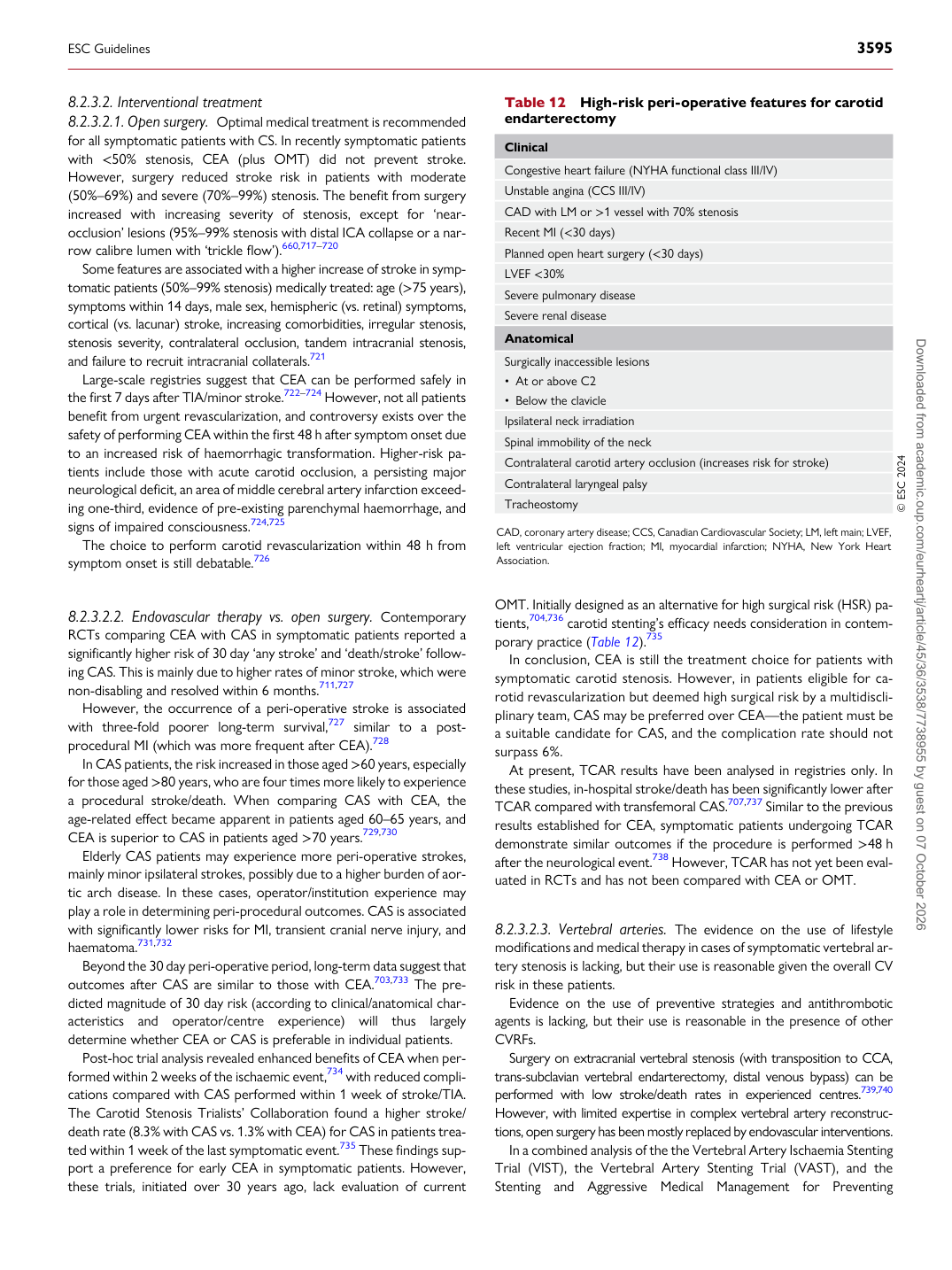
RCTs comparing CEA with CAS in symptomatic patients reported a significantly higher risk of 30 day ‘any stroke’ and ‘death/stroke’ following CAS. This is mainly due to higher rates of minor stroke, which were non-disabling and resolved within 6 months.711,727 However, the occurrence of a peri-operative stroke is associated with three-fold poorer long-term survival,727 similar to a postprocedural MI (which was more frequent after CEA).728 In CAS patients, the risk increased in those aged >60 years, especially for those aged >80 years, who are four times more likely to experience a procedural stroke/death. When comparing CAS with CEA, the age-related effect became apparent in patients aged 60–65 years, and CEA is superior to CAS in patients aged >70 years.729,730 Elderly CAS patients may experience more peri-operative strokes, mainly minor ipsilateral strokes, possibly due to a higher burden of aortic arch disease. In these cases, operator/institution experience may play a role in determining peri-procedural outcomes. CAS is associated with significantly lower risks for MI, transient cranial nerve injury, and haematoma.731,732 Beyond the 30 day peri-operative period, long-term data suggest that outcomes after CAS are similar to those with CEA.703,733 The predicted magnitude of 30 day risk (according to clinical/anatomical characteristics and operator/centre experience) will thus largely determine whether CEA or CAS is preferable in individual patients. Post-hoc trial analysis revealed enhanced benefits of CEA when performed within 2 weeks of the ischaemic event,734 with reduced complications compared with CAS performed within 1 week of stroke/TIA. The Carotid Stenosis Trialists’ Collaboration found a higher stroke/ death rate (8.3% with CAS vs. 1.3% with CEA) for CAS in patients treated within 1 week of the last symptomatic event.735 These findings support a preference for early CEA in symptomatic patients. However, these trials, initiated over 30 years ago, lack evaluation of current OMT. Initially designed as an alternative for high surgical risk (HSR) patients,704,736 carotid stenting’s efficacy needs consideration in contemporary practice (Table 12).735

In conclusion, CEA is still the treatment choice for patients with symptomatic carotid stenosis. However, in patients eligible for carotid revascularization but deemed high surgical risk by a multidiscliplinary team, CAS may be preferred over CEA—the patient must be a suitable candidate for CAS, and the complication rate should not surpass 6%. At present, TCAR results have been analysed in registries only. In these studies, in-hospital stroke/death has been significantly lower after TCAR compared with transfemoral CAS.707,737 Similar to the previous results established for CEA, symptomatic patients undergoing TCAR demonstrate similar outcomes if the procedure is performed >48 h after the neurological event.738 However, TCAR has not yet been evaluated in RCTs and has not been compared with CEA or OMT.

8.2.3.2.3 Vertebral arteries. The evidence on the use of lifestyle

modifications and medical therapy in cases of symptomatic vertebral artery stenosis is lacking, but their use is reasonable given the overall CV risk in these patients. Evidence on the use of preventive strategies and antithrombotic agents is lacking, but their use is reasonable in the presence of other CVRFs. Surgery on extracranial vertebral stenosis (with transposition to CCA, trans-subclavian vertebral endarterectomy, distal venous bypass) can be performed with low stroke/death rates in experienced centres.739,740 However, with limited expertise in complex vertebral artery reconstructions, open surgery has been mostly replaced by endovascular interventions. In a combined analysis of the the Vertebral Artery Ischaemia Stenting Trial (VIST), the Vertebral Artery Stenting Trial (VAST), and the Stenting and Aggressive Medical Management for Preventing

Table 12 High-risk peri-operative features for carotid endarterectomy Clinical Congestive heart failure (NYHA functional class III/IV) Unstable angina (CCS III/IV) CAD with LM or >1 vessel with 70% stenosis Recent MI (<30 days) Planned open heart surgery (<30 days) LVEF <30% Severe pulmonary disease Severe renal disease Anatomical Surgically inaccessible lesions • At or above C2 • Below the clavicle Ipsilateral neck irradiation Spinal immobility of the neck Contralateral carotid artery occlusion (increases risk for stroke) Contralateral laryngeal palsy Tracheostomy © ESC 2024

CAD, coronary artery disease; CCS, Canadian Cardiovascular Society; LM, left main; LVEF, left ventricular ejection fraction; MI, myocardial infarction; NYHA, New York Heart Association.

ESC Guidelines                                                                                                                                                                                          3595

Downloaded from academic.oup.com/eurheartj/article/45/36/3538/7738955 by guest on 07 October 2026