p.57 抽出テキスト
The Stenting and Angioplasty with Protection in Patients at High Risk for Endarterectomy (SAPPHIRE) trial randomized symptomatic and asymptomatic patients deemed ‘high-risk for surgery’ to either CEA or CAS (using embolic protection devices).704 Overall, 71% of SAPPHIRE patients were asymptomatic, and in these patients the 30 day rate of death/stroke after CAS was 5.8% vs. 6.1% after CEA704— both beyond the recommended 3%. If these procedural risk levels reflect contemporary practice, most ‘high-risk for surgery’ asymptomatic patients would be better treated medically. A small sample size RCT has provided evidence that the use of a double-layer mesh stent can reduce the occurrence of peri-procedural diffusion-weighted imaging (DWI)-detected ischaemic lesion after carotid stents, when compared with conventional stents. At 1 year followup the use of a double-layer mesh stent was associated with a significant reduction in the composite endpoint of MACE and in-stent restenosis or occlusion. The clinical benefit of these findings has to be proven.705,706 Transcarotid artery revascularization (TCAR) has been introduced recently. Although no RCTs are available, large registry-based analyses report a 99.7% technical success rate and low 30 day complication rates (<3% in 30 day stroke/death and <1% MI).681 In a large-scale registry the 1 year rate of stroke or death was 6.4% for TCAR, 5.2% for CEA, and 9.7% for transfemoral carotid artery stenting (TFCAS).707 Properly conducted RCTs comparing TCAR with CEA in asymptomatic patients are required to establish the true place of TCAR in carotid revascularization.708 8.2.3 Symptomatic carotid artery stenosis

8.2.3.1. Medical treatment 8.2.3.1.1. Lipid-lowering therapy. See Section 7. 8.2.3.1.2. Antihypertensive therapy. See Section 7. 8.2.3.1.3. Glucose-lowering therapy. See Section 7. 8.2.3.1.4. Antithrombotic therapy. Symptomatic CS is associated with a high risk of early recurrence of cerebrovascular ischaemic events.667–669,683 DAPT with low-dose aspirin and clopidogrel is recommended for all patients with symptomatic CS for at least 3 months.669 Those undergoing surgical revascularization can stop clopidogrel after surgery.711 Those undergoing endovascular revascularization should continue DAPT with clopidogrel and low-dose aspirin for 4 weeks after the procedure.488,666,711,712 In patients with stroke related to extracranial arterial disease, aspirin was more effective than VKAs in reducing recurrencies.687,713 Subgroup analysis from the Acute Stroke or Transient Ischaemic Attack Treated with Aspirin or Ticagrelor and Patient Outcomes (SOCRATES) trial suggested a lower rate of MACE in patients receiving ticagrelor vs. aspirin;689 however, this analysis was underpowered to make any conclusions regarding the benefit of ticagrelor. A combination of aspirin and clopidogrel in the early phase of symptomatic carotid stenosis reduces asymptomatic cerebral embolization and stroke.692,694,714 It also reduces stroke recurrence after a minor stroke/TIA.667,668 Recently, the Acute Stroke or Transient Ischaemic Attack Treated with Ticagrelor and acetylsalicylic acid for Prevention of Stroke and Death (THALES) trial showed a 17% reduction in the risk of death or stroke when using ticagrelor and aspirin vs. aspirin alone in patients with minor stroke or high-risk TIA;715 however, bleeding events occurred more frequently in the ticagrelor plus aspirin group.700,716 Of note, COMPASS data cannot be applied to symptomatic carotid stenosis since these patients were excluded because of intracranial bleeding risk.499

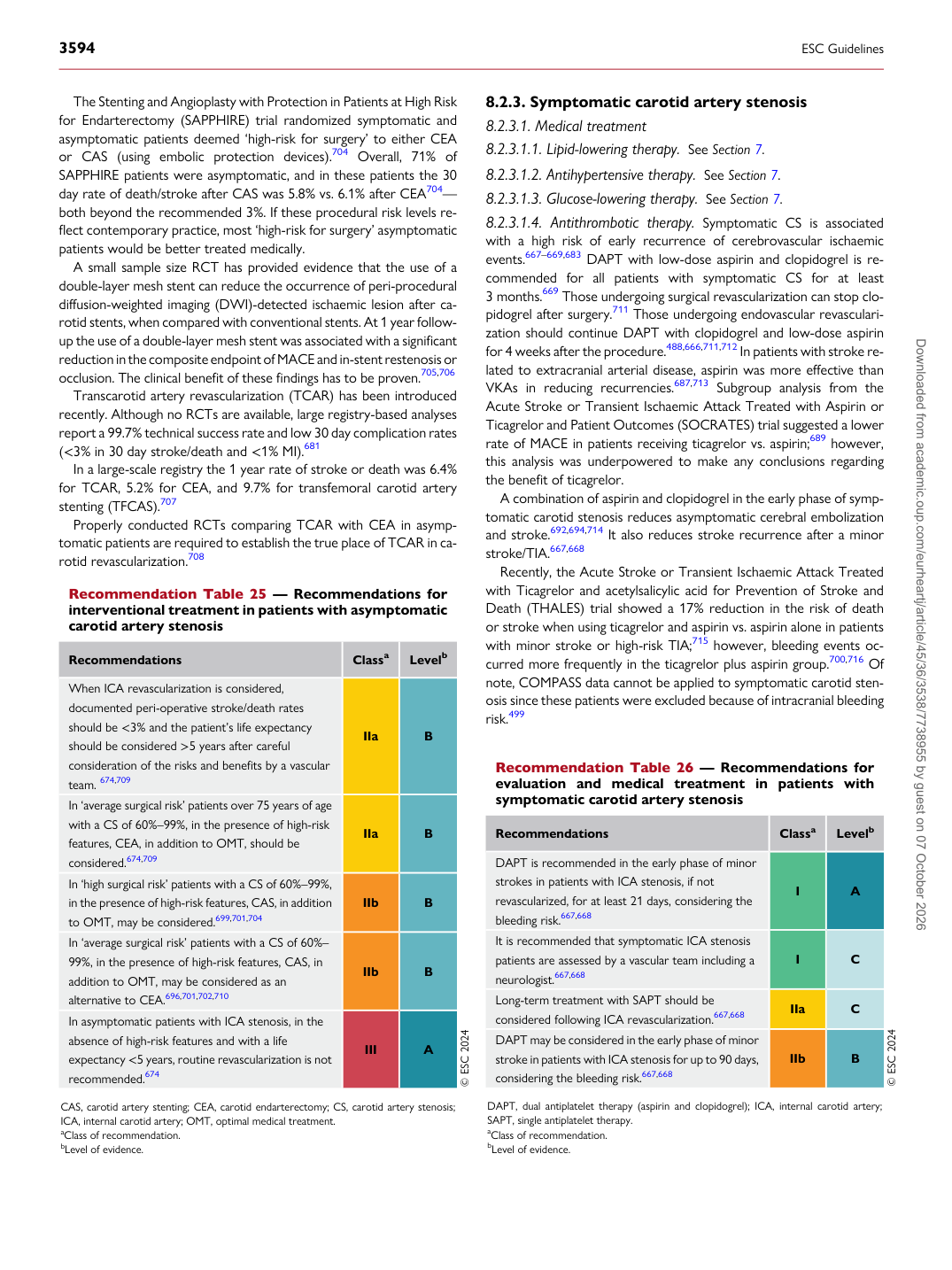
Recommendation Table 25 — Recommendations for interventional treatment in patients with asymptomatic carotid artery stenosis

Recommendations Classa Levelb

When ICA revascularization is considered, documented peri-operative stroke/death rates should be <3% and the patient’s life expectancy should be considered >5 years after careful consideration of the risks and benefits by a vascular team. 674,709 IIa B In ‘average surgical risk’ patients over 75 years of age with a CS of 60%–99%, in the presence of high-risk features, CEA, in addition to OMT, should be considered.674,709 IIa B In ‘high surgical risk’ patients with a CS of 60%–99%, in the presence of high-risk features, CAS, in addition to OMT, may be considered.699,701,704 IIb B In ‘average surgical risk’ patients with a CS of 60%– 99%, in the presence of high-risk features, CAS, in addition to OMT, may be considered as an alternative to CEA.696,701,702,710 IIb B In asymptomatic patients with ICA stenosis, in the absence of high-risk features and with a life expectancy <5 years, routine revascularization is not recommended.674 III A © ESC 2024

CAS, carotid artery stenting; CEA, carotid endarterectomy; CS, carotid artery stenosis; ICA, internal carotid artery; OMT, optimal medical treatment. aClass of recommendation. bLevel of evidence. Recommendation Table 26 — Recommendations for evaluation and medical treatment in patients with symptomatic carotid artery stenosis

Recommendations Classa Levelb

DAPT is recommended in the early phase of minor strokes in patients with ICA stenosis, if not revascularized, for at least 21 days, considering the bleeding risk.667,668 I A It is recommended that symptomatic ICA stenosis patients are assessed by a vascular team including a neurologist.667,668 I C Long-term treatment with SAPT should be considered following ICA revascularization.667,668 IIa C DAPT may be considered in the early phase of minor stroke in patients with ICA stenosis for up to 90 days, considering the bleeding risk.667,668 IIb B © ESC 2024

DAPT, dual antiplatelet therapy (aspirin and clopidogrel); ICA, internal carotid artery; SAPT, single antiplatelet therapy. aClass of recommendation. bLevel of evidence. Downloaded from academic.oup.com/eurheartj/article/45/36/3538/7738955 by guest on 07 October 2026