p.55 抽出テキスト
vs. aspirin alone or rivaroxaban 5 mg b.i.d. alone. However, specific data on asymptomatic CS were not reported. Since these patients present a two times higher risk of MI,30 lifelong low-dose aspirin should be considered in asymptomatic CS patients at increased risk for CV events (i.e. diabetic patients) and low bleeding risk497 to reduce stroke and CV risk.19,299,488,666

8.2.2.2 Interventional treatment

8.2.2.2.1. Open surgery vs. medical therapy. The rationale for carotid endarterectomy (CEA) in asymptomatic CS stems from two trials that were published some time ago. The Asymptomatic Carotid Atherosclerosis Study (ACAS) and the Asymptomatic Carotid Surgery Trial 1 (ACST-1) compared CEA with medical therapy in asymptomatic patients with 60%–99% CS.672–674 In ACAS, 5 year rates of ipsilateral stroke/death under CEA vs. medical therapy were 5.1% vs. 11.0%. ACST-1 reported 5 year rates of any stroke of 6.4% vs. 11.8%, respectively. In a combined analysis of both trials, CEA conferred less benefit in women at 5 years.675 At 10 years, however, ACST-1674 reported that females benefit following CEA (absolute risk reduction [ARR] 5.8%) to the same extent as men (ARR 5.5%). Medical treatment has advanced following the recruitment of patients in these trials.672–676 A 60%–70% decline in annual stroke rates was also observed in medically treated patients in both trials over 1995 to 2010.676 This reduction was attributed to better medical treatment and lower smoking incidence. The Stent Protected Angioplasty versus Carotid Endarterectomy study (SPACE-2) compared OMT alone against OMT plus CEA/carotid artery stenting (CAS) in asymptomatic patients with CS ≥70% according to ECST criteria. Due to slow recruitment, the study was underpowered. The 1 year rate of the major secondary endpoint was 2.5% after CEA, 3.0% after CAS, and 0.9% after OMT.677 Incidence of any stroke or death from any cause within 30 days or any ipsilateral ischaemic stroke within 5 years (primary efficacy endpoint) was 2.5% with CEA plus OMT, 4.4% with CAS plus OMT, and 3.1% with OMT alone. Results from the Carotid Revascularization Endartectomy vs. Stenting Trial 2 (CREST-2) are awaited to clarify whether intervention is beneficial in the treatment of asymptomatic CS compared with modern OMT. The ARR in stroke favouring surgery over OMT was only 4.6% at 10 years in ACST-1, indicating that 95% of asymptomatic patients ultimately underwent unnecessary interventions.674,678

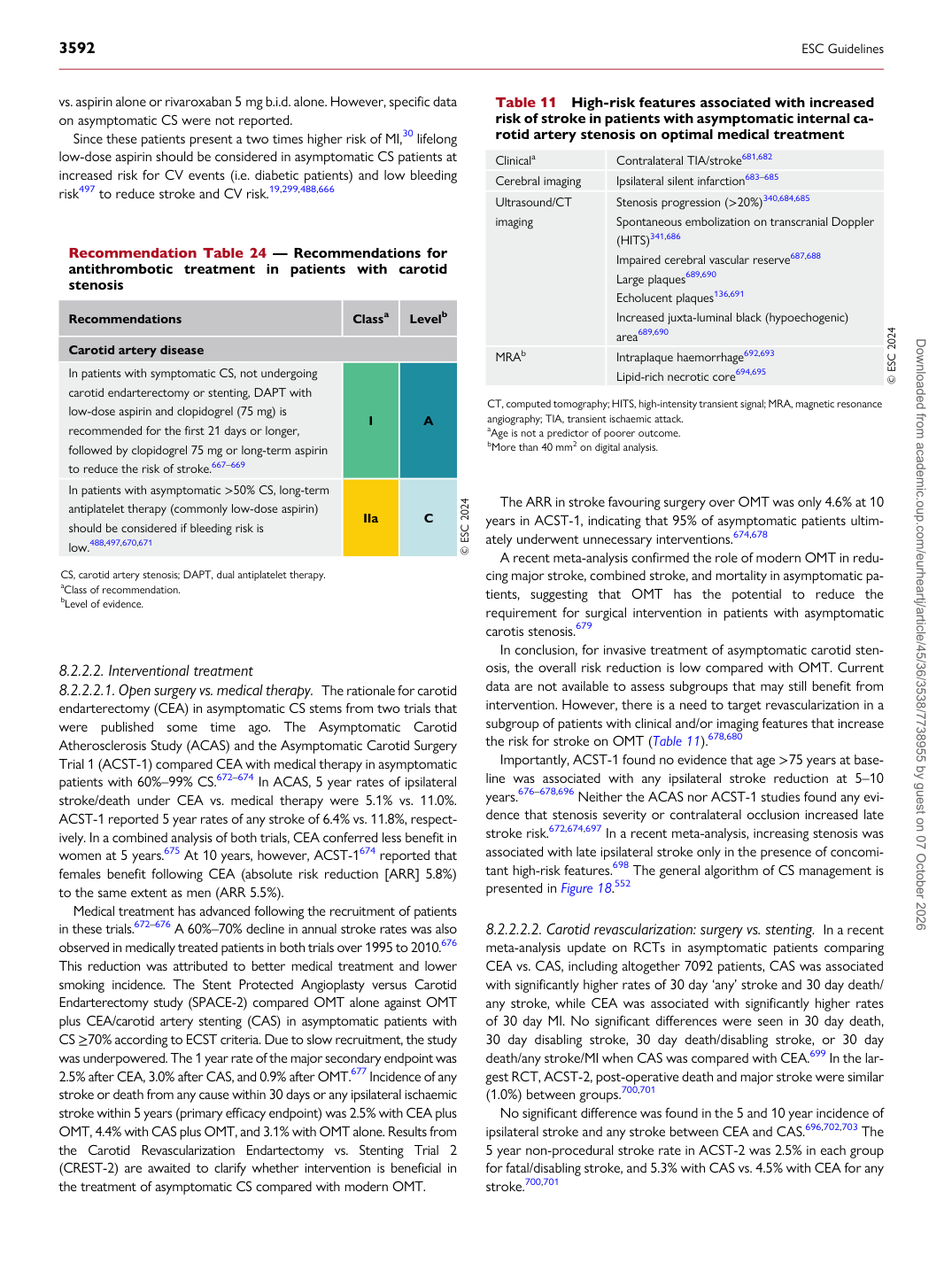
A recent meta-analysis confirmed the role of modern OMT in reducing major stroke, combined stroke, and mortality in asymptomatic patients, suggesting that OMT has the potential to reduce the requirement for surgical intervention in patients with asymptomatic carotis stenosis.679 In conclusion, for invasive treatment of asymptomatic carotid stenosis, the overall risk reduction is low compared with OMT. Current data are not available to assess subgroups that may still benefit from intervention. However, there is a need to target revascularization in a subgroup of patients with clinical and/or imaging features that increase the risk for stroke on OMT (Table 11).678,680 Importantly, ACST-1 found no evidence that age >75 years at baseline was associated with any ipsilateral stroke reduction at 5–10 years.676–678,696 Neither the ACAS nor ACST-1 studies found any evidence that stenosis severity or contralateral occlusion increased late stroke risk.672,674,697 In a recent meta-analysis, increasing stenosis was associated with late ipsilateral stroke only in the presence of concomitant high-risk features.698 The general algorithm of CS management is presented in Figure 18.552

8.2.2.2.2 Carotid revascularization: surgery vs. stenting. In a recent

meta-analysis update on RCTs in asymptomatic patients comparing CEA vs. CAS, including altogether 7092 patients, CAS was associated with significantly higher rates of 30 day ‘any’ stroke and 30 day death/ any stroke, while CEA was associated with significantly higher rates of 30 day MI. No significant differences were seen in 30 day death, 30 day disabling stroke, 30 day death/disabling stroke, or 30 day death/any stroke/MI when CAS was compared with CEA.699 In the largest RCT, ACST-2, post-operative death and major stroke were similar (1.0%) between groups.700,701 No significant difference was found in the 5 and 10 year incidence of ipsilateral stroke and any stroke between CEA and CAS.696,702,703 The 5 year non-procedural stroke rate in ACST-2 was 2.5% in each group for fatal/disabling stroke, and 5.3% with CAS vs. 4.5% with CEA for any stroke.700,701

Recommendation Table 24 — Recommendations for antithrombotic treatment in patients with carotid stenosis

Recommendations Classa Levelb

Carotid artery disease In patients with symptomatic CS, not undergoing carotid endarterectomy or stenting, DAPT with low-dose aspirin and clopidogrel (75 mg) is recommended for the first 21 days or longer, followed by clopidogrel 75 mg or long-term aspirin to reduce the risk of stroke.667–669 I A In patients with asymptomatic >50% CS, long-term antiplatelet therapy (commonly low-dose aspirin) should be considered if bleeding risk is low.488,497,670,671 IIa C © ESC 2024

CS, carotid artery stenosis; DAPT, dual antiplatelet therapy. aClass of recommendation. bLevel of evidence. Table 11 High-risk features associated with increased risk of stroke in patients with asymptomatic internal carotid artery stenosis on optimal medical treatment

Clinicala Contralateral TIA/stroke681,682 Cerebral imaging Ipsilateral silent infarction683–685 Ultrasound/CT imaging Stenosis progression (>20%)340,684,685

Spontaneous embolization on transcranial Doppler (HITS)341,686 Impaired cerebral vascular reserve687,688 Large plaques689,690 Echolucent plaques136,691 Increased juxta-luminal black (hypoechogenic) area689,690

MRAb Intraplaque haemorrhage692,693

Lipid-rich necrotic core694,695 © ESC 2024

CT, computed tomography; HITS, high-intensity transient signal; MRA, magnetic resonance angiography; TIA, transient ischaemic attack. aAge is not a predictor of poorer outcome. bMore than 40 mm2 on digital analysis. Downloaded from academic.oup.com/eurheartj/article/45/36/3538/7738955 by guest on 07 October 2026