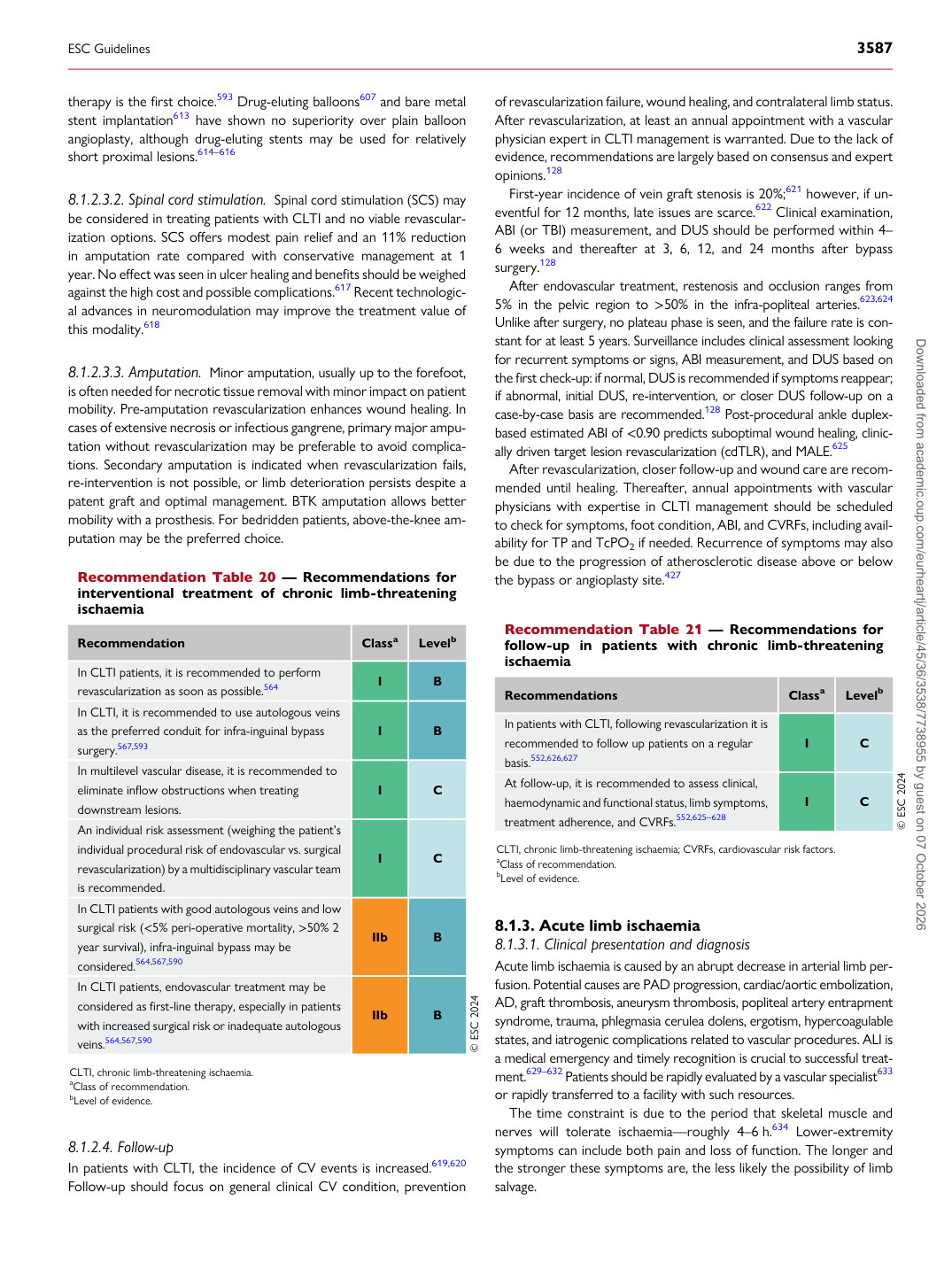
p.50 抽出テキスト
therapy is the first choice.593 Drug-eluting balloons607 and bare metal stent implantation613 have shown no superiority over plain balloon angioplasty, although drug-eluting stents may be used for relatively short proximal lesions.614–616

8.1.2.3.2 Spinal cord stimulation. Spinal cord stimulation (SCS) may

be considered in treating patients with CLTI and no viable revascularization options. SCS offers modest pain relief and an 11% reduction in amputation rate compared with conservative management at 1 year. No effect was seen in ulcer healing and benefits should be weighed against the high cost and possible complications.617 Recent technological advances in neuromodulation may improve the treatment value of this modality.618

8.1.2.3.3. Amputation. Minor amputation, usually up to the forefoot, is often needed for necrotic tissue removal with minor impact on patient mobility. Pre-amputation revascularization enhances wound healing. In cases of extensive necrosis or infectious gangrene, primary major amputation without revascularization may be preferable to avoid complications. Secondary amputation is indicated when revascularization fails, re-intervention is not possible, or limb deterioration persists despite a patent graft and optimal management. BTK amputation allows better mobility with a prosthesis. For bedridden patients, above-the-knee amputation may be the preferred choice.

8.1.2.4 Follow-up

In patients with CLTI, the incidence of CV events is increased.619,620 Follow-up should focus on general clinical CV condition, prevention of revascularization failure, wound healing, and contralateral limb status. After revascularization, at least an annual appointment with a vascular physician expert in CLTI management is warranted. Due to the lack of evidence, recommendations are largely based on consensus and expert opinions.128

First-year incidence of vein graft stenosis is 20%;621 however, if uneventful for 12 months, late issues are scarce.622 Clinical examination, ABI (or TBI) measurement, and DUS should be performed within 4– 6 weeks and thereafter at 3, 6, 12, and 24 months after bypass surgery.128 After endovascular treatment, restenosis and occlusion ranges from 5% in the pelvic region to >50% in the infra-popliteal arteries.623,624 Unlike after surgery, no plateau phase is seen, and the failure rate is constant for at least 5 years. Surveillance includes clinical assessment looking for recurrent symptoms or signs, ABI measurement, and DUS based on the first check-up: if normal, DUS is recommended if symptoms reappear; if abnormal, initial DUS, re-intervention, or closer DUS follow-up on a case-by-case basis are recommended.128 Post-procedural ankle duplexbased estimated ABI of <0.90 predicts suboptimal wound healing, clinically driven target lesion revascularization (cdTLR), and MALE.625 After revascularization, closer follow-up and wound care are recommended until healing. Thereafter, annual appointments with vascular physicians with expertise in CLTI management should be scheduled to check for symptoms, foot condition, ABI, and CVRFs, including availability for TP and TcPO2 if needed. Recurrence of symptoms may also be due to the progression of atherosclerotic disease above or below the bypass or angioplasty site.427

8.1.3 Acute limb ischaemia

8.1.3.1. Clinical presentation and diagnosis Acute limb ischaemia is caused by an abrupt decrease in arterial limb perfusion. Potential causes are PAD progression, cardiac/aortic embolization, AD, graft thrombosis, aneurysm thrombosis, popliteal artery entrapment syndrome, trauma, phlegmasia cerulea dolens, ergotism, hypercoagulable states, and iatrogenic complications related to vascular procedures. ALI is a medical emergency and timely recognition is crucial to successful treatment.629–632 Patients should be rapidly evaluated by a vascular specialist633 or rapidly transferred to a facility with such resources. The time constraint is due to the period that skeletal muscle and nerves will tolerate ischaemia—roughly 4–6 h.634 Lower-extremity symptoms can include both pain and loss of function. The longer and the stronger these symptoms are, the less likely the possibility of limb salvage.

Recommendation Table 20 — Recommendations for interventional treatment of chronic limb-threatening ischaemia

Recommendation Classa Levelb

In CLTI patients, it is recommended to perform revascularization as soon as possible.564 I B In CLTI, it is recommended to use autologous veins as the preferred conduit for infra-inguinal bypass surgery.567,593 I B In multilevel vascular disease, it is recommended to eliminate inflow obstructions when treating downstream lesions. I C An individual risk assessment (weighing the patient’s individual procedural risk of endovascular vs. surgical revascularization) by a multidisciplinary vascular team is recommended. I C In CLTI patients with good autologous veins and low surgical risk (<5% peri-operative mortality, >50% 2 year survival), infra-inguinal bypass may be considered.564,567,590 IIb B In CLTI patients, endovascular treatment may be considered as first-line therapy, especially in patients with increased surgical risk or inadequate autologous veins.564,567,590 IIb B © ESC 2024

CLTI, chronic limb-threatening ischaemia. aClass of recommendation. bLevel of evidence. Recommendation Table 21 — Recommendations for follow-up in patients with chronic limb-threatening ischaemia

Recommendations Classa Levelb

In patients with CLTI, following revascularization it is recommended to follow up patients on a regular basis.552,626,627 I C At follow-up, it is recommended to assess clinical, haemodynamic and functional status, limb symptoms, treatment adherence, and CVRFs.552,625–628 I C © ESC 2024

CLTI, chronic limb-threatening ischaemia; CVRFs, cardiovascular risk factors. aClass of recommendation. bLevel of evidence.

ESC Guidelines                                                                                                                                                                                          3587

Downloaded from academic.oup.com/eurheartj/article/45/36/3538/7738955 by guest on 07 October 2026