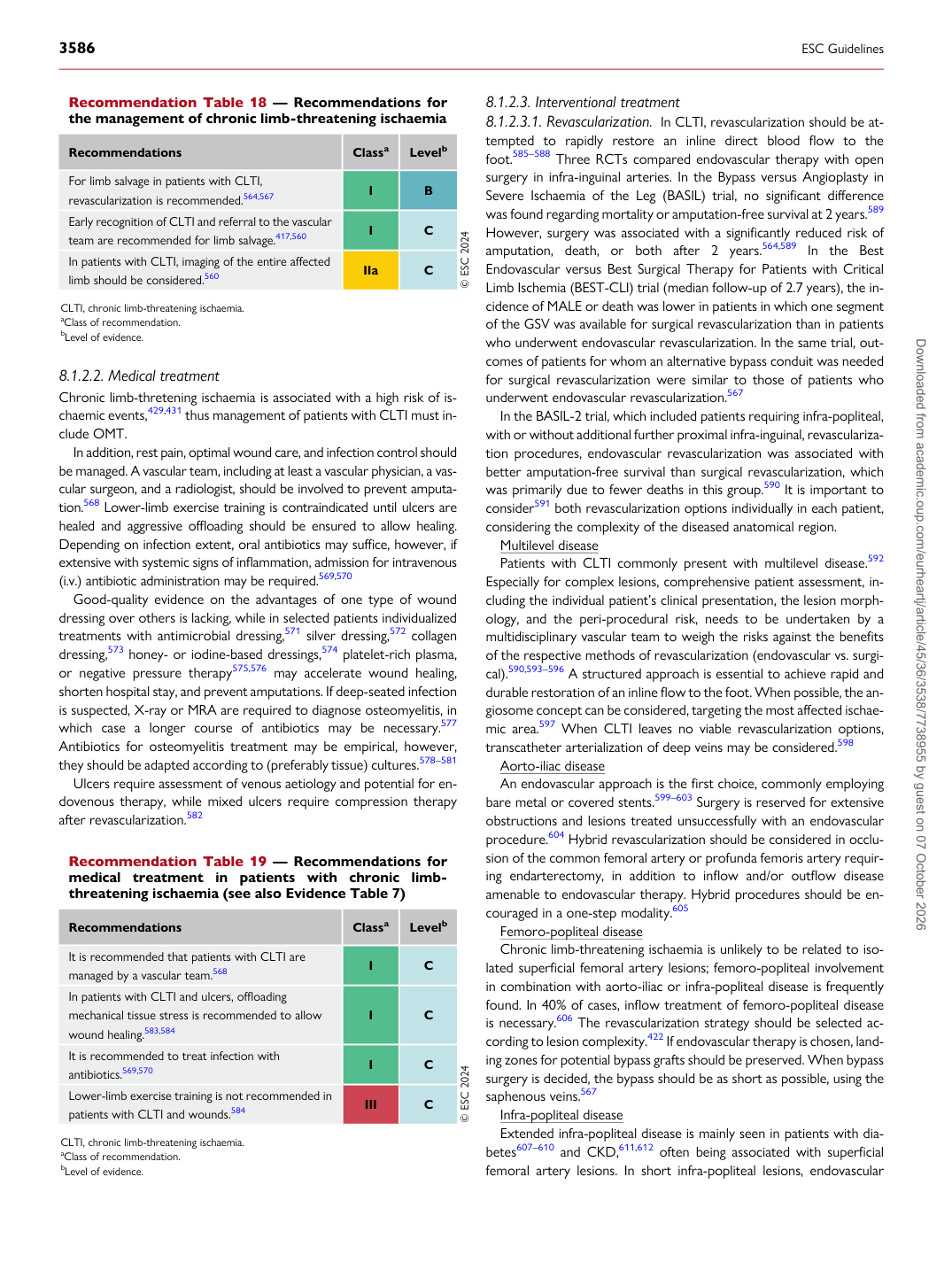
p.49 抽出テキスト
8.1.2.2 Medical treatment

Chronic limb-thretening ischaemia is associated with a high risk of ischaemic events,429,431 thus management of patients with CLTI must include OMT. In addition, rest pain, optimal wound care, and infection control should be managed. A vascular team, including at least a vascular physician, a vascular surgeon, and a radiologist, should be involved to prevent amputation.568 Lower-limb exercise training is contraindicated until ulcers are healed and aggressive offloading should be ensured to allow healing. Depending on infection extent, oral antibiotics may suffice, however, if extensive with systemic signs of inflammation, admission for intravenous (i.v.) antibiotic administration may be required.569,570 Good-quality evidence on the advantages of one type of wound dressing over others is lacking, while in selected patients individualized treatments with antimicrobial dressing,571 silver dressing,572 collagen dressing,573 honey- or iodine-based dressings,574 platelet-rich plasma, or negative pressure therapy575,576 may accelerate wound healing, shorten hospital stay, and prevent amputations. If deep-seated infection is suspected, X-ray or MRA are required to diagnose osteomyelitis, in which case a longer course of antibiotics may be necessary.577 Antibiotics for osteomyelitis treatment may be empirical, however, they should be adapted according to (preferably tissue) cultures.578–581 Ulcers require assessment of venous aetiology and potential for endovenous therapy, while mixed ulcers require compression therapy after revascularization.582 8.1.2.3 Interventional treatment

8.1.2.3.1. Revascularization. In CLTI, revascularization should be attempted to rapidly restore an inline direct blood flow to the foot.585–588 Three RCTs compared endovascular therapy with open surgery in infra-inguinal arteries. In the Bypass versus Angioplasty in Severe Ischaemia of the Leg (BASIL) trial, no significant difference was found regarding mortality or amputation-free survival at 2 years.589 However, surgery was associated with a significantly reduced risk of amputation, death, or both after 2 years.564,589 In the Best Endovascular versus Best Surgical Therapy for Patients with Critical Limb Ischemia (BEST-CLI) trial (median follow-up of 2.7 years), the incidence of MALE or death was lower in patients in which one segment of the GSV was available for surgical revascularization than in patients who underwent endovascular revascularization. In the same trial, outcomes of patients for whom an alternative bypass conduit was needed for surgical revascularization were similar to those of patients who underwent endovascular revascularization.567 In the BASIL-2 trial, which included patients requiring infra-popliteal, with or without additional further proximal infra-inguinal, revascularization procedures, endovascular revascularization was associated with better amputation-free survival than surgical revascularization, which was primarily due to fewer deaths in this group.590 It is important to consider591 both revascularization options individually in each patient, considering the complexity of the diseased anatomical region.

Multilevel disease Patients with CLTI commonly present with multilevel disease.592 Especially for complex lesions, comprehensive patient assessment, including the individual patient’s clinical presentation, the lesion morphology, and the peri-procedural risk, needs to be undertaken by a multidisciplinary vascular team to weigh the risks against the benefits of the respective methods of revascularization (endovascular vs. surgical).590,593–596 A structured approach is essential to achieve rapid and durable restoration of an inline flow to the foot. When possible, the angiosome concept can be considered, targeting the most affected ischaemic area.597 When CLTI leaves no viable revascularization options, transcatheter arterialization of deep veins may be considered.598 Aorto-iliac disease An endovascular approach is the first choice, commonly employing bare metal or covered stents.599–603 Surgery is reserved for extensive obstructions and lesions treated unsuccessfully with an endovascular procedure.604 Hybrid revascularization should be considered in occlusion of the common femoral artery or profunda femoris artery requiring endarterectomy, in addition to inflow and/or outflow disease amenable to endovascular therapy. Hybrid procedures should be encouraged in a one-step modality.605 Femoro-popliteal disease Chronic limb-threatening ischaemia is unlikely to be related to isolated superficial femoral artery lesions; femoro-popliteal involvement in combination with aorto-iliac or infra-popliteal disease is frequently found. In 40% of cases, inflow treatment of femoro-popliteal disease is necessary.606 The revascularization strategy should be selected according to lesion complexity.422 If endovascular therapy is chosen, landing zones for potential bypass grafts should be preserved. When bypass surgery is decided, the bypass should be as short as possible, using the saphenous veins.567 Infra-popliteal disease Extended infra-popliteal disease is mainly seen in patients with diabetes607–610 and CKD,611,612 often being associated with superficial femoral artery lesions. In short infra-popliteal lesions, endovascular

Recommendation Table 18 — Recommendations for the management of chronic limb-threatening ischaemia

Recommendations Classa Levelb

For limb salvage in patients with CLTI, revascularization is recommended.564,567 I B Early recognition of CLTI and referral to the vascular team are recommended for limb salvage.417,560 I C In patients with CLTI, imaging of the entire affected limb should be considered.560 IIa C © ESC 2024

CLTI, chronic limb-threatening ischaemia. aClass of recommendation. bLevel of evidence.

Recommendation Table 19 — Recommendations for medical treatment in patients with chronic limbthreatening ischaemia (see also Evidence Table 7)

Recommendations Classa Levelb

It is recommended that patients with CLTI are managed by a vascular team.568 I C In patients with CLTI and ulcers, offloading mechanical tissue stress is recommended to allow wound healing.583,584 I C It is recommended to treat infection with antibiotics.569,570 I C Lower-limb exercise training is not recommended in patients with CLTI and wounds.584 III C © ESC 2024

CLTI, chronic limb-threatening ischaemia. aClass of recommendation. bLevel of evidence. Downloaded from academic.oup.com/eurheartj/article/45/36/3538/7738955 by guest on 07 October 2026