p.47 抽出テキスト
8.1.1.2.4 Femoro-popliteal lesion revascularization. If revasculariza-

tion is indicated, endovascular therapy should be the first choice even for complex lesions, especially in surgical high-risk patients.119,529–531 Endovascular therapy faces the challenge of sustaining long-term patency and durability in the femoro-popliteal region, particularly post-stent placement in a highly mobile artery. Drug-eluting balloons have improved long-term patency in complex patient cohorts and lesions.532 With regard to paclitaxel-coated devices, a meta-analysis caused a decline in their usage, especially as the United States Food and Drug Administration (FDA) reacted and restricted their use.533 Consequently, data from large national databases were evaluated and the mortality signal could not be confirmed. The FDA revised its position, and drug-eluting treatment is now deemed to be a safe and efficient treatment strategy for femoro-popliteal lesions.534–538 An open surgical approach in femoro-popliteal lesions should be considered when an autologous vein (e.g. great saphenous vein [GSV]) is available and the patient shows low surgical risk, and in complex lesions after an interdisciplinary team discussion.

8.1.1.2.5 Below-the-knee artery revascularization. In patients with

severe IC in whom endovascular femoro-popliteal treatment is performed, BTK arteries can be treated in the same intervention if there is substantially impaired outflow.539

N Y

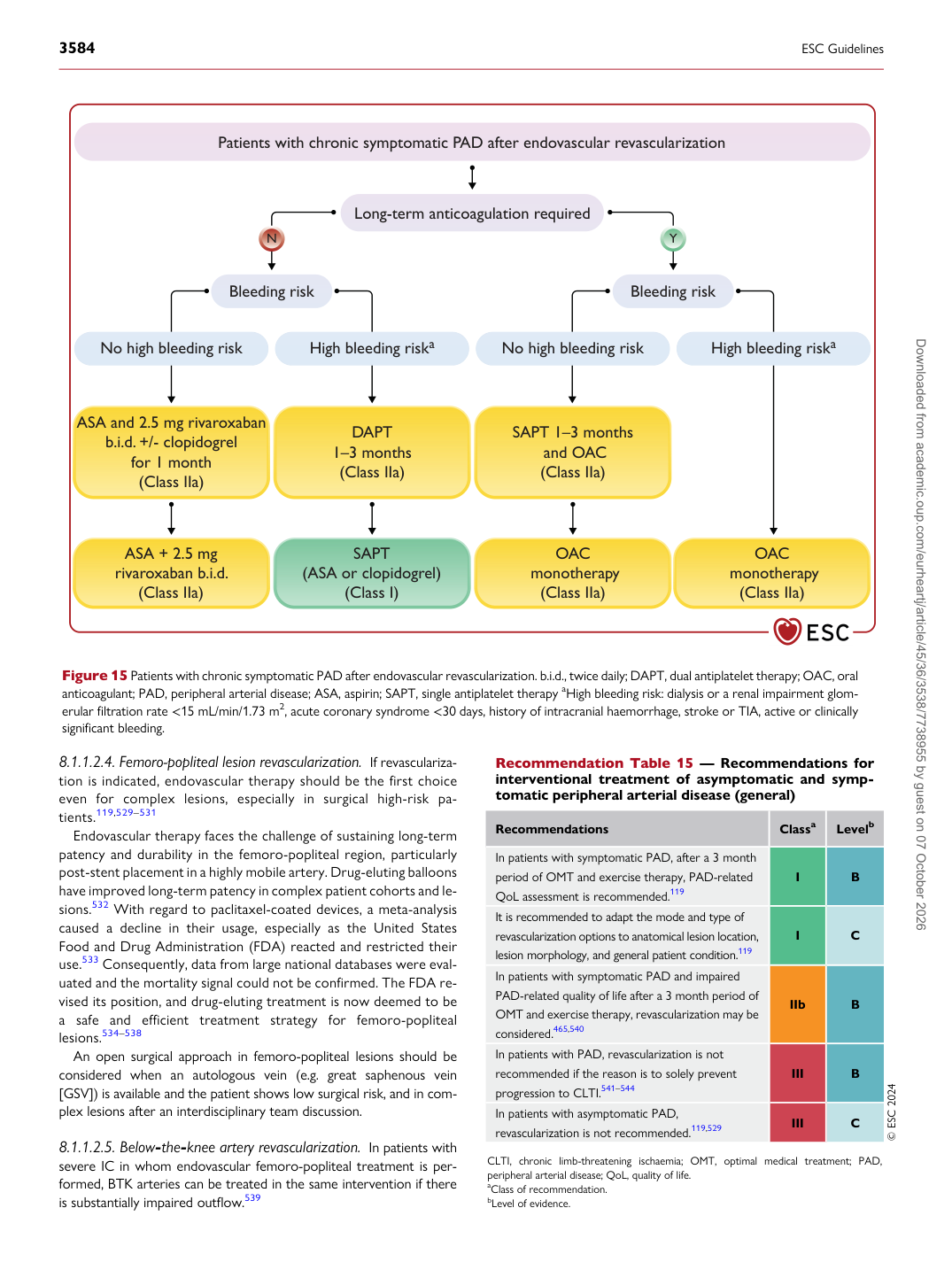
Patients with chronic symptomatic PAD after endovascular revascularization

Long-term anticoagulation required

Bleeding risk

No high bleeding risk High bleeding riska No high bleeding risk High bleeding riska

Bleeding risk

ASA and 2.5 mg rivaroxaban

b.i.d. +/- clopidogrel

for 1 month (Class IIa)

ASA + 2.5 mg rivaroxaban b.i.d.

(Class IIa) OAC monotherapy

(Class IIa) OAC monotherapy

(Class IIa)

SAPT (ASA or clopidogrel)

(Class I)

DAPT 1–3 months (Class IIa) SAPT 1–3 months

and OAC (Class IIa)

Figure 15 Patients with chronic symptomatic PAD after endovascular revascularization. b.i.d., twice daily; DAPT, dual antiplatelet therapy; OAC, oral anticoagulant; PAD, peripheral arterial disease; ASA, aspirin; SAPT, single antiplatelet therapy aHigh bleeding risk: dialysis or a renal impairment glomerular filtration rate <15 mL/min/1.73 m2, acute coronary syndrome <30 days, history of intracranial haemorrhage, stroke or TIA, active or clinically significant bleeding.

Recommendation Table 15 — Recommendations for interventional treatment of asymptomatic and symptomatic peripheral arterial disease (general)

Recommendations Classa Levelb

In patients with symptomatic PAD, after a 3 month period of OMT and exercise therapy, PAD-related QoL assessment is recommended.119 I B It is recommended to adapt the mode and type of revascularization options to anatomical lesion location, lesion morphology, and general patient condition.119 I C In patients with symptomatic PAD and impaired PAD-related quality of life after a 3 month period of OMT and exercise therapy, revascularization may be considered.465,540 IIb B In patients with PAD, revascularization is not recommended if the reason is to solely prevent progression to CLTI.541–544 III B In patients with asymptomatic PAD, revascularization is not recommended.119,529 III C © ESC 2024

CLTI, chronic limb-threatening ischaemia; OMT, optimal medical treatment; PAD, peripheral arterial disease; QoL, quality of life. aClass of recommendation. bLevel of evidence. Downloaded from academic.oup.com/eurheartj/article/45/36/3538/7738955 by guest on 07 October 2026