p.45 抽出テキスト
8.1.1.2.2 Pharmacological treatment. Antithrombotic therapy

Asymptomatic PAD Although patients with PAD are at very high CV risk,404,484 a trial evaluating the effect of antiplatelet agents in asymptomatic patients with an ABI ≤0.95 did not show an effect on MACE or revascularization.485 Another trial on patients with an ABI ≤0.99 and diabetes also failed to show any difference in MACE or amputation.486 However, these data were not powered to analyse subgroups and do not rule out the possibility that aspirin could provide a benefit in subjects at increased risk of CV events. In a randomized trial evaluating aspirin in the prevention of cancer and CVD in patients with diabetes without known arterial disease, MACE occurred in a significantly lower percentage of participants in the aspirin group than in the placebo group, with more major bleeding events in the aspirin group.487 The effect of antithrombotics in patients with higher-risk PAD (i.e. ABI <0.90 and other CV risk factors) has not been evaluated in randomized trials. Antithrombotic therapy should not be systematically administered in patients with asymptomatic PAD.

Symptomatic PAD In patients with symptomatic PAD, antithrombotic therapy improves CV prognosis.488–492 Clopidogrel may have a modest advantage over aspirin (Figure 14).493,494 In the Examining Use of tiCagreLor In peripheral artery Disease (EUCLID) trial, single antiplatelet therapy (SAPT) with ticagrelor showed no superior benefit in the reduction of MACE or major bleeding compared with clopidogrel.495–497 Dual antithrombotic therapy with aspirin and vascular-dose rivaroxaban (2.5 mg b.i.d.) in patients with PAD is more effective than aspirin alone, reducing MACE, MALE, and preventing acute limb ischaemia (ALI), but with increased major bleeding risk.429,430,498,499 Patients with high-risk limb presentation (CLTI, previous amputation, or revascularization) or high-risk comorbidities (heart failure [HF], diabetes, or polyvascular disease [PVD]) benefit the most.498 After endovascular therapy, dual antiplatelet therapy (DAPT) for 1–3 months is supported by rare randomized studies.500,501 DAPT is not associated with reduced CV mortality or MACE,501 but seems to improve patency without increasing bleeding (Figure 15).502–504 The combination of aspirin 100 mg and vascular-dose rivaroxaban (2.5 mg b.i.d.), started post-revascularization, showed a moderate but significantly lower incidence of MALE and MACE compared with aspirin alone,490,505 without an increase in thrombolysis in myocardial infarction (TIMI) major bleedings, but with an increase in International Society on Thrombosis and Haemostasis (ISTH) major bleedings, especially when clopidogrel was given for >1 month.506

Patients with CLTI are at high risk of MACE and MALE.429,431,507 Among CLTI patients, there is no robust evidence favouring a specific antithrombotic strategy for vein graft maintenance. DAPT with clopidogrel and aspirin is not superior to aspirin alone in below-the-knee (BTK) bypass grafts.508–510 Vitamin K antagonists (VKAs) may be considered for high-risk conduits with low bleeding risk.509 Dual antiplatelet therapy could confer benefit for prosthetic conduit (occlusion, revascularization, amputation, or death), without increasing major bleeding.510 VKAs with an international normalized ratio (INR) of 3–4.5 are slightly beneficial in venous conduits, but with a 1.9-fold and 1.3-fold increase in major and fatal bleedings, respectively.509 A study suggested that VKAs could be associated with prolonged patency of at-risk prosthetic grafts due to poor run-off.511 In patients with another indication for OAC (such as atrial fibrillation [AF] or mechanic valve replacement) and PAD, anticoagulation is warranted.512 Additional SAPT post-endovascular therapy should be brief.

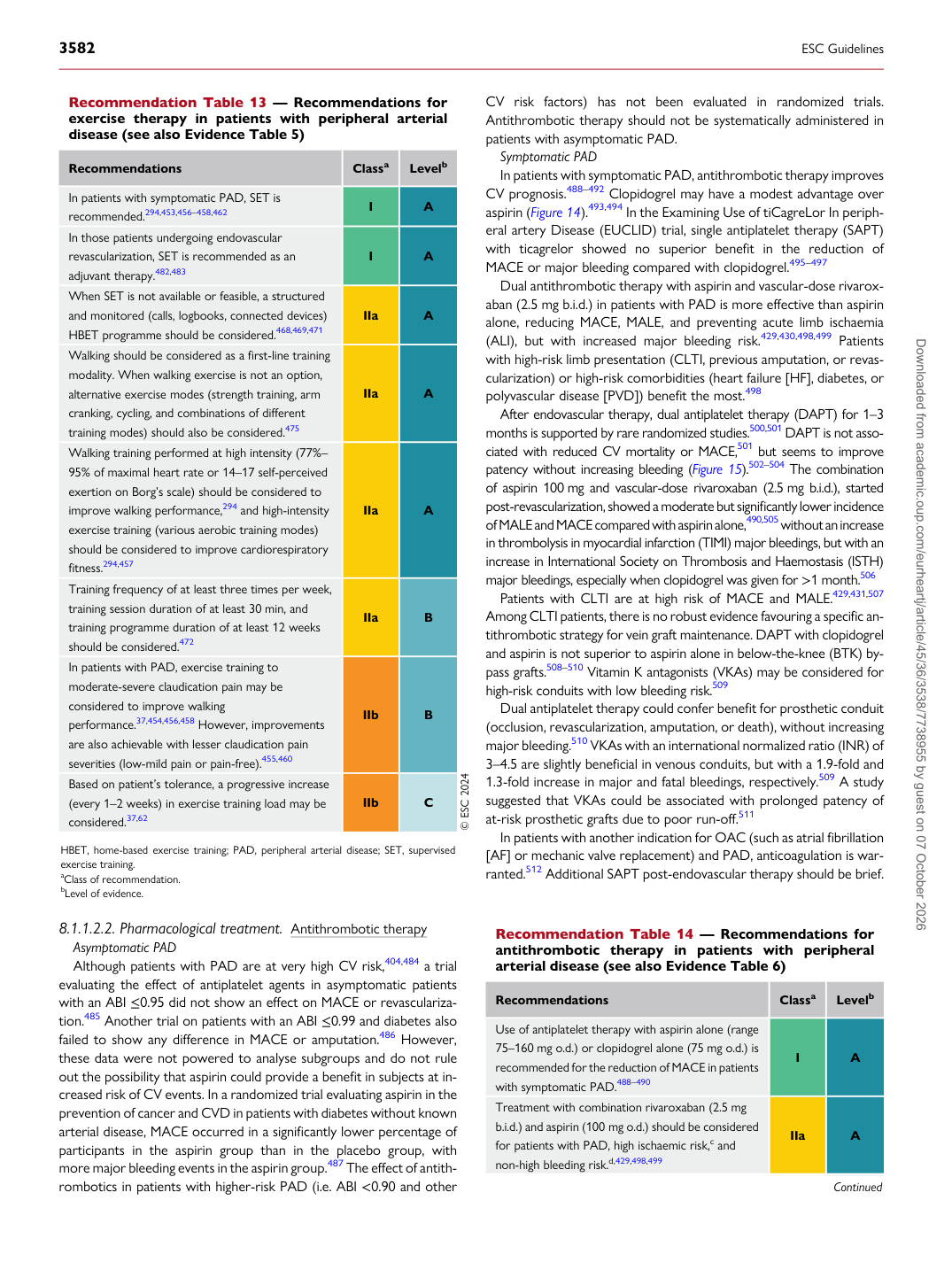
Recommendation Table 13 — Recommendations for exercise therapy in patients with peripheral arterial disease (see also Evidence Table 5)

Recommendations Classa Levelb

In patients with symptomatic PAD, SET is recommended.294,453,456–458,462 I A In those patients undergoing endovascular revascularization, SET is recommended as an adjuvant therapy.482,483 I A When SET is not available or feasible, a structured and monitored (calls, logbooks, connected devices) HBET programme should be considered.468,469,471 IIa A Walking should be considered as a first-line training modality. When walking exercise is not an option, alternative exercise modes (strength training, arm cranking, cycling, and combinations of different training modes) should also be considered.475 IIa A Walking training performed at high intensity (77%– 95% of maximal heart rate or 14–17 self-perceived exertion on Borg’s scale) should be considered to improve walking performance,294 and high-intensity exercise training (various aerobic training modes) should be considered to improve cardiorespiratory fitness.294,457 IIa A Training frequency of at least three times per week, training session duration of at least 30 min, and training programme duration of at least 12 weeks should be considered.472 IIa B In patients with PAD, exercise training to moderate-severe claudication pain may be considered to improve walking performance.37,454,456,458 However, improvements are also achievable with lesser claudication pain severities (low-mild pain or pain-free).455,460 IIb B Based on patient’s tolerance, a progressive increase (every 1–2 weeks) in exercise training load may be considered.37,62 IIb C © ESC 2024

HBET, home-based exercise training; PAD, peripheral arterial disease; SET, supervised exercise training. aClass of recommendation. bLevel of evidence.

Recommendation Table 14 — Recommendations for antithrombotic therapy in patients with peripheral arterial disease (see also Evidence Table 6)

Recommendations Classa Levelb

Use of antiplatelet therapy with aspirin alone (range 75–160 mg o.d.) or clopidogrel alone (75 mg o.d.) is recommended for the reduction of MACE in patients with symptomatic PAD.488–490 I A Treatment with combination rivaroxaban (2.5 mg b.i.d.) and aspirin (100 mg o.d.) should be considered for patients with PAD, high ischaemic risk,c and non-high bleeding risk.d,429,498,499 IIa A

Continued Downloaded from academic.oup.com/eurheartj/article/45/36/3538/7738955 by guest on 07 October 2026