p.41 抽出テキスト
8.1.1.2 Medical treatment

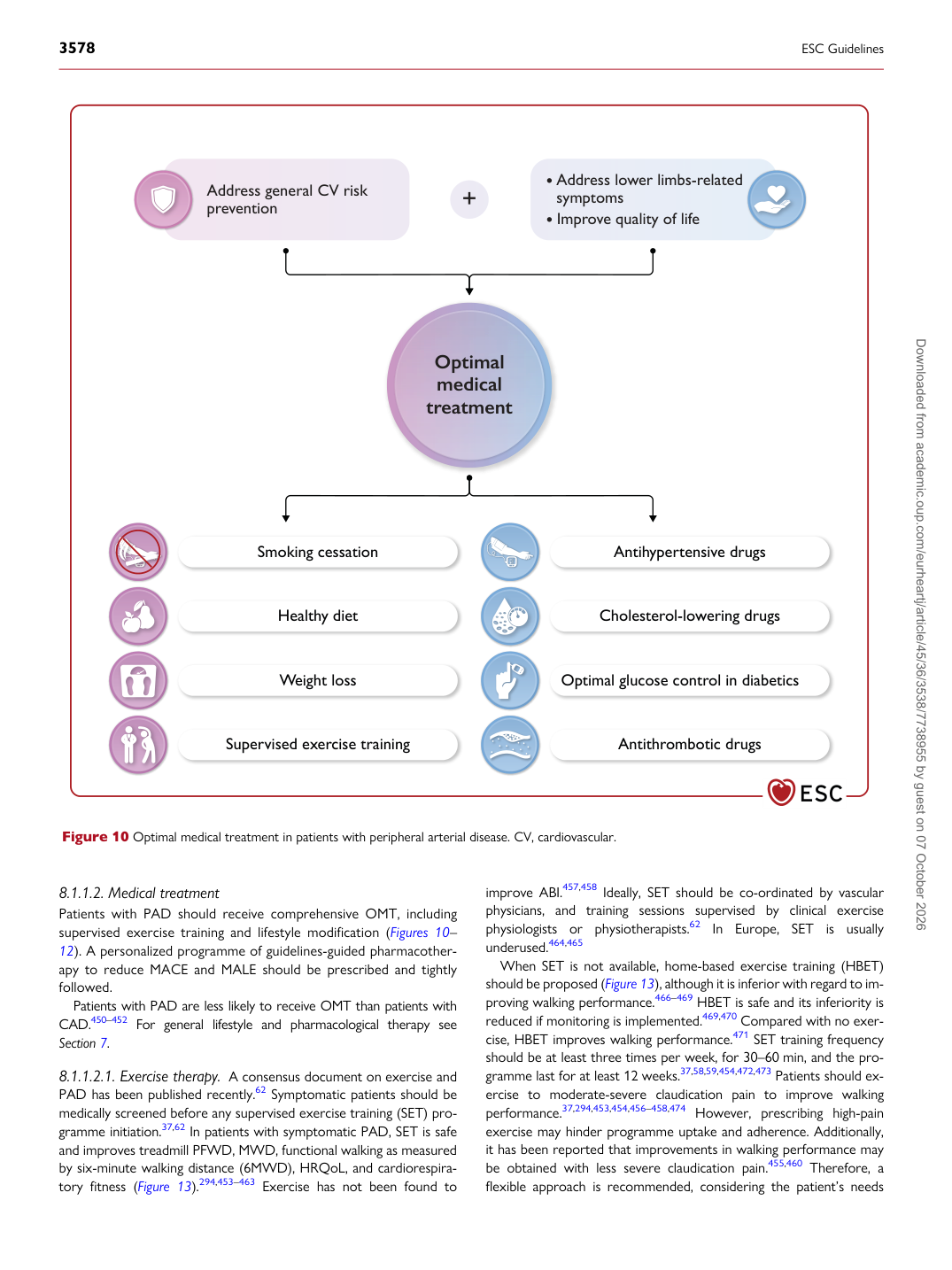
Patients with PAD should receive comprehensive OMT, including supervised exercise training and lifestyle modification (Figures 10– 12). A personalized programme of guidelines-guided pharmacotherapy to reduce MACE and MALE should be prescribed and tightly followed. Patients with PAD are less likely to receive OMT than patients with CAD.450–452 For general lifestyle and pharmacological therapy see Section 7.

8.1.1.2.1 Exercise therapy. A consensus document on exercise and

PAD has been published recently.62 Symptomatic patients should be medically screened before any supervised exercise training (SET) programme initiation.37,62 In patients with symptomatic PAD, SET is safe and improves treadmill PFWD, MWD, functional walking as measured by six-minute walking distance (6MWD), HRQoL, and cardiorespiratory fitness (Figure 13).294,453–463 Exercise has not been found to improve ABI.457,458 Ideally, SET should be co-ordinated by vascular physicians, and training sessions supervised by clinical exercise physiologists or physiotherapists.62 In Europe, SET is usually underused.464,465

When SET is not available, home-based exercise training (HBET) should be proposed (Figure 13), although it is inferior with regard to improving walking performance.466–469 HBET is safe and its inferiority is reduced if monitoring is implemented.469,470 Compared with no exercise, HBET improves walking performance.471 SET training frequency should be at least three times per week, for 30–60 min, and the programme last for at least 12 weeks.37,58,59,454,472,473 Patients should exercise to moderate-severe claudication pain to improve walking performance.37,294,453,454,456–458,474 However, prescribing high-pain exercise may hinder programme uptake and adherence. Additionally, it has been reported that improvements in walking performance may be obtained with less severe claudication pain.455,460 Therefore, a flexible approach is recommended, considering the patient’s needs

Optimal

medical treatment Address lower limbs-related symptoms Improve quality of life

Address general CV risk prevention

Smoking cessation

Weight loss

Healthy diet

Supervised exercise training Antihypertensive drugs

Optimal glucose control in diabetics

Cholesterol-lowering drugs

Antithrombotic drugs

+

Figure 10 Optimal medical treatment in patients with peripheral arterial disease. CV, cardiovascular. Downloaded from academic.oup.com/eurheartj/article/45/36/3538/7738955 by guest on 07 October 2026