p.37 抽出テキスト
7.2.5 Other pharmacological therapy

Increased attention is focused on inflammation in ASCVD,413 supported by the Canakinumab Anti-Inflammatory Thrombosis Outcomes Study (CANTOS),414 which showed that canakinumab, a monoclonal antibody targeting interleukin (IL)-1β, reduced MACE in high-risk patients with previous MI and increased high-sensitivity (hs)-CRP. Data for patients with PAAD are not reported. Furthermore, low-dose colchicine (0.5 mg/day) has been shown to reduce MACE among those with stable atherosclerosis after recent MI.415 However, the effect of colchicine and other anti-inflammatory drugs in PAAD remains unproven.416

8 Peripheral arterial disease

8.1 Lower-extremity peripheral arterial

disease 8.1.1. Peripheral arterial disease syndromes 8.1.1.1. Clinical presentation and diagnosis Atheromatous lower-extremity PAD is a chronic disease with different clinical manifestations. PAD may be symptomatic or asymptomatic and may or may not be associated with limb wounds. Wound healing and amputation risk may be affected by the concomitant presence of PAD, diabetes, and/or infection;417 therefore, amputation risk assessment should be systematically performed using the Wound, Ischaemia, and foot Infection (WIfI) classification. PAD presents as: • Asymptomatic PAD: suspected by lower-limb pulse abolition or imaging studies performed for other purposes and detected by pathological ABI or TBI.418,419 These patients do not present with IC or atypical effort-related symptoms. However, attention should be paid to those with wounds, with masked effort-related symptoms due to reduced walking capacity (for reasons other than PAD), or reduced pain sensitivity. ‘Masked PAD’ is defined as PAD without provoked leg pain because of reduced walking capacity for other reasons or reduced pain sensitivity.420 • Symptomatic (effort-related) PAD: patients with pathological ABI or TBI, presenting with IC, atypical effort-related symptoms, or chronic lower-limb wounds (diabetic foot or non-healing ulceration/gangrene ≥2 weeks) without critically reduced limb perfusion.417,421 In these patients, IC is characterized by exertional muscle pain and dysfunction in the supply area of the obstructed arterial segment, which is relieved at rest.422 Some patients may present with atypical symptoms or with ‘masked PAD’.420,423 In women, the prevalence of IC is lower than in men, while atypical symptoms are more common.424

• CLTI represents the more severe chronic PAD presentation and underlies poor limb outcomes without intervention. In addition to common signs of chronic PAD, patients with CLTI present with a critical haemodynamic status (ankle pressure <50 mmHg, toe pressure [TP] <30 mmHg, or TcPO2 <30 mmHg) responsible for ischaemic rest pain, non-healing chronic (>2 weeks of duration) ulceration, or foot gangrene.425,426

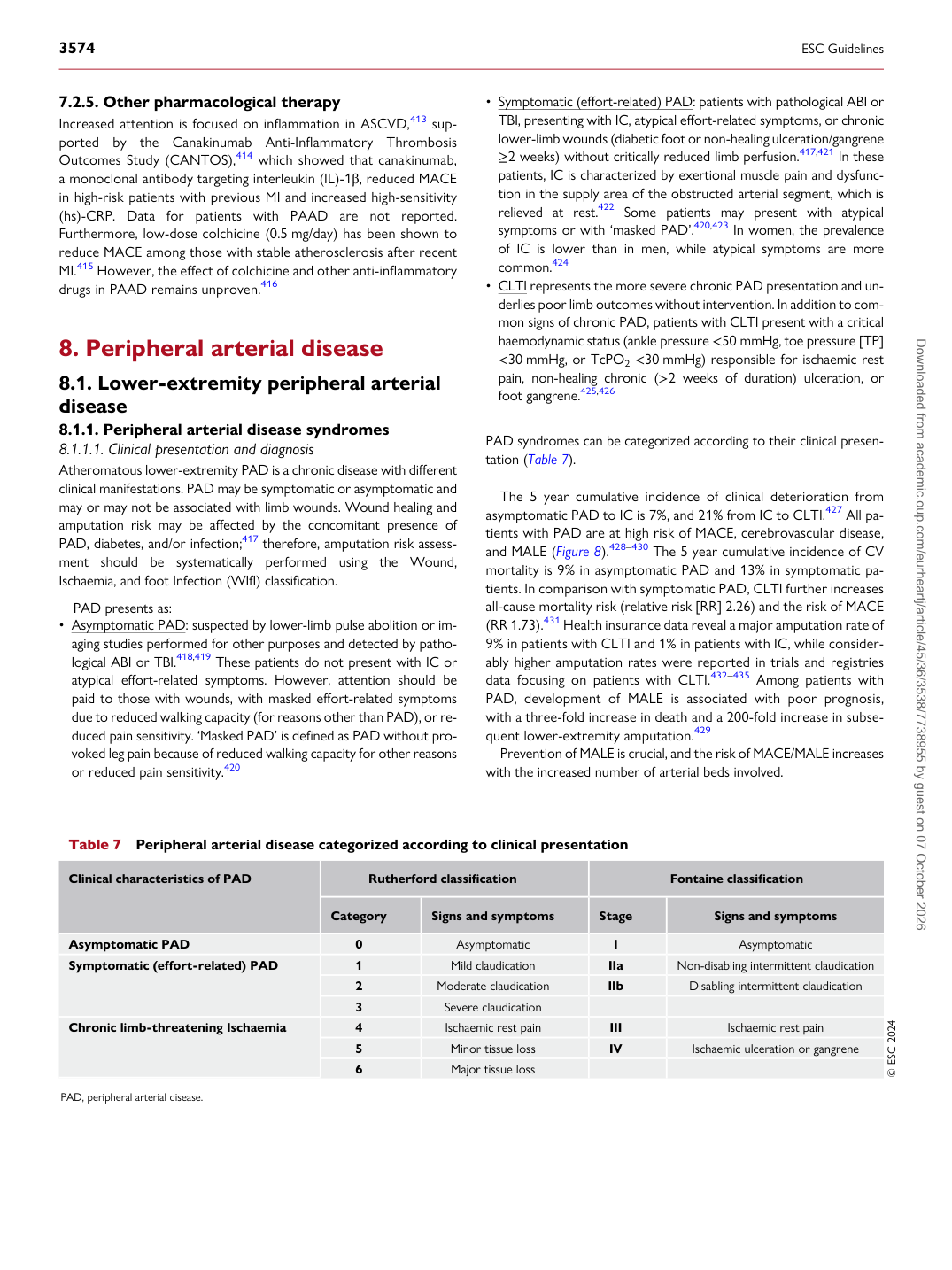
PAD syndromes can be categorized according to their clinical presentation (Table 7).

The 5 year cumulative incidence of clinical deterioration from asymptomatic PAD to IC is 7%, and 21% from IC to CLTI.427 All patients with PAD are at high risk of MACE, cerebrovascular disease, and MALE (Figure 8).428–430 The 5 year cumulative incidence of CV mortality is 9% in asymptomatic PAD and 13% in symptomatic patients. In comparison with symptomatic PAD, CLTI further increases all-cause mortality risk (relative risk [RR] 2.26) and the risk of MACE (RR 1.73).431 Health insurance data reveal a major amputation rate of 9% in patients with CLTI and 1% in patients with IC, while considerably higher amputation rates were reported in trials and registries data focusing on patients with CLTI.432–435 Among patients with PAD, development of MALE is associated with poor prognosis, with a three-fold increase in death and a 200-fold increase in subsequent lower-extremity amputation.429 Prevention of MALE is crucial, and the risk of MACE/MALE increases with the increased number of arterial beds involved.

Table 7 Peripheral arterial disease categorized according to clinical presentation

Clinical characteristics of PAD Rutherford classification Fontaine classification

Category Signs and symptoms Stage Signs and symptoms

Asymptomatic PAD 0 Asymptomatic I Asymptomatic Symptomatic (effort-related) PAD 1 Mild claudication IIa Non-disabling intermittent claudication

2 Moderate claudication IIb Disabling intermittent claudication

3 Severe claudication

Chronic limb-threatening Ischaemia 4 Ischaemic rest pain III Ischaemic rest pain

5 Minor tissue loss IV Ischaemic ulceration or gangrene

6 Major tissue loss © ESC 2024

PAD, peripheral arterial disease. Downloaded from academic.oup.com/eurheartj/article/45/36/3538/7738955 by guest on 07 October 2026