p.36 抽出テキスト
7.2.4 Diabetes and pre-diabetes conditions

Screening for diabetes or pre-diabetes is recommended in PAAD. Recent ESC Guidelines on diabetes and CVD374 provide detailed diagnostic criteria and underscore the importance of diagnosing diabetes in ASCVD patients and vice versa. Both Type 1 (T1DM) and Type 2 (T2DM) diabetes mellitus imply significantly increased risk of PAD, carotid stenosis, and polyvascular disease, depending on disease duration and the status of other CVRFs. Diabetes is present in 30% of patients with IC and 50%–70% of those with CLTI.375,376 Although the prevalence of PAD in patients with diabetes is 20%–30%, only half of them are symptomatic because of peripheral neuropathy with decreased pain sensitivity.377 As already detailed in Section 4, diabetes implies reduced risk of TAA, AAA, or aortic dissection. However, patients with T2DM and PAAD are in the very high-risk group for stroke, MI, and CV death,374 and for T1DM, an online risk prediction tool has recently been developed.377–380 For non-pregnant PAAD patients, aiming for an HbA1c level of <53 mmol/mol (7%) to avoid significant hypoglycaemia is appropriate. Consider a higher threshold (<69 mmol/mol [8.5%]) for limited life expectancy or when treatment risks outweigh benefits.374 In PAAD, it is recommended to aim for tight glycaemic control, preferably with agents with proven CV benefits such as sodium-glucose co-transporter-2 inhibitors (SGLT2i) and glucagon-like peptide-1 receptor agonists (GLP-1RA), adding metformin and other glucoselowering agents as necessary.374,381–384 The Liraglutide Effect and Action in Diabetes: Evaluation of Cardiovascular Outcome Results (LEADER) trial and Trial to Evaluate Cardiovascular and Other Long-term Outcomes with Semaglutide in Subjects with Type 2 Diabetes (SUSTAIN-6) investigated subcutaneous GLP-1RAs liraglutide (≤1.8 mg/day) and semaglutide (0.5 or 1.0 mg/week), respectively, vs. placebo in T2DM patients with high CV risk. Overall, 12.7% of patients in LEADER and 14.0% in SUSTAIN-6 presented with PAD at baseline. Although non-statistically significant due to a lack of power, the effects on MACE showed a consistently beneficial trend in PAD: liraglutide (hazard ratio (HR), 0.77; 95% confidence interval (CI), 0.58–1.01) and semaglutide (HR, 0.61; 95% CI, 0.33–1.13).381 The (Empagliflozin) Cardiovascular Outcome Event Trial in Type 2 Diabetes Mellitus Patients (EMPA-REG OUTCOME) investigated the SGLT2i empagliflozin (10 mg or 25 mg per day) vs. placebo in patients with T2DM and high CV risk. Overall, 20.8% of patients presented with PAD at baseline. In these patients, empagliflozin reduced CV death (HR, 0.57; 95% CI, 0.37–0.88) and all-cause mortality (HR, 0.62; 95% CI, 0.44–0.88), and there was a non-significant reduction in limb amputation: 5.5% with empagliflozin vs. 6.3% with placebo (HR, 0.84; 95% CI, 0.54–1.32).382 In the Canagliflozin Cardiovascular Assessment Study (CANVAS)385 investigating canagliflozin, there was an increased risk of amputation, but this was not confirmed in the Canagliflozin and Renal Events in Diabetes with Established Nephropathy Clinical Evaluation (CREDENCE) trial investigating canagliflozin in patients with T2DM and chronic kidney disease (CKD).386 Still, the use of other SLGT2is seems reasonable in PAD patients.

Patients with carotid stenosis were included in trials testing GLP-1RA and SGLT2i, but no analysis on this subpopulation was performed. A meta-analysis of eight trials investigating GLP-1RAs vs. placebo in patients with T2DM reported a reduction in all strokes (HR, 0.84; 95% CI, 0.75–0.93).387 Among patients with T2DM and prior history of MI or non-fatal stroke, GLP-1RAs reduced the incidence of recurrent MACE (HR, 0.86; 95% CI, 0.8–0.92).388 SGLT2is do not appear to reduce stroke in patients with T2DM, but patients with a stroke history experienced similar cardiorenal benefits as the rest of the population.389 Before the era of GLP-1RAs and SGLT2is, different studies (United Kingdom Prospective Diabetes Study [UKPDS] 34390 and Hyperinsulinaemia: the Outcomes of its Metabolic Effects [HOME] trials391) showed that metformin reduced the risk of MALE and MACE in patients with PAD.391,392 But a recent study with GLP-1RA dulaglutide found the same risk reduction in MACE between patients with and without baseline metformin, calling into question its add-on value.384,393 However, there are studies suggesting that metformin may reduce AAA growth (see Section 9.2.4).

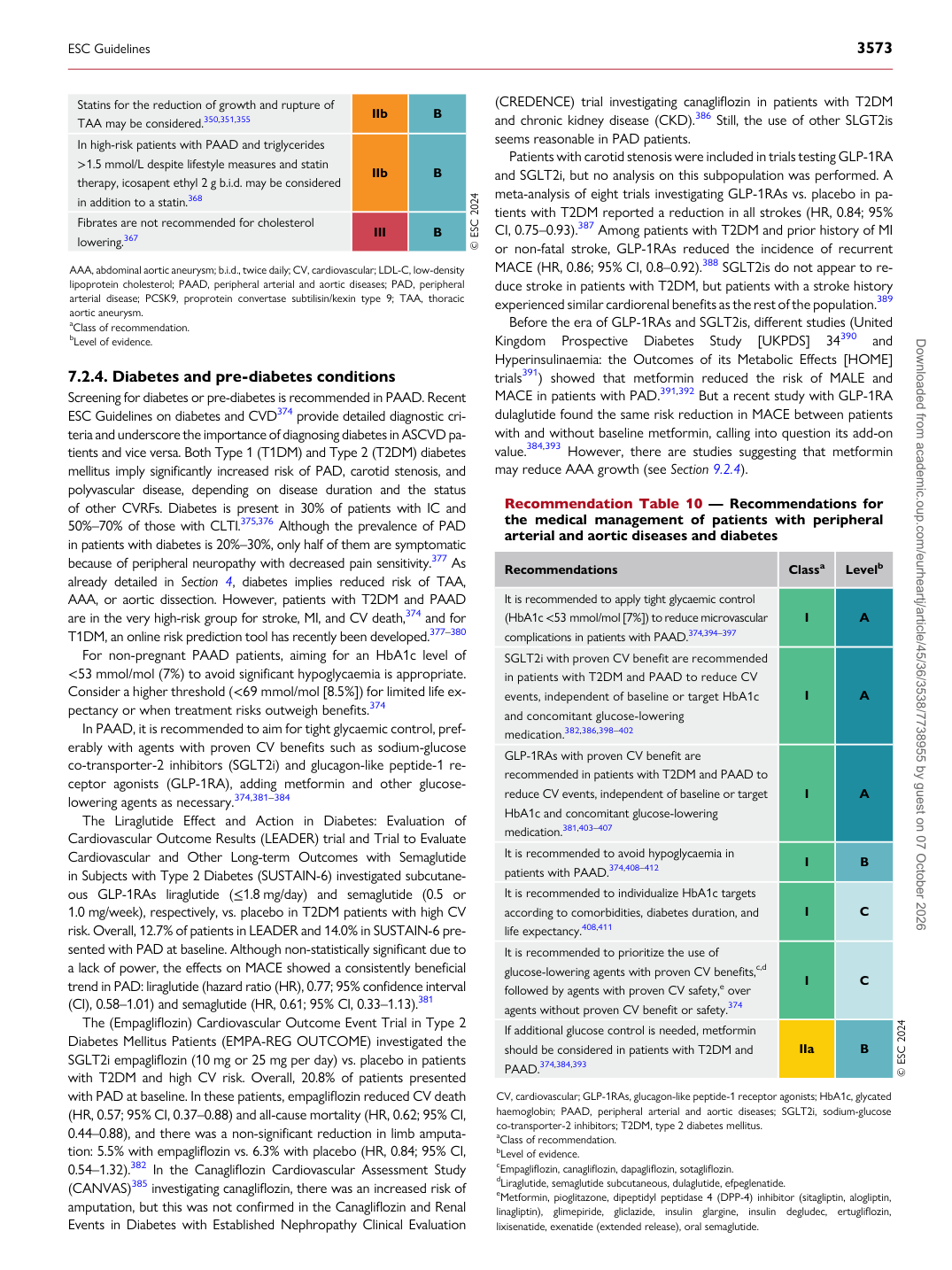
Statins for the reduction of growth and rupture of TAA may be considered.350,351,355 IIb B In high-risk patients with PAAD and triglycerides >1.5 mmol/L despite lifestyle measures and statin therapy, icosapent ethyl 2 g b.i.d. may be considered in addition to a statin.368 IIb B Fibrates are not recommended for cholesterol lowering.367 III B © ESC 2024

AAA, abdominal aortic aneurysm; b.i.d., twice daily; CV, cardiovascular; LDL-C, low-density lipoprotein cholesterol; PAAD, peripheral arterial and aortic diseases; PAD, peripheral arterial disease; PCSK9, proprotein convertase subtilisin/kexin type 9; TAA, thoracic aortic aneurysm. aClass of recommendation. bLevel of evidence.

Recommendation Table 10 — Recommendations for the medical management of patients with peripheral arterial and aortic diseases and diabetes

Recommendations Classa Levelb

It is recommended to apply tight glycaemic control (HbA1c <53 mmol/mol [7%]) to reduce microvascular complications in patients with PAAD.374,394–397 I A SGLT2i with proven CV benefit are recommended in patients with T2DM and PAAD to reduce CV events, independent of baseline or target HbA1c and concomitant glucose-lowering medication.382,386,398–402 I A GLP-1RAs with proven CV benefit are recommended in patients with T2DM and PAAD to reduce CV events, independent of baseline or target HbA1c and concomitant glucose-lowering medication.381,403–407 I A It is recommended to avoid hypoglycaemia in patients with PAAD.374,408–412 I B It is recommended to individualize HbA1c targets according to comorbidities, diabetes duration, and life expectancy.408,411 I C It is recommended to prioritize the use of glucose-lowering agents with proven CV benefits,c,d followed by agents with proven CV safety,e over agents without proven CV benefit or safety.374 I C If additional glucose control is needed, metformin should be considered in patients with T2DM and PAAD.374,384,393 IIa B © ESC 2024

CV, cardiovascular; GLP-1RAs, glucagon-like peptide-1 receptor agonists; HbA1c, glycated haemoglobin; PAAD, peripheral arterial and aortic diseases; SGLT2i, sodium-glucose co-transporter-2 inhibitors; T2DM, type 2 diabetes mellitus. aClass of recommendation. bLevel of evidence. cEmpagliflozin, canagliflozin, dapagliflozin, sotagliflozin. dLiraglutide, semaglutide subcutaneous, dulaglutide, efpeglenatide. eMetformin, pioglitazone, dipeptidyl peptidase 4 (DPP-4) inhibitor (sitagliptin, alogliptin, linagliptin), glimepiride, gliclazide, insulin glargine, insulin degludec, ertugliflozin, lixisenatide, exenatide (extended release), oral semaglutide.

ESC Guidelines                                                                                                                                                                                          3573

Downloaded from academic.oup.com/eurheartj/article/45/36/3538/7738955 by guest on 07 October 2026