p.35 抽出テキスト
7.2.3 Lipid-lowering therapy

Patients with symptomatic PAAD are at very high CV risk but are usually inadequately managed compared with patients with CAD.5,247,326–332 Both LDL-C reduction by ≥50% from baseline and an LDL-C goal of <1.4 mmol/L (<55 mg/dL) are recommended to obtain a reduction in CV death, MI, and stroke, and to improve walking distance.242,333–336

7.2.3.1 Statins

Statins demonstrate mortality and CV event reduction in RCTs for PAD, CS, and severe aortic arch plaques.243–245 Even in advanced disease stages, they are linked to lower MACE and mortality.246 Statins significantly improve CV outcomes in patients with PAD, reducing major adverse limb events (MALE).244,327–329,337,338 Meta-analyses show enhanced walking distances.244,338,339 For CS, statin pre-treatment lowers recurrent stroke risk posttransient ischaemic attack (TIA).19,340–343 While lacking RCTs in renovascular or visceral artery disease, statins benefit cardiorenal events and post-RAS stenting prognosis.344–346 Mixed evidence suggests statins may mitigate AAA and TAA growth.347–352 However, since most patients with AAA or TAA present with associated CVRFs, liberal use of lipid-lowering treatment19 should be considered, using an individualized approach with shared decision-making and considering residual CV risk.353 Pre-operative statin use links to increased 5 year survival after TEVAR.19 Statin use was associated with a mean AAA growth rate reduction and a lower rupture risk.347–349,352,354 Some evidence suggests that statins may reduce TAA growth rate and risk of rupture.350,351,355 No benefit on AAA or TAA growth rate was shown with fenofibrate therapy.356,357

7.2.3.2 Ezetimibe

Ezetimibe combined with statins benefits selected patients with PAAD, particularly when the target LDL-C level is not met.335 In an IMProved Reduction of Outcomes: Vytorin Efficacy International Trial (IMPROVE-IT) subanalysis, involving acute coronary syndrome (ACS) patients with PAD, ezetimibe consistently reduced CV risk, especially in high-risk subgroups.247,331

7.2.3.3 Proprotein convertase subtilisin/kexin type 9 inhibitors

Proprotein convertase subtilisin/kexin type 9 (PCSK9) inhibitors, in addition to statins, reduce CV events in symptomatic atherosclerotic disease patients with LDL-C ≥1.8 mmol/L.336 Adding them to statins further reduces MACE and MALE risk in patients with PAD and improves walking distance;333 however, their potential in TAA/AAA is an emerging area of research.247 Inclisiran, administered semi-annually, has proved a notable 26% MACE risk reduction in a pooled phase III analysis,358 but its role in PAAD is not firmly established and ongoing RCTs including PAD participants (e.g. ClinicalTrials.gov NCT05030428) aim to provide insights. 7.2.3.4 Bempedoic acid

Bempedoic acid, acting upstream of statins in cholesterol metabolism, has been shown to reduce cholesterol levels by 17%–28%359,360 and demonstrated a decrease in the incidence of MACE in statin-intolerant PAD patients.361 However, its impact on aortic diseases and AAA still requires further research.

7.2.3.5 Hypertriglyceridaemia

Beyond LDL-C, evidence shows insulin resistance, elevated triglycerides, and remnant lipoproteins are associated with ASCVD, particularly in PAD.362–365 However, in a meta-analysis and an RCT, fibrates showed no benefit over placebo in reducing MACE in patients with PAD for a composite outcome of non-fatal stroke, non-fatal MI, and vascular death.366 Fibrates showed no benefit over placebo in reducing coronary and cerebrovascular events in patients with PAD in an RCT.367 While the relationship between triglycerides and aortic diseases is complex and not fully understood, some evidence suggests that triglyceride levels may contribute to the development and progression of aortic diseases. In contrast, icosapent ethyl (IPE) demonstrated a reduction in mortality and morbidity among individuals with hypertriglyceridaemia in the Reduction of Cardiovascular Events With Icosapent Ethyl–Intervention Trial (REDUCE-IT).368 Its impact on patients with PAAD is unexplored,369 although a small pilot RCT suggested an improved ABI in hyperglycaemic haemodialysis patients.370

In cases where on-treatment SBP is at or below target (120–129 mmHg) but DBP is not at target (≥80 mmHg), intensifying BP-lowering treatment to achieve an on-treatment DBP of 70–79 mmHg may be considered to reduce CVD risk.306 IIb C © ESC 2024

ACEIs, angiotensin-converting enzyme inhibitors; ARBs, angiotensin receptor blockers; BP, blood pressure; CVD, cardiovascular disease; DBP, diastolic blood pressure; PAAD, peripheral arterial and aortic diseases; PAD, peripheral arterial disease; RAS, renal artery stenosis; SBP, systolic blood pressure. aClass of recommendation. bLevel of evidence.

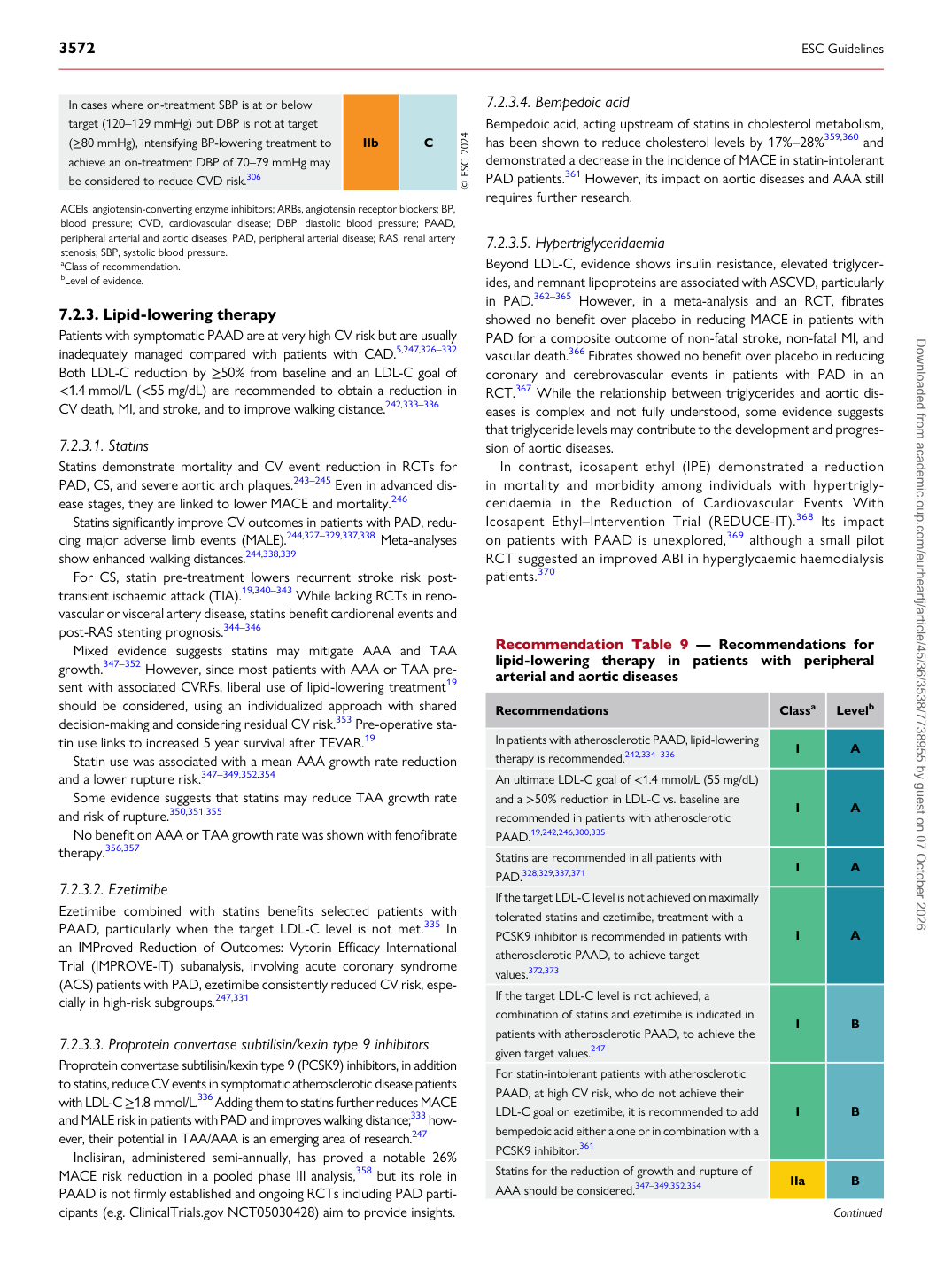
Recommendation Table 9 — Recommendations for lipid-lowering therapy in patients with peripheral arterial and aortic diseases

Recommendations Classa Levelb

In patients with atherosclerotic PAAD, lipid-lowering therapy is recommended.242,334–336 I A An ultimate LDL-C goal of <1.4 mmol/L (55 mg/dL) and a >50% reduction in LDL-C vs. baseline are recommended in patients with atherosclerotic PAAD.19,242,246,300,335 I A Statins are recommended in all patients with PAD.328,329,337,371 I A If the target LDL-C level is not achieved on maximally tolerated statins and ezetimibe, treatment with a PCSK9 inhibitor is recommended in patients with atherosclerotic PAAD, to achieve target values.372,373 I A If the target LDL-C level is not achieved, a combination of statins and ezetimibe is indicated in patients with atherosclerotic PAAD, to achieve the given target values.247 I B For statin-intolerant patients with atherosclerotic PAAD, at high CV risk, who do not achieve their LDL-C goal on ezetimibe, it is recommended to add bempedoic acid either alone or in combination with a PCSK9 inhibitor.361 I B Statins for the reduction of growth and rupture of AAA should be considered.347–349,352,354 IIa B

Continued Downloaded from academic.oup.com/eurheartj/article/45/36/3538/7738955 by guest on 07 October 2026