p.34 抽出テキスト
7.2 Principles of pharmacological medical

therapy 7.2.1. Antithrombotic therapy Antithrombotic therapy is crucial for patients with symptomatic PAAD at high CV risk. While trials are fewer than in CAD, recent evidence should guide practice. In the absence of specific indications for chronic oral anticoagulation (OAC) in concomitant CV disease, a single antiplatelet agent is the primary long-term treatment for patients with symptomatic PAAD. Combining it with another antiplatelet agent or low-dose anticoagulants depends on the patient’s ischaemic and bleeding risk, as well as therapeutic paths (e.g. endovascular therapy). Recent guidelines299 propose a tool for bleeding risk assessment in PAD patients (OAC3 PAD score). Antithrombotic strategy is detailed in Sections 8 and 9 for each arterial territory.

7.2.2 Antihypertensive therapy

New 2024 ESC Guidelines on hypertension are currently published and should be reviewed for further details.300 Patients with hypertension and PAAD are considered to have target organ damage and are at high CV risk.300 Different meta-analyses showed that systolic BP treatments reduce CV risk in all ages up to 85 years down to a level of 120– 129 mmHg.301,302 There is no need to increase the BP target in healthy patients up to the age of 85 years.303,304 To reduce cardiovascular disease (CVD) risk, it is recommended that treated SBP values in most adults be targeted to 120–129 mmHg, provided the treatment is well tolerated. However, in cases where BP-lowering treatment is poorly tolerated and achieving an SBP of 120–129 mmHg is not possible, it is recommended to target an SBP level that is ‘as low as reasonably achievable’ (ALARA principle).301,302,305 To avoid overtreatment, out-of-office BP measurements may be helpful when pursuing this target. If on-treatment SBP is on target, but diastolic blood pressure (DBP) is ≥80 mmHg, intensified treatment may be considered to further reduce the CV risk.306 Because the CVD benefit of an on-treatment BP target of 120– 129 mmHg may not generalize to some groups, setting personalized and more lenient BP targets (e.g. <140/90 mmHg) has to be considered in patients with pre-treatment orthostatic hypotension, age ≥85 years, clinically significant frailty at any age, or a limited lifespan (<3 years).301 Patients with both PAAD and hypertension face a high or very high CV risk. Antihypertensive medications such as diuretics, beta-blockers (BBs), calcium channel blockers (CCBs), angiotensin-converting enzyme inhibitors (ACEIs), and angiotensin receptor blockers (ARBs) are all appropriate options for managing hypertension in PAAD. These agents can be used as monotherapy or in various combinations (excluding ARBs+ACEIs), considering individual patients’ conditions. It is often necessary to implement combination therapy, preferably in the form of a single pill, to effectively achieve the recommended treatment goals. However, ACEIs or ARBs should be considered as first-line antihypertensive therapy to reduce CV events.300,307–312 Regardless of BP levels and in the absence of contraindications, ACEIs/ARBs may be considered in all patients with PAD to reduce cardiovascular events.312,313 A meta-analysis suggests that antihypertensive treatment may improve mean walking distance in patients with PAD.310 Beta-blockers can be prescribed, if necessary, to patients with intermittent claudication, since they do not worsen walking capacity or limb events.314 There is some evidence suggesting a higher amputation rate315 or increased rate of re-intervention316 in patients with CLTI treated with ACEIs, although in one smaller study no effect on limb-related outcomes was observed.317 Thus, they remain a treatment option in hypertensive patients with PAD, especially in those with concomitant CAD.318 BBs were not associated with worsened clinical outcomes in a retrospective study319 on CLTI patients, but it seems prudent to avoid excessively low heart rates in these patients.

7.2.2.1 Renovascular hypertension

Angiotensin-converting enzyme inhibitors and ARBs effectively manage unilateral renal artery stenosis (RAS) by blocking the renin–angiotensin system, potentially reducing renal capillary perfusion pressure.320–322 This transiently lowers glomerular filtration rate (GFR) and raises serum creatinine. For bilateral RAS, regular follow-up assessments of renal function and kidney perfusion are advised. Angiotensin-converting enzyme inhibitors and ARBs additionally (combined with hydrochlorothiazide and/or CCBs if needed) contribute to CV risk reduction in patients with atherosclerotic disease and reduced eGFR.307,323,324

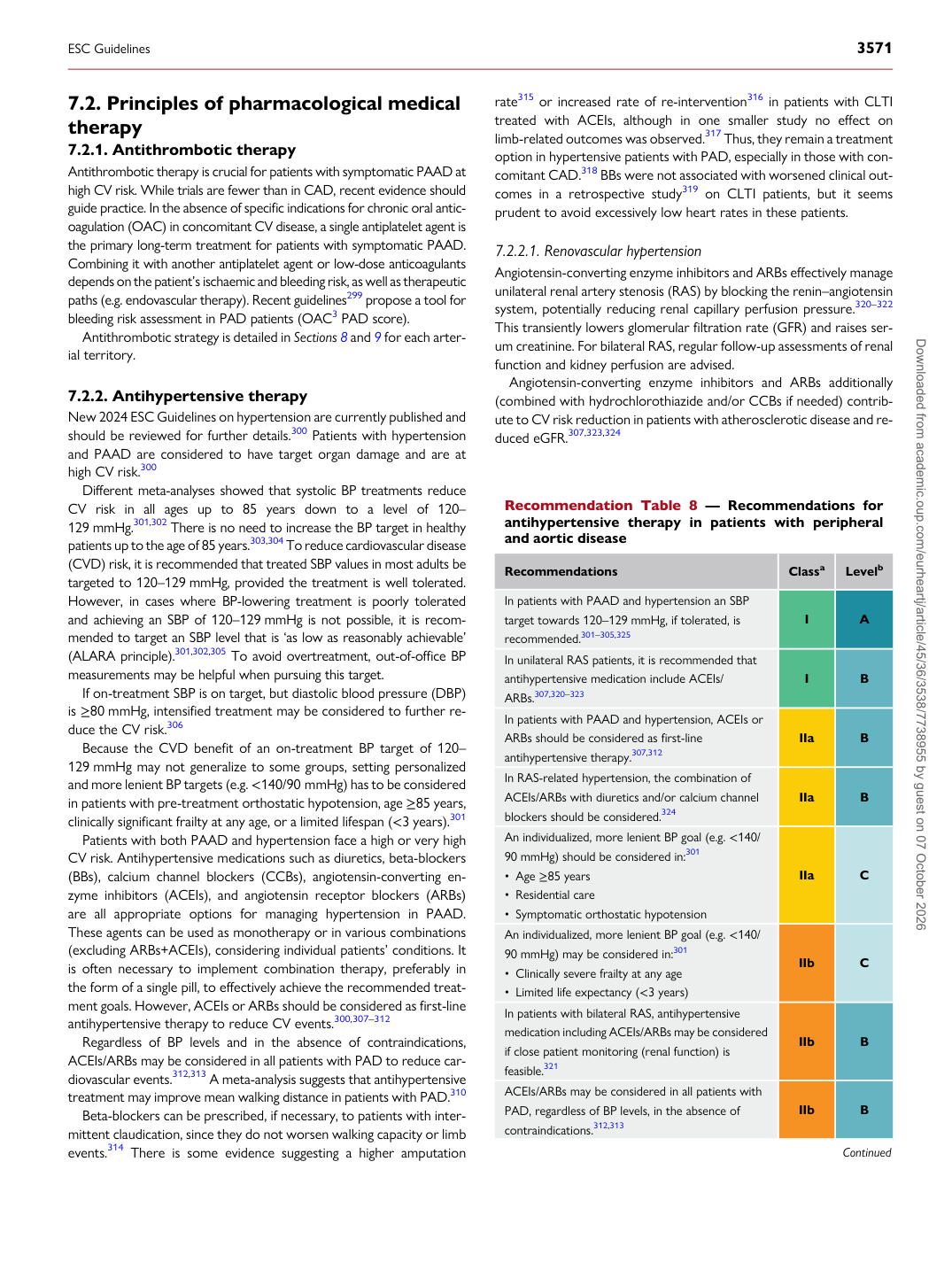
Recommendation Table 8 — Recommendations for antihypertensive therapy in patients with peripheral and aortic disease

Recommendations Classa Levelb

In patients with PAAD and hypertension an SBP target towards 120–129 mmHg, if tolerated, is recommended.301–305,325 I A In unilateral RAS patients, it is recommended that antihypertensive medication include ACEIs/ ARBs.307,320–323 I B In patients with PAAD and hypertension, ACEIs or ARBs should be considered as first-line antihypertensive therapy.307,312 IIa B In RAS-related hypertension, the combination of ACEIs/ARBs with diuretics and/or calcium channel blockers should be considered.324 IIa B An individualized, more lenient BP goal (e.g. <140/ 90 mmHg) should be considered in:301 • Age ≥85 years • Residential care • Symptomatic orthostatic hypotension IIa C An individualized, more lenient BP goal (e.g. <140/ 90 mmHg) may be considered in:301 • Clinically severe frailty at any age • Limited life expectancy (<3 years) IIb C In patients with bilateral RAS, antihypertensive medication including ACEIs/ARBs may be considered if close patient monitoring (renal function) is feasible.321 IIb B ACEIs/ARBs may be considered in all patients with PAD, regardless of BP levels, in the absence of contraindications.312,313 IIb B

Continued

ESC Guidelines                                                                                                                                                                                          3571

Downloaded from academic.oup.com/eurheartj/article/45/36/3538/7738955 by guest on 07 October 2026